Wide Receiver Tiers For Fantasy Football 2026: Puka Nacua, DeVonta Smith & More
Dwain McFarland runs through all 14 tiers of his wide receiver fantasy football rankings for 2026, highlighting undervalued ADPs, fades and key targets for your 2026 drafts.
Creating wide receiver tiers for fantasy football is one of my favorite exercises because it forces us to think in buckets instead of strict fantasy football rankings. That makes it easier to identify values and fades relative to average draft position (fantasy football ADP).
It also helps frame wide receivers through the lens of floor and ceiling—critical when building a roster. If you pass on an early-round WR, you need ceiling options capable of catching the teams that drafted them, but you may also need a player who can hold the line early.
Ultimately, identifying the small group of wide receivers with league-winning upside is the priority, and that remains the focus here. This approach blends data-driven insights with context around how offenses and roles could evolve in 2026.
Because of that, these tiers will not perfectly align with my fantasy football rankings or projections. Players are grouped based on talent, age, role certainty, and team environment. This update on Aug. 26 took into account the latest preseason news and injury updates, all to give you the most comprehensive information for your fantasy drafts.
For more on the data and concepts referenced throughout, check out What Matters for Wide Receivers, which lays the foundation for this analysis.
All the positional tiers are LIVE, y'all!
Before we start, here are a few housekeeping items:
- Historical points = PPR scoring.
- This is mostly re-draft focused, where upside matters even more, but I have included some bestball notes.
Tier 1 Fantasy Football WRs for 2026
- Ja'Marr Chase | Bengals
- Puka Nacua | Rams
These WRs are elite talents in their prime, with favorable team environments heading into 2026.
 Ja'Marr Chase | Bengals
- Age: 26 (Prime)
- Fantasy PPG (23-25): 16.4, 23.7, 19.6
- Receiving YPG: 76, 100.5, 88.3
Chase is the WR2 over the last three years with 19.99 PPG, just behind Puka Nacua at 20.0. Over that span, he has been elite across the underlying per-game data points that best predict future success.
- Receiving yards per game: 88.5 (2nd)
- Receptions per game: 7.2 (1st)
- Targets per game: 10.3 (2nd)
Injuries to Joe Burrow have limited their time together—just 33 of 54 games over the last three seasons—but Chase has averaged 21.5 PPG and 94 YPG with his star QB.
Zac Taylor doesn’t lean on play action (31st) or motion (23rd), but volume carries the offense. Cincinnati has ranked top four in dropback rate over expected (DBOE) in each of the last three seasons:
- 2023: +5% DBOE (2nd)
- 2024: +8% DBOE (1st)
- 2025: +3% DBOE (4th)
The Bengals project for 255 passing YPG (tied for 3rd), 2.7 total TDs per game (6th), and face one of the league’s easiest schedules (8.2 opponent win totals, 2nd).
- Superpower: Elite talent in his prime with Burrow—Chase is so good he wears No. 1 like it’s a warning label for defenses.
- Kryptonite: None. Zac Taylor’s play calling might be a randomized side quest, but Burrow-to-Chase is still the main storyline.
Bottom Line: Chase is locked in as a top-four selection in 2026 fantasy drafts.
 Puka Nacua | Rams
- Age: 25 (Prime)
- Fantasy PPG (23-25): 17.6, 18.8, 23.4
- Receiving YPG: 87.4, 90, 107.2
Over the last three seasons, Nacua leads all WRs with 20 PPG and 95 receiving YPG. He plays in an offense with the King Maker, Matthew Stafford, that is highly consolidated with Nacua as the clear-cut WR1. He dominated the passing game with a 93 Utilization Score, even with the addition of Davante Adams.
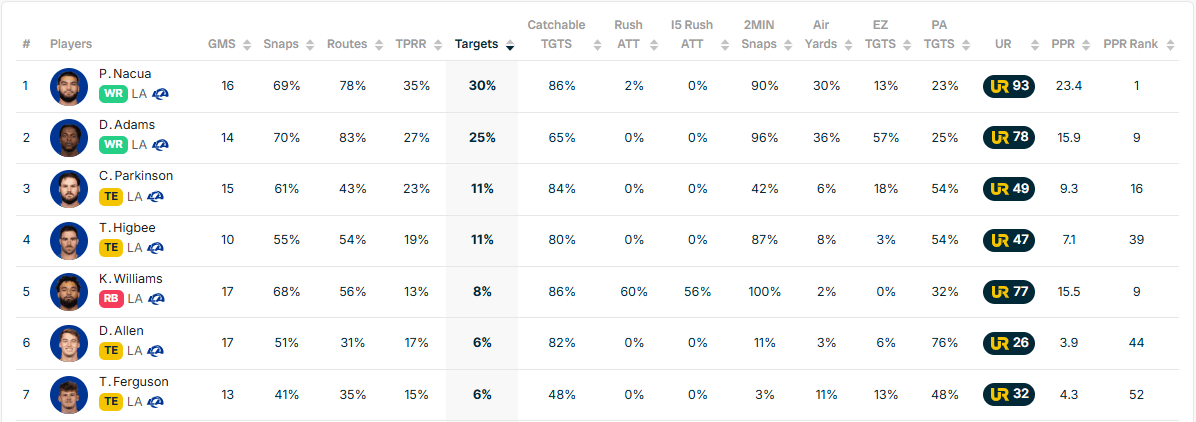
If there is a nit to pick from 2025, it’s his 0.63 TDs per game, which jumped from 0.35 and 0.27 in the prior two seasons. However, that level of scoring aligns with historical expectations. Since 2011, WRs averaging 90+ YPG have averaged 0.63 TDs per game.
I lean slightly toward Chase over Nacua due to Burrow’s consistently elite TD rate versus more volatility from Stafford:
- Burrow: 6.5%, 5.8%, 4.1%, 6.6%, 6.6%
- Stafford: 6.8%, 3.3%, 4.6%, 3.9%, 7.7%
Still, it’s a close call. Nacua benefits from Sean McVay, one of the NFL’s best play-callers, while Zac Taylor has lagged in leveraging amplification levers.
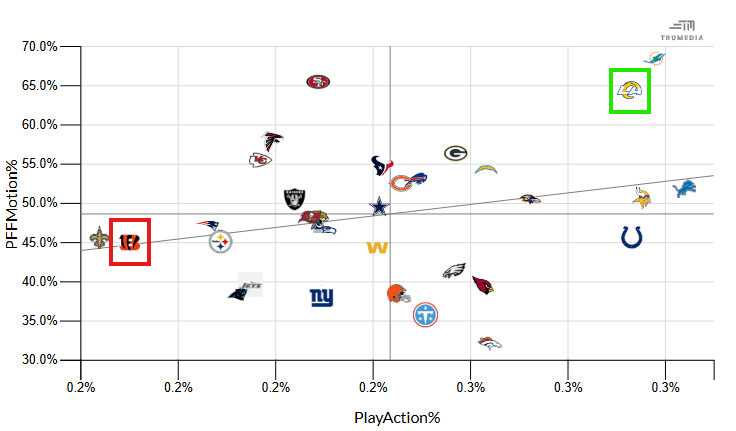
I have the Rams projected for 255 passing YPG (tied for third) and as the No. 4 scoring offense at 2.8 total TDs per game.
Update (8/26): Nacua has been out for the last two weeks with hip flexor and groin injuries, but has returned to the field for individual training work. He is also under NFL investigation for biting a woman. He is still my WR2 overall, but carries some risk.
- Superpower: Elite talent + Prime + Scheme.
- Kryptonite: None.
Bottom Line: Nacua is an elite WR1 worthy of taking in the first four picks of drafts.
2026 Fantasy Football WRs - Tier 2
- Jaxon Smith-Njigba | Seahawks
- Amon-Ra St. Brown | Lions
- CeeDee Lamb | Cowboys
- Justin Jefferson | Vikings
These WRs are high-end talents at their peak powers and play in favorable environments.
 Jaxon Smith-Njigba | Seahawks
- Age: 24 (Prime)
- Fantasy PPG (23-25): 8.8, 14.9, 21.2
- Receiving YPG: 36.9, 66.5, 105.5
Smith-Njigba followed up his Year 2 breakout, finishing as the WR2 overall in Year 3. He crushed fantasy leagues, showing up on 71% of ESPN playoff rosters—the second-most of any player—delivering 3.5 wins above replacement (WAR).
The former Round 1 pick posted the No. 1 Utilization Score (94) and led all WRs with a massive 36% target share.
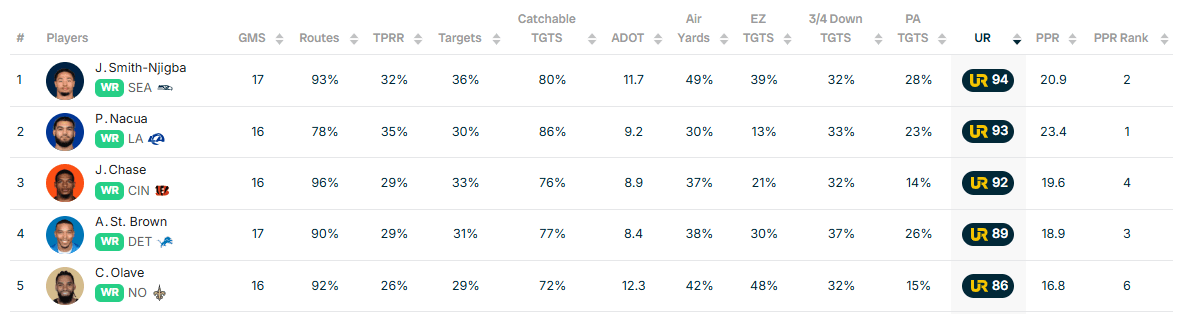
With DK Metcalf gone, Smith-Njigba expanded his game—playing 77% of snaps out wide while upping his average depth of target (aDOT) from 8.7 to 11.7 yards. He also became a priority weapon when in scoring position, accounting for 39% of end-zone targets.
Despite being the focal point of opposing defenses, JSN posted the No. 2 ESPN Open Score (89) and was one of only two WRs to exceed 3.00 yards per route run (YPRR) against both man and zone.
- Smith-Njigba: 4.41 YPRR vs man; 3.81 YPRR vs zone
- Nacua: 3.57 YPRR vs man; 4.05 YPRR vs zone
The biggest question facing Seattle is the loss of Klint Kubiak. Brian Fleury has never called plays in the NFL, but I expect many of the same play designs and concepts. Fleury spent the last seven seasons under Kyle Shanahan, most recently as the run game coordinator.
Seattle projects for 235 passing YPG and 2.4 TDs per game (14th). Sam Darnold has now supported elite WR1 seasons in back-to-back years.
- Superpower: Elite talent + Prime + Low Target Competition
- Kryptonite: Unknown play-caller.
Bottom Line: Smith-Njigba is a high-end WR1 worthy of a top-six selection.
 Amon-Ra St. Brown | Lions
- Age: 27 (Prime)
- Fantasy PPG (23-25): 20.7, 18.6, 19.1
- Receiving YPG: 94.7, 74.3, 82.4
St. Brown has delivered three consecutive top-five finishes, with elite per-game production:
- PPG: 19.4 (3rd)
- Receiving YPG: 83.6 (4th)
- Receptions per game: 7.0 (3rd)
- Targets per game: 9.5 (6th)
Last season, removing Week 13 (6% snaps due to an ankle sprain), he averaged 20.3 PPG. He also averaged 20 PPG before Sam LaPorta’s season-ending injury in Week 10.
After early-career struggles earning end-zone looks, St. Brown has posted 32% (30th) and 30% (32nd) end-zone target shares over the last two seasons. He has also dominated against all coverages, topping 2.00 YPRR vs. man and zone in each of the last three years, including career highs of 2.68 and 2.64 last season.
He has been one of the NFL’s most consistent elite performers and operates within one of the league’s top passing offenses:
- 2023: 271 YPG (4th), 1.8 TDs per game (4th)
- 2024: 263 YPG (2nd), 2.4 TDs (4th)
- 2025: 269 YPG (3rd), 2.1 TDs (3rd)
I have the Lions projected for the second-most passing YPG (261) and the second-most offensive TDs (2.9).
While Jameson Williams, LaPorta and Jahmyr Gibbs create target competition, this offense supports multiple producers—and St. Brown remains the clear alpha.
Dan Campbell assumed play calling in Week 10 of 2025, and the Lions replaced John Morton with Drew Petzing this offseason. Petzing looks underrated, using a variety of looks in the run game and ranking 9th in play-action rate (26%) over the last three seasons. Motion usage sits at 40% (27th), but Detroit has ranked 11th since 2023 and could maintain that identity.
- Superpower: The most consistent WR in fantasyland over the last three years.
- Kryptonite: None.
Bottom Line: St. Brown is a great mid-Round 1 target in fantasy drafts.
 CeeDee Lamb | Cowboys
- Age: 27 (Prime)
- Fantasy PPG (23-25): 23.7, 17.6, 14.4
- Receiving YPG: 102.9, 79.6, 76.9
Lamb’s production has dipped over the last two seasons, but context matters.
In 2024, Dak Prescott suffered a season-ending injury in Week 9. Lamb averaged 18.3 PPG with 87.6 YPG in games with Prescott.
In 2025, Lamb battled injuries:
- Week 3: High-ankle sprain (6% snaps)
- Weeks 4-6: Out
- Week 14: Concussion (46% snaps)
- Week 18: Shut down early (38% snaps)
In healthy games, Lamb averaged 16.5 PPG with 86.6 YPG.
When Lamb and Prescott were healthy together:
- 2023: 23.7 PPG, 102.9 YPG, 0.71 TDs
- 2024: 18.3 PPG, 87.6 YPG, 0.57 TDs
- 2025: 16.5 PPG, 86.6 YPG, 0.27 TDs
The TD dip in 2025 stands out. Since 2011, WRs averaging 80–90 YPG have averaged 0.56 TDs per game.
George Pickens is a great red-zone/end-zone weapon, but Lamb still led when healthy.
- Lamb: 1.45 RZ targets, 1.00 EZ targets
- Pickens: 1.10 RZ targets, 0.82 EZ targets
The setup points to positive TD regression.
With Prescott healthy, Dallas has remained one of the NFL’s top passing offenses:
- 2023: 274 YPG (3rd), 2.1 TDs (1st)
- 2025: 279 YPG (1st), 1.8 TDs (5th)
I have the Cowboys projected for 263 passing YPG (1st) and 2.7 total TDs per game (7th).
Brian Schottenheimer impressed in Year 1, ranking 10th in play action (27%) and 13th in motion (54%).
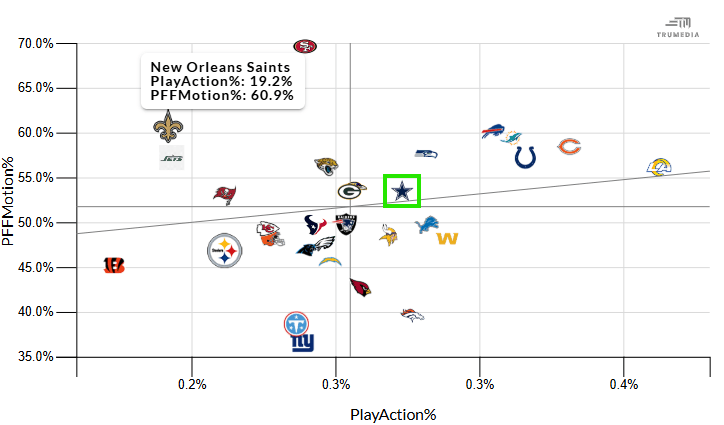
The more you zoom out, the more Lamb mirrors Ja’Marr Chase: elite talent, elite offense and strong secondary target competition.
- Superpower: Prime high-end talent in one of the best passing offenses in the NFL.
- Kryptonite: Pickens plays more like Batman than Robin.
Bottom Line: Lamb is a great mid-to-late Round 1 fantasy pick who offers WR1 overall upside.
 Justin Jefferson | Vikings
- Age: 27 (Prime)
- Fantasy PPG (23-25): 20.2, 18.7, 11.9
- Receiving YPG: 107.4, 90.2, 61.7
J.J. McCarthy completely nuked Jefferson's value last year—becoming one of the only QBs to not succeed under Kevin O'Connell in Minnesota. It was a massive drop-off in passing yards and TDs per game.
- 2023: 276 (1st), 1.8 (4th)
- 2024: 258 (5th), 2.1 (5th)
- 2025: 189 (30th), 1.1 (29th)
McCarthy played eight full games, averaging 168 YPG. Max Brosmer also played two full contests, averaging 88.5 YPG. Just brutal.
That doesn't shake my belief in Jefferson's talent, though. He posted a 31% target share—the fourth-best mark in the NFL—and is in his prime. He is still one of the best WRs in the NFL.
The issue is quarterback certainty.
Is Murray an elite QB? No. Is he good enough to support Jefferson with Kevin O'Connell's help? Yes.
Over the last three years, O'Connell ranks third in play action (30%) and 12th in motion at the snap (51%). He knows how to dial up the cheat codes.
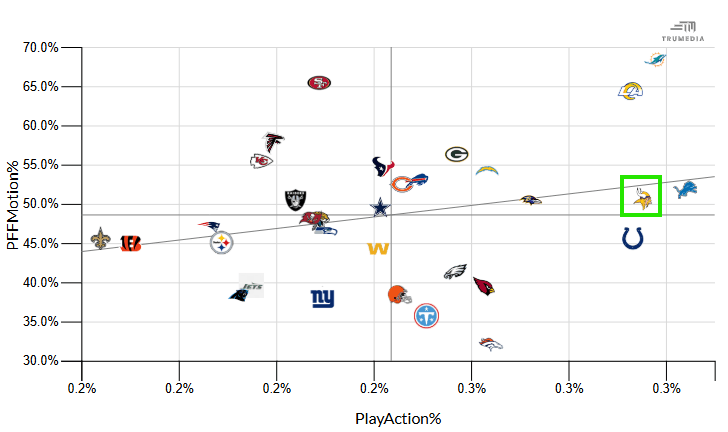
We also have recent evidence of Jefferson's ceiling with competent QB play. Last year, in five games with Carson Wentz taking the majority of snaps, the team averaged 243 passing YPG. In those contests, Jefferson averaged 16.3 PPG and 95.4 YPG.
I have the Vikings projected for 224 passing YPG (22nd) with 2.2 offensive TDs per game (21st).
With Kyler Murray named the Vikings starter, Jefferson upgrades to the back end of Tier 2.
- Superpower: Elite talent in his prime in a great scheme.
- Kryptonite: If J.J. McCarthy ever gets under center in 2026.
Bottom Line: Jefferson is a strong pick at the end of Round 1.
Want access to the rest of my WR tiers? Get an exclusive 20% discount off a Tier 2 FantasyLife+ package with code DWAIN20, valid until 10 AM EST on 8/13/26. Code DWAIN gets you 10% off after the exclusive offer expires.
Tier 3 WRs For 2026 Fantasy Football
- Malik Nabers | Giants
- Drake London | Falcons
- Nico Collins | Texans
- A.J. Brown | Patriots
- Chris Olave | Saints
- Rashee Rice | Chiefs
Every player here has one or two recent 16+ PPG seasons and offers high-end WR1 upside, but each carries a question mark that keeps them out of Tier 2.
 Malik Nabers | Giants
- Age: 23 (Early Prime)
- Fantasy PPG (24-25): 18.2, 14.3
- Receiving YPG: 80.3, 67.8
Before his season-ending ACL injury in Week 4, Nabers averaged 17.7 PPG and 83.7 YPG in three contests in 2025. He dominated targets (29%) and rarely left the field with a 97% route participation rate. His 87 Utilization Score tied for fifth.
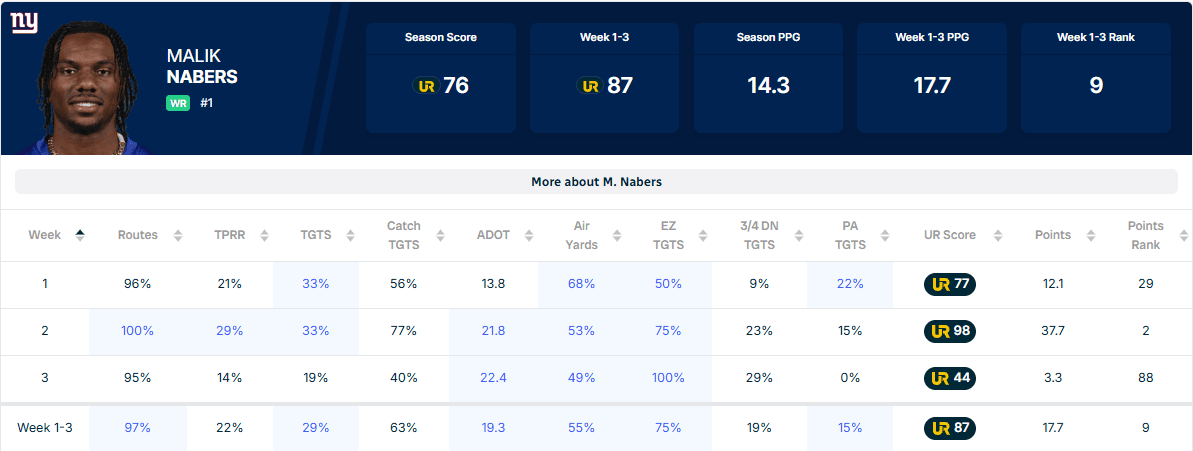
Yes, that is a small sample, but it aligns with his rookie data. And Nabers was an elite prospect, grading out as the No. 4 WR prospect all-time in the Rookie Super Model.
On the injury front, we got a great update from the first day of training camp—Nabers was a full participant in practice and Jeff Mueller, a Doctor of Physical Therapy, was impressed by the video.
Nabers still comes with risk of re-aggravation and might not be 100%, especially early this season, but there are nitpicks with all of the WRs in this tier. Ultimately, we want to bet on the upside of prime superstar talent profiles.
From an offensive environment standpoint, Nabers doesn't have much target competition outside of Isaiah Likely. Likely is a very good receiving prospect but hasn't been a target maven at the NFL level with a 17% targets per route run (TPRR) average for his career.
That is important, because Jaxson Dart's passing ceiling remains an unknown after averaging 184 YPG as a rookie. And Matt Nagy is not an inspiring offensive hire as offensive coordinator. He has been one of the worst schemers in the NFL.
- Motion at the snap: 39% (bad)
- Play Action: 17% (bad)
- Two-WR sets: 21% (bad)
But John Harbaugh has a history of utilizing play action married with the QB run game with Lamar Jackson.
- Motion at the snap: 39% (average)
- Play Action: 27% (good)
- Two-WR sets: 48% (elite)
And the personnel moves from the offseason matchup with the team adding Likely to go with Theo Johnson, plus acquiring fullback Patrick Ricard.
Update (8/26): Nabers is on track for Week 1. He is no longer wearing a non-contact jersey in practice. He is my most-drafted WR in the first five rounds, a key pillar of my 2026 draft strategy.
- Superpower: Elite talent in his prime without much target competition.
- Kryptonite: ACL recovery could mean a slow start, and Nagy’s offense is still running on dial-up in a fiber-optic world.
Bottom Line: Nabers is in play in Round 2 of fantasy drafts as a mid-range to low-end WR1 option.
 Drake London | Falcons
- Age: 25 (Prime)
- Fantasy PPG (23-25): 10.9, 16.5, 16.8
- Receiving YPG: 56.6, 74.8, 76.6
London has collected back-to-back 16+ PPG seasons, finishing as the WR13 and WR7. Before a PCL injury last season, he averaged 19.4 PPG with 90 receiving YPG. Over that nine-game stretch, he had the No. 3 Utilization Score (89) and a 32% target share.
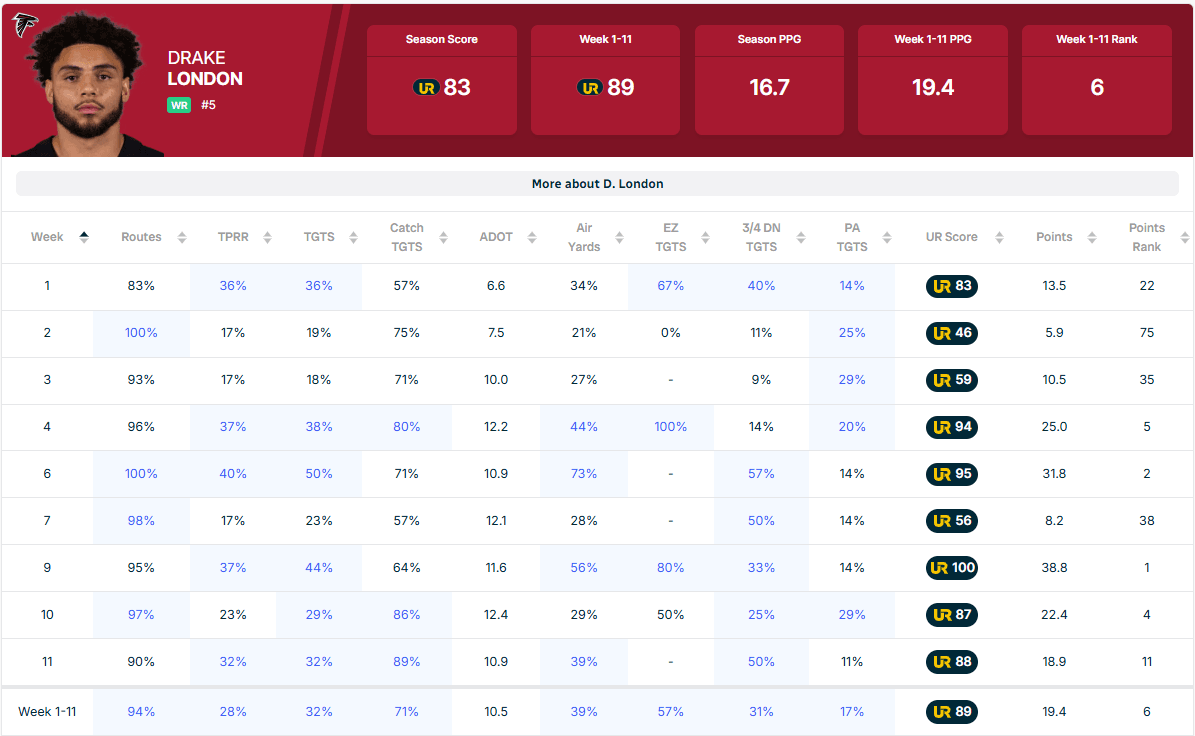
Freed from Arthur Smith and poor QB play, London ranks strongly in per-game and per-route metrics over the last two seasons:
- Receiving YPG: 75.5 (9th)
- Receptions per game: 5.8 (8th)
- Targets per game: 9.3 (4th)
- Target share: 25.5% (7th)
- YPRR: 2.34 (9th)
- FDRR: 0.12 (5th)
The former No. 8 overall pick is a proven alpha, and the No. 2 WR role is wide open with Zachariah Branch, Jahan Dotson and Olamide Zaccheaus competing.
Kevin Stefanski takes over as HC with Tommy Reese at OC. Stefanski’s tendency toward heavy-TE personnel aligns with the Austin Hooper addition, pointing to a concentrated attack around London, Kyle Pitts and Bijan Robinson.
The biggest concern is the staff’s recent motion and play-action rates:
- Reese in 2025: 23% play action (25th); 48% motion (22nd)
- Stefanskin in 2023 and 2024: 25% play action (13th), 34% motion (29th)
Tua Tagovailoa gets the first shot at QB with Michael Penix recovering from an ACL tear. Tua has averaged 234 passing YPG in full-time games over the last two years, above Atlanta’s 218 last season. Penix has averaged 231 in healthy games.
I project Atlanta for 233 passing YPG (12th) and 2.2 offensive TDs per game (22nd).
Update (8/26): Penix returned to practice this week. London averaged 21.6 PPG in 10 games with Penix over the last two seasons. Yes, please.
- Superpower: High-end talent in his prime in a consolidated offense.
- Kryptonite: The offensive brain trust has been lackluster.
Bottom Line: London is a Round 2 target in fantasy drafts.
 Nico Collins | Texans
- Age: 27 (Prime)
- Fantasy PPG (23-25): 17.4, 17.6, 15.1
- Receiving YPG: 86.5, 83.8, 74.5
Collins ranks WR7 over the last three seasons in PPG (16.6) and receiving YPG (81.4)—both aligning with mid-to-low WR1 production.
He started last season slowly as OC Nick Caley adjusted the offense, which had become too reliant on quick-hitting passes. More vertical concepts were added in the second half, unlocking Collins.
For this analysis, Week 7 (concussion; 52% snaps) is excluded, as Houston had a Week 8 bye.
- Weeks 1 to 6: 11.0 aDOT → 14.0 PPG, 62.4 YPG, 7.2 targets, 4.4 receptions
- Weeks 9 to 17: 13.9 aDOT → 16.6 PPG, 86.4 YPG, 8.2 targets, 5.0 receptions
Over that final stretch, Collins had a sizzling 2.58 YPRR. Over the last three seasons, he ranks second in YPRR (2.75) behind only Nacua.
This offseason, the Texans emphasized a stronger run identity: adding David Montgomery, drafting C Keylan Rutledge (Round 1) and signing G Wyatt Teller and T Braden Smith. They also upgraded TE with Foster Moreau and Marlin Klein (Round 2).
Passing volume could dip, but the offense should be more balanced and harder to defend. Collins remains the clear WR1, especially after the season-ending knee injury from Jayden Higgins. More heavy personnel would also benefit Collins.
The main concern is C.J. Stroud, whose passing YPG has declined from 274 as a rookie to 219 and 217. I’m projecting modest improvement, with Houston at 225 passing YPG (21st).
Update (8/26): Higgins is out for the season. He will be replaced by Kayshon Boutte, who has not been a high-end target earner for his career. In an offense where we could see a ton of heavy TE personnel, Collins is about to cook.
- Superpower: No. 2 YPRR WR over last three seasons with low target competition.
- Kryptonite: QB struggles.
Bottom Line: Collins is a mid-range WR1 and a strong pick in Round 2 of fantasy drafts.
 A.J. Brown | Patriots
- Age: 29 (Late Prime)
- Fantasy PPG (23-25): 17, 16.7, 14.7
- Receiving YPG: 85.7, 83, 66.9
Brown is in his late-prime and coming off his worst fantasy season since 2021. The red flag is a degenerative knee condition. GM Eliot Wolf acknowledged it, though the medical staff cleared the trade—still a long-term risk given the recent dip in production.
Even so, Brown finished WR11 on a team that passed for just 206 YPG. Despite DeVonta Smith’s presence, Brown led in target share (30%) and YPRR (2.06).
Now he lands in New England, which ranked No. 4 in passing YPG (262) with Drake Maye. The surrounding target competition is weaker—Romeo Doubs is not Smith, and Hunter Henry is not Dallas Goedert.
Here are the PPG changes for WRs with a 25–30% target share who saw a 40+ team passing YPG increase since 2011:
- Antonio Brown | 2018 | Age 30: 22.0 → 21.6
- Brandon Marshall | 2013 | Age 30: 20.9 → 18.8
- Antonio Brown | 2014 | Age 25: 19.3 → 23.6
- CeeDee Lamb | 2023 | Age 24: 17.7 → 23.8
- Davante Adams | 2018 | Age 26: 15.9 → 21.8
- Julio Jones | 2018 | Age 30: 15.7 → 20.6
- Stefon Diggs | 2020 | Age 27: 14.6 → 20.5
- Reggie Wayne | 2012 | Age 34: 12.2 → 16.9
- Josh Gordon | 2013 | Age 22: 10.0 → 22.5
On average, this group improved by 4.6 PPG (28%), with seven of nine increasing. Age comps are mixed: Brown (30) and Marshall declined slightly, while Jones, Diggs and even a 34-year-old Wayne improved.
I project the Patriots as the No. 6 passing offense (241 YPG) and No. 11 in offensive TDs (2.5).
- Superpower: High-volume target in an elite passing offense with reduced competition.
- Kryptonite: Age and a knee that comes with its own maintenance schedule.
Bottom Line: Brown is a low-end WR1 who could have one high-end WR1 boom still in the holster. He is a target in the middle of Round 2 and is currently an early Round 3 pick on ESPN.
 Chris Olave | Saints
- Age: 26 (Prime)
- Fantasy PPG (23-25): 14.5, 9.6, 16.8
- Receiving YPG: 70.2, 50, 72.7
Olave finished as WR6 with 16.8 PPG. Under Kellen Moore, he shifted more playing time to the slot (42%), creating matchup nightmares for interior defenders.
Tyler Shough emerged as a viable passer, averaging 251 yards after taking over in Week 9. Olave posted a 29% target share and 126 air yards per game across eight contests with Shough, ranking as the No. 4 WR (18.8 PPG) over that span.
The arrival of Round 1 pick Jordyn Tyson could cap Olave's ceiling when he returns, but this should be a highly concentrated attack. The Saints lack a proven WR3, with Devaughn Vele and Bryce Lance competing for WR2 reps with Tyson sidelined. Juwan Johnson is a solid receiving TE but not an alpha, and could see fewer snaps with Oscar Delp added.
Expect a concentrated attack around Olave and Tyson. Tyson operated primarily from the slot in college, but early reports are that Olave—who signed a four-year contract with $90M guaranteed—will still play plenty of reps inside.
Saints projected for passing-yard regression (236 YPG) given the small Shough sample. Olave’s target share dips to 25% (from 27%) with Tyson. TD regression: 0.38 per game in 2026 (down from 0.56), aligning with historical 65–75 YPG WRs (0.43). Still projects as WR14.
- Superpower: Prime WR with two 70+ YPG seasons in the last three years.
- Kryptonite: Shough's sample size is small, and Tyson will challenge for targets if/when healthy.
Bottom Line: Olave is a borderline WR1 who is a viable target in Round 3 of fantasy drafts and sees a heightened floor/ceiling combination in Tyson's absence.
 Rashee Rice | Chiefs
- Age: 26 (Prime)
- Fantasy PPG (23-25): 13.3, 16.2, 18.8
- Receiving YPG: 58.6, 72, 71.4
Rice notched a career-high 18.8 PPG, averaging a sterling 9.6 targets over eight games last season. In those starts, he collected five top-12 finishes in PPR formats.
The fourth-year WR has a 4.3-yard aDOT over the last three seasons, making him an underneath-coverage merchant. That’s low for this level of fantasy production. Since 2011, there are 40 instances of a WR with an aDOT below 6.0 who ran at least 250 routes. They averaged 8.9 PPG, with only Rice and Percy Harvin (twice) reaching 16+ PPG.
Harvin is the cautionary tale for this archetype—he had a rugged playstyle like Rice, and lower-body injuries limited his fantasy relevance to his age-23 and -24 seasons. High-scoring underneath weapons (also think Deebo Samuel) rely on YAC to add value.
Rice is recovering from an arthroscopic debridement to remove debris from his 2024 ACL-LCL injury. He served 30 days in jail following the surgery, complicating his recovery. He is ramping up in training camp, but none of this is ideal for his archetype.
While the Chiefs are not interested in a long-term deal with Rice due to health and off-field concerns, the depth chart offers little target competition. Xavier Worthy could make a Year 3 leap, but there’s zero evidence he can. Travis Kelce is in the twilight of his career.
Rice comes with multiple red flags, including little leeway for another off-field issue, which could mean a lengthy suspension. I’ve docked Rice an extra game for his knee (I dock all WRs one game), making him WR14 in our projections. Remove that game, and he’s WR8.
I’m projecting a slightly more balanced Chiefs attack in 2026 with Kenneth Walker, dropping their pass rate from 66.2% to 63.5%. I have them at 244 passing YPG—below Mahomes’ 256 in 2025.
- Superpower: Volume hog in an offense willing to feature underneath weapons and plays with a GOAT QB.
- Kryptonite: Off-field concerns and knee issues.
Bottom Line: Rice comes with multiple red flags, but he offers mid-range WR1 potential as a Round 2-3 turn pick in 12-team fantasy drafts.
2026 Fantasy WRs - Tier 4
- DeVonta Smith | Eagles
- George Pickens | Cowboys
- Tee Higgins | Bengals
 DeVonta Smith | Eagles
- Age: 28 (Late Prime)
- Fantasy PPG (23-25): 14.2, 15.3, 11.9
- Receiving YPG: 66.6, 64.1, 59.3
Smith has never reached 16+ PPG, but has reached 14+ three times. Now A.J. Brown and his 30% target share are gone, and Sean Mannion brings scheme upside from his time under Matt LaFleur in Green Bay. Historically, that combination has been a great setup.
The former Round 1 pick and No. 6 prospect all-time in the Rookie Super Model has been dominant on plays without Brown over the last three seasons. On 210 routes, Smith commanded a 38% target share with a 2.80 YPRR. It’s a small sample, but a 25%+ target share is easily in play for 2026.
The nitpick: Smith has not shown alpha traits against man coverage, posting YPRRs of 1.33, 1.86 and 1.33 over the last three campaigns. Those aren’t WR1 marks (2.63); they align more with WR4s.
Part of that could be due to Brown, who was an elite man-beater. On the other hand, Smith isn’t a big WR. If it was due to man-coverage struggles, defenses could test him in 2026. Still, the NFL uses zone on ~70% of plays, so it’s hard to dock Smith too much.
Mannion could shield Smith with more tight and off-ball alignments. We could also see a significant uptick in motion—the Packers ranked fifth over the last two years at 59%, 11 points higher than Philadelphia under Kevin Patullo last year (48%).
The great part: I only project modest Eagles improvement to 212 passing YPG (28th), with Makai Lemon and Dallas Goedert in solid roles. Still, Smith projects as WR12 on a 26% target share (3 points higher than last year).
- Superpower: Fantastic prospect who has dominated without Brown on the field.
- Kryptonite: Questionable passing attack and potential ascension of Lemon.
Bottom Line: Smith is a strong bet to improve in 2026 with mid-range WR1 upside—a high-priority Round 3 target. He’s going late Round 3 on ESPN and Round 4 on Sleeper. SMASH.
George Pickens | Cowboys
- Age: 25 (Prime)
- Fantasy PPG (23-25): 12.3, 11.7, 17.2
- Receiving YPG: 67.1, 64.3, 84.1
Pickens is a prime example of how a change in scenery can unlock a WR. His move from Pittsburgh to Dallas came with a +66.4 passing YPG swing, and his PPG jumped 47%.
With Dak Prescott throwing, Pickens improved his catch rate from 57% to 68%, and his receptions rose from 4.2 to 5.5 per game. His boom wasn’t tied to Lamb’s injuries—he averaged 16.8 PPG across 11 healthy games with Lamb.
Some may worry about TD regression after a career-high 0.53 per game, but I’m less concerned. In his last three healthy seasons, Prescott has been elite, posting TD-per-attempt rates of 6.2%, 6.1% and 5.0%. In those campaigns, he averaged 278, 265 and 268 YPG.
I don’t expect team passing TDs to decline in 2026. If anything, there’s room for growth. I have Dallas projected No. 1 in passing YPG (263) and seventh in offensive TDs (2.7).
I’m bullish on Pickens remaining a high-end yardage option. Regressing him to 70–80 YPG, historical comps still averaged 0.47 TDs per game. Pickens also ranked No. 4 in end-zone targets per game in 2025 at 1.0 per contest—which fits his skill set.
- Superpower: Ascending WR talent in his prime unlocked by a high-end offense.
- Kryptonite: Lamb still projects as the WR1.
Bottom Line: Pickens is a low-end WR1 option with league-smashing contingent upside if Lamb were injured. He is a viable fantasy target in Round 3.
Tee Higgins | Bengals
- Age: 28 (Late Prime)
- Fantasy PPG (23-25): 11.5, 18.5, 14.1
- Receiving YPG: 54.7, 75.9, 56.4
Higgins is very similar to Pickens—a great WR2 in one of the NFL’s best passing offenses. Over the last three seasons, he has played in 22 games with Burrow, and the results have been pretty pretty pretty good:
- PPG: 16.0 (low-end WR1 territory)
- YPG: 65.6 (mid-range WR2 territory)
- TDs per game: 0.73 (high-end WR1 territory)
- YPRR: 1.89 (WR3 territory)
The biggest difference is that Pickens is in his prime and hasn’t faced the same injury challenges as Higgins, who has missed five, two and five contests over the last three years. His 1.89 YPRR is a bit low, but still very good playing alongside an alpha like Chase. On routes without Chase: 2.28 YPRR.
The Bengals project as my No. 3 passing attack (255 YPG), and Burrow has been amazingly consistent in TD-per-attempt (see Chase above). Taylor is a below-average schemer, but the team is pass-first.
Higgins' ceiling is capped with Chase and comes with injury risk. However, he still has league-winning upside in his range of outcomes, given his Round 4 price tag.
Since 2016, the WRs who showed up on 50%+ of ESPN playoff rosters as Round 4 selections averaged 18.4 PPG (+4.3 PPG over expected). Higgins did that the last time Burrow was healthy.
Half the time a WR reached 16 PPG as a Round 4 pick, they were on 50%+ of ESPN rosters—which is a more realistic ceiling target for Higgins.
- Superpower: One of the best WR2s in the NFL on a great passing attack.
- Kryptonite: Often injured and Chase caps his ceiling.
Bottom Line: Higgins comes with red flags, but is priced right in Round 4 of drafts—he offers borderline WR1 upside, and his contingency upside if Chase is injured is top-six.
Tier 5 Fantasy Football WRs for 2026
All of these players are in their early prime to late-prime windows.
- Tetairoa McMillan | Panthers
- Ladd McConkey | Chargers
- Zay Flowers | Ravens
- Jaylen Waddle | Broncos
- Garrett Wilson | Jets
- Emeka Egbuka | Buccaneers
- Luther Burden | Bears
- Christian Watson | Packers
- Parker Washington | Jaguars
The prime window matters! Since 2016, younger WRs have outscored their ADP by 2+ PPG more often than older players in Rounds 1 to 5 of fantasy drafts:
- Age 21-23: 31%
- Age 24-27: 25%
- Age 28-29: 22%
- Age 30-31: 16%
- Age 32-33: 11%
I like all of the players in the tier and am actively targeting them in fantasy drafts; it comes down to price on the sites and how you want to play it.
I don't think there is a wrong way, but I do a lot of nitpicking across these profiles, because upside is king.
Most of these players are Round 3-5 picks depending on your site. Below is a quick summary of what we expect from these players based on historical ADP + what league-winners have averaged based on ESPN playoff data (50%+ advance rates):
- Round 3: 15 PPG; 17.4 PPG
- Round 4: 14.1 PPG; 17.4 PPG
- Round 5: 13.1 PPG; 17.1 PPG
Notice that while expected points go down due to ADP, what it takes to be a league-winner holds steady. We want players with a realistic shot at 17+ PPG.
 Tetairoa McMillan | Panthers
- Age: 23 (Early Prime)
- Fantasy PPG (25): 12.4
- Receiving YPG: 59.6
McMillan averaged nearly 60 yards per game as a rookie despite playing in one of the NFL’s worst passing offenses. The Panthers averaged only 194 YPG (27th). His 31% yardage share ranks eighth since 2011, comparable to Justin Jefferson (33%), A.J. Green (32%), Mike Evans (31%) and Ja’Marr Chase (30%).
 Nerd Note: I don't discuss yardage share much because it is mostly captured in YPG, but it is useful in cases like this. Yardage share adds better context than a number like YPRR when QB play is bad.
The No. 8 pick posted a 26% target share (WR1 material historically), but Carolina’s offense limited his per-game output:
- Receiving YPG: 59.6 (mid-range WR3)
- Receptions per game: 4.1 (low-end WR3)
- Targets per game: 7.1 (mid-range to low-end WR2)
He led the team in end zone targets with a 38% share (12th in the NFL). Despite a poor offense, McMillan ranked well in red- and end-zone targets in 2025:
- End zone targets per game: 0.65 (19th - low-end WR1 range)
- Red zone targets per game: 0.88 (20th - low-end WR2 range)
Considering the offense, McMillan performed well. The No. 14 WR in the Rookie Super Model has WR1 potential, but the big question for 2026 is whether he can grow his role enough to offset Bryce Young—or if Young can improve beyond one of the league’s worst QBs.
- 2023: 180 YPG, 0.7 TDs per game
- 2024: 196 YPG, 1.3 TDs per game
- 2025: 192 YPG, 1.5 TDs per game
Dear god. It’s hard to project Young improving—I have him at 197 YPG with 1.4 TDs per game for 2026.
Question: What would it take for him to reach 16+ PPG in the projection model?
Answer: ~30+.
That aligns decently with historical data.
Since 2011, five WRs on teams with 190–210 passing YPG and a 29%–32% target share averaged 15.2 PPG. Two eclipsed 16+ PPG: A.J. Brown (16.7) and Malik Nabers (18.2). Vincent Jackson averaged 15.2 PPG; Brandon Lloyd, 13.1; Garrett Wilson, 12.5.
Young is a massive problem for McMillan, but his strongest target competition is Jalen Coker, who had a 16% target share in 2025 games played. There’s room for McMillan to expand his footprint. At 6’4”, 212 pounds, he should be a major part of Carolina’s high-leverage offense in the red zone and on end zone targets.
Update (8/26): McMillan has been playing from the slot more often in camp and in the preseason. That is one way to help boost his targets and improve matchups. The team has also been putting him in motion.
- Superpower: Good prospect whose underlying metrics looked like a WR1 as a rookie.
- Kryptonite: Bryce Young. Bryce Young. Bryce Young. Bryce Young. Bryce Young.
Bottom Line: McMillan is a mid-range WR2 with low-end WR1 upside. He is a viable target in Round 4 of fantasy drafts and is a fantastic option in Round 5 in FFPC drafts.
 Ladd McConkey | Chargers
- Age: 25 (Prime)
- Fantasy PPG (24-25): 15.1, 11.3
- Receiving YPG: 71.8, 49.3
McConkey was a Round 2-3 pick in 2025 after finishing as the WR17 as a rookie. Ultimately, he was a colossal bust last year, finishing as the WR34. McConkey regressed across multiple key data points:
- Receiving YPG: 71.8 → 49.3 (mid-range WR4)
- Receptions per game: 5.1 → 4.1 (borderline WR3)
- Targets per game: 7 → 6.6 (borderline WR3)
- Target share: 25% → 21% (WR3)
- YPRR: 2.40 → 1.40 (WR5)
With Keenan Allen returning to the Chargers and the addition of Oronde Gadsden, McConkey had more target competition. While Allen is past his prime, he had a similar impact on Rome Odunze in 2024. On 142 routes without Allen, McConkey notched a 28% target share.
However, that didn't improve his YPRR much at 1.61. But the offense had other issues too—primarily a banged-up offensive line with Joe Alt and Rashawn Slater hurt. Alt missed 11 games, and Slater missed the entire season.
Only five QBs had a quicker time to pressure than Herbert at 2.45 seconds. He was sacked on 21.6% of his pressures, which ranked 25 out of 36 QBs with at least 250 dropbacks, per Sumer Sports.
If you have watched McConkey's game, he is a nuanced route runner who wins by setting up defenders. Watching the film, the 6'0", 185-pound WR was still getting open, and his ESPN Open Score of 72 was only five points below his rookie season mark of 77. Herbert was often moved off his spot or running for his life before McConkey's route could fully develop.
McConkey has averaged 0.72 red-zone (WR4 territory) and 0.63 end-zone (WR2 territory) targets per game over the last two years—similar to Smith-Njigba's numbers over his first three seasons of 0.78 and 0.51.
That brings us to 2026. Keenan Allen is gone. The offensive line is healthy and added three new starters in G Jake Slaughter (Round 2 NFL Draft pick), C Tyler Biadasz and G Cole Strange. And most importantly, Mike McDaniel is taking over play-calling duties.
McDaniel has dialed up cheat codes for his WRs as well as anyone over the last three years.
- Motion at the snap: 68% (1st)
- Play Action: 30% (2nd)
- Two-WR sets: 39% (3rd)
The Chargers added FB Alec Ingold and TEs Charlie Kolar and David Njoku in the offseason, signaling their intent to use plenty of two-WR sets. While that can be good from an efficiency standpoint, it does raise the biggest question about McConkey: playing time.
Over the last two years, he has a 71% route participation rate out of 21 personnel and 52% in 12 groupings. As a comparison, Jaylen Waddle was at 75% and 72%, respectively, under McDaniel over the last two seasons in Miami.
McDaniel has been notorious for withholding routes from his top wideouts:
- Tyreek Hill: 83%, 80%, 81%, injured
- Jaylen Waddle: 82%, 75%, 81%, 80%
Historically, WR1s like Hill top a 90% route rate and strong WRs like Waddle get into the mid-80s or higher.
Likely, McConkey won't see a 90% route participation rate this season, with Tre Harris and Quentin Johnston also vying for reps in an offense that could lead the NFL in 2-WR sets. McConkey should be a staple of 11 personnel, but that is also when Oronde Gadsden—the teams best receiving TE—is the most likely to see the field.
Playing time could be pretty spread out. But the Chargers project for the eighth-most passing yards per game (237). And there is significant upside—they could be a top-three passing unit in a pure runout.
- Superpower: Prime WR with a solid profile + potentially great offense.
- Kryptonite: His path to elite route participation is murky.
Bottom Line: McConkey is a mid-range WR2 with low-end WR1 upside.
 Zay Flowers | Ravens
- Age: 26 (Prime)
- Fantasy PPG (23-25): 12.9, 12.3, 14.3
- Receiving YPG: 53.6, 62.3, 71.2* (*76.6 with Lamar Jackson)
The newly minted four-year, $140M WR has improved his receiving YPG each season, ranking 13th (66.8) and seventh in YPRR (2.40) since his rookie year. His target share has risen yearly, but raw targets have held steady in Baltimore’s run-oriented offense:
- 2023: 23%, 6.8 per game (low-end WR2)
- 2024: 25%, 6.8 per game
- 2025: 29%, 6.9 per game
An underneath/intermediate target who excels with motion and slot routes, Flowers has reduced screen/RPO dependence, raising his aDOT from 8.5 to 10.4 and 10.2.
While his 2025 receiving YPG reached high-end WR2 territory, his 0.29 TDs per game (0.36 with Lamar Jackson) remained WR4-level. Unlocking TDs is the challenge; he posted 0.31 and 0.24 in his first two seasons.
Historically, WRs averaging 65-75 YPG average 0.42 TDs per contest. At 75-85, that jumps to 0.51 per game. There’s room for positive regression, but at 5-foot-9, 183 pounds, Flowers hasn’t been featured in high-leverage situations. His red zone and end zone target ranks:
- 2023: 0.81 (35th), 0.25 (71st)
- 2024: 0.41 (73rd), 0.53 (42nd)
- 2025: 0.59 (49th), 0.29 (64th)
This isn’t just low pass volume—Flowers has low red- and end-zone target shares:
- 2023: 23%, 15% (66th)
- 2024: 19%, 17% (58th)
- 2025: 23%, 17% (61st)
Nerd Note: Red-zone and end-zone targets are more sticky year-over-year than receiving TDs (correlations: 0.61, 0.50 vs. 0.41). Red-zone targets are also more predictive of next season’s fantasy points (0.57 vs. 0.48).
Isaiah Likely is gone, but he has not been a massive blocker to Flowers' end-zone targets: 0.06, 0.56, 0.21.
Flowers could reasonably reach 0.40–0.45 TDs per game (6.8–7.7 over 17 games) with a few more long grabs, but massive upside requires more high-leverage targets. His historical comps averaged 0.39 TDs with 0.40–1.00 red zone targets per game.
From 2012 to 2024, eight WRs with 26+ routes per game (at least the WR3 on their team) scored five or fewer TDs in their first three seasons. Zero became regular 8+ TD scorers. DJ Moore, Jarvis Landry, and Kenny Stills managed one spike season of 8+ TDs. The cohort averaged five TDs per season in their prime years.
Nerd Note: 2025 was excluded (no year-after data), removing George Pickens, who has a size advantage over Flowers.
Can Declan Doyle do what Todd Monken couldn’t? Ben Johnson, who mentored Doyle, did it with Amon-Ra St. Brown in Detroit—but St. Brown is bigger (6-foot, 202 pounds).
Antonio Brown dominated at 5’10”, 185 lbs, but averaged 1.2 end zone targets per game in a pass-heavy offense (11.1 targets per contest).
Flowers’ size comps: Diontae Johnson, T.Y. Hilton, Tyler Lockett, Brandin Cooks, Hollywood Brown. Three notched 16+ PPG seasons:
- Johnson | Age 26: 17.2 PPG
- Hilton | Age 29: 17.1 PPG
- Lockett | Age 28: 16.6
Hilton was a 4.34-second 40-yard-dash player.
Flowers reportedly added eight pounds this offseason, which is noteworthy, as that would change his comp group with Tyreek Hill entering the equation. The Cheetah was an outlier speed freak (4.29-second 40-yard dash), but he did overcome low red- and end-zone target seasons in 2018 and 2022 with 20.9 and 20.4 PPG.
Doyle will put Flowers in favorable positions, but that narrative might be overblown because Monken was already dialing cheat codes for Flowers in 2024-2025:
- Motion at the snap: 24% (5th)
- Play action: 31% (6th)
- 2 WR sets: 57% (2nd)
Flowers already ranked fifth in motion-at-the-snap (24%) over the last two years under Monken.
More passing from Baltimore would boost yards and TDs, but 2026 defenses are best attacked with balance. Lamar Jackson isn’t running as much, but he’s still a dual-threat, which correlates strongly with run-heavy attacks.
I have Baltimore projected for 229 passing YPG (16th) and 2.9 total TDs per game (3rd).
Connecting the dots: I’ve written extensively on Flowers and think he’s very good—but my job is to nitpick players in this range as we decide who to target for 2026. Flowers has surged up best ball boards to mid-Round 3, driven by expectations of natural TD regression and a scheme upgrade. I don’t think those arguments are as strong as the market suggests.
That doesn’t make him a fade—I just want to temper expectations. There are legitimate question marks given the history of similar WRs.
The biggest positives: he’s a great player in his prime on a good offense without much target competition. Those alone make him worthy of drafting. And yes, TD variance is real, as we’ve discussed, which could benefit Flowers—he just isn’t the archetype we can unquestioningly project for a 10-TD ceiling.
- Superpower: Ascending prime WR in an explosive offense without much target competition.
- Kryptonite: Run-centric offense and doesn't offer prototypical size for high-end TDs.
Bottom Line: Flowers is a strong mid-range WR2 pick who offers low-end WR1 upside with a reasonable TD increase. He is a late Round 3 to mid-Round 4 target in fantasy drafts.
 Jaylen Waddle | Broncos
- Age: 28 (Late Prime)
- Fantasy PPG (23-25): 14.2, 10, 12.1
- Receiving YPG: 72.4, 49.6, 56.9
- 5'10", 185
Over the last four seasons, Waddle dealt with injuries to Tua Tagovailoa and a downward-spiraling offense. In games with a healthy Tagovailoa, he averaged 14.1 PPG with 69.5 receiving YPG and 0.39 TDs. Removing five games where Waddle played less than 60% of snaps due to injuries, things look even better:
- Fantasy points per game: 15 (high-end WR2 territory)
- Receiving YPG: 73.5 (borderline WR1 territory)
- Receiving TDs per game: 0.44 (low-end WR2 territory)
Historically, the 5-foot-10, 185-pound WR has not been a highly utilized target in the end zone, but with Hill out in 2025, he registered a career high.
- 2022: 21% (42nd)
- 2023: 19% (55th)
- 2024: 9% (115th)
- 2025: 33% (22nd)
Over that span, he averaged 0.60 red-zone targets (WR5 range) and 0.35 end-zone targets (WR5 range).
In Denver, he will compete with Courtland Sutton, a highly utilized end-zone weapon who posted 38% (14th) and 49% (6th) in two seasons with Bo Nix. While that could cap Waddle’s high-end TD, Sutton will be 31 and is not a dominant target earner.
Waddle notched 23%, 17% and 23% target shares over the last three years. The first two seasons were opposite of Hill, who had 33% and 22%. Waddle offers 25%+ target share upside with the Broncos.
Denver traded their Round 1, Round 3 and Round 4 picks in the 2026 NFL Draft to secure Waddle. Sean Payton and Davis Webb have called out his ability to line up all over the formation, and they love his speed.
With only Sutton as his primary target competition, Waddle could thrive with the Broncos, who have ranked third (3%) and seventh (3%) in DBOE over the last two seasons. Plus, Waddle will play the Z and slot roles, which are a great fit for his YAC ability—and could boost his targets.
Historically, some of our biggest fantasy hits have come from good WRs who changed teams—but most were from WRs who saw a significant upgrade in their team’s passing offense:
- George Pickens: Steelers to Cowboys; 11.9 → 17.1 PPG (+66 passing YPG)
- DJ Moore: Panthers to Bears; 11.7 → 17 (+10)
- Golden Tate: Seahawks to Lions; 11.7 → 16. 2 (+49)
- Emmanuel Sanders: Steelers to Broncos; 11.2 → 18.8 (+30)
Waddle is on the same talent spectrum; the question is if his addition helps unlock a new ceiling for Bo Nix, who has averaged 222 (18th) and 231 (13th) YPG.
The nitpicks with Waddle:
- He is entering his post-prime window.
- He played in a Mike McDaniel scheme, which can boost production.
I’m not too concerned about the post-prime window—he’s still in a range where good WRs have experienced boom seasons. As for the scheme, it’s hard not to expect a dropoff because McDaniel is so good.
Data from the last two years: McDaniel → Payton (and Webb)
- Play Action: 30% (4th) → 28% (7th)
- Motion at Snap: 64% (3rd) → 35% (32nd)
- 2-WR Sets: 38% (2nd) → 16% (28th)
One potential positive: McDaniel has historically limited his WR route participation rates. Waddle: 82%, 75%, 81%, 80%—below the 85-90% for similar players. While not a given, after trading so much draft capital, it’s hard to imagine not seeing more routes for the former Round 1 NFL Draft pick in 2026.
- Superpower: High-end WR2 profile with a change of scenery and speed to burn.
- Kryptonite: Not a monster in high-leverage scoring situations.
Bottom Line: Waddle is a mid-range WR2 with low-end WR1 upside. He is a Round 4 target.
 Garrett Wilson | Jets
- Age: 26 (Prime)
- Fantasy PPG (23-25): 12.5, 14.8, 14.2
- Receiving YPG: 61.3, 64.9, 56.4* (*76.4 before injury)
Wilson has been remarkably consistent despite multiple bad breaks over the last three years.
- 2023: Aaron Rodgers injured in the first series
- 2024: Jets traded for Davante Adams
- 2025: Justin Fields at QB + Wilson sprained his knee in Week 5
Before his injury, Wilson was off to an amazing start with 18.6 PPG despite terrible QB play, with the Jets averaging 201 passing YPG (27th). Wilson overcame this thanks to 8.8 targets per game (32%).
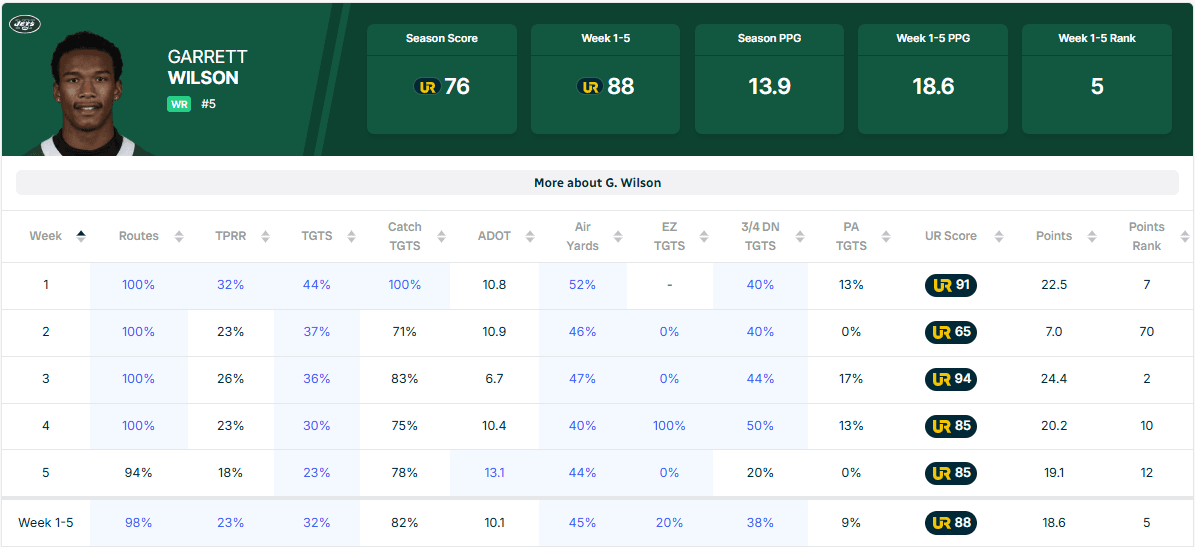
Over that span, Wilson averaged 76.4 YPG with 6.6 receptions per game. Target-earning has been a calling card throughout his career. Over the last three years, he ranks seventh in the NFL with 9.3 targets per game.
Wilson has never been an end-zone target monster, but has been highly active in the red zone, reaching 1.0 and 1.4 per game in his last two healthy seasons (low-end to mid-range WR1 territory).
The 6’0”, 183-pound WR profiles similarly to his Ohio State teammate, Chris Olave, who snapped into form last year with 16.8 PPG. Going back in the time machine, he reminds me of Emmanuel Sanders, who boomed with better QB play.
But that’s the big question mark: Can Geno Smith right the ship?
- 2023 | Seahawks: 251 YPG, 1.4 TDs per game
- 2024 | Seahawks: 261 YPG, 1.3 TDs per game
- 2025 | Raiders: 196 YPG, 1.3 TDs per game
Smith's weapons were terrible last season. Bowers was injured for the first half of the year, and Jakobi Meyers was traded to the Jaguars in Week 10.
At age 36, Geno isn’t what he used to be, but he has a group of weapons in New York that are better than the Raiders. But the additions of Kenyon Sadiq and Omar Cooper in Round 1 add target competition for Wilson.
And then there’s the head-scratching addition of Frank Reich as the new play caller. Reich was okay in 2021, but rarely jammed the cheat code buttons in 2022 and 2023:
2021 Colts
- Play Action: 32% (3rd)
- Motion at Snap: 36% (17th)
- 2 WR Sets: 22% (16th)
2022 Colts (fired ahead of Week 10)
- Play Action: 20% (26th)
- Motion at Snap: 28% (30th)
- 2 WR Sets: 16% (23rd)
2023 Panthers (fired ahead of Week 13)
- Play Action: 15% (31st)
- Motion at Snap: 27% (28th)
- 2 WR Sets: 6% (31st)
The Jets' passing offense projects as my No. 23 passing offense (220 YPG) but comes in with 1.9 total TDs per game (30th)
- Superpower: Target magnet in his prime.
- Kryptonite: Questionable QB + FREAKING FRANK REICH + Added Target Competition.
Bottom Line: Wilson is a mid-range WR2 with low-end WR1 upside. He is in play in Round 4 of drafts.
 Emeka Egbuka | Buccaneers
- Age: 24 (Prime)
- Fantasy PPG (25): 11.5
- Receiving YPG: 55.2
Egbuka averaged 20.1 PPG over his first five games as a rookie before injuries struck. Over that stretch, the Round 1 NFL pick was dominant.
- Receiving YPG: 89 (mid-range WR1)
- Receptions per game: 5 (mid-range WR2)
- Targets per game: 7.6 (high-end WR2)
- Target share: 23% (low-end WR1)
It’s a small sample, and veteran returns contributed to Egbuka’s drop to 7.8 PPG. But Baker Mayfield also battled injuries, falling from 257 YPG (first six) to 193 YPG rest of season.
I’m bullish on Egbuka. He’s the No. 19 WR prospect all-time in the Rookie Super Model, and Mike Evans is gone. Evans dominated high-leverage scoring targets; Egbuka flashed with a 30% end zone share (31st). At 6’1”, 205, he has the size to become a red-zone staple. Don’t be surprised if he ranks top 12 in end-zone targets in 2026—Chris Godwin has cleared 20% only twice in eight-game seasons.
Egbuka shifts to Z, where he can increase target share and YAC (a college strength). He already has multiple downfield hits in camp, matching his Year 1 profile. His 13.2 aDOT was a pleasant surprise, with three TDs of 25-plus yards.
Godwin will battle for targets, with Jalen McMillan and Ted Hurst vying for WR3. I like Godwin at price, but Egbuka is the player we could be drafting in Round 1 of 2027 fantasy drafts.
Zac Robinson replaces Josh Grizzard as play caller. Grizzard ranked 29th in play action (21%) and 15th in motion (53%) in 2025. Robinson ranked 27th (22%) and 2nd (64%), planning to feature Egbuka heavily via motion.
Robinson leaned into heavy-TE personnel in 2025, but the Bucs are stronger at WR. Expect plenty of 11-personnel, maybe extra multi-TE sets. Key takeaway: Evans is not one of the three WRs anymore—he still had an elite 26% TPRR last season. Neither McMillan nor Hurst matches that.
I project the Bucs for 231 passing YPG (14th) with 2.4 offensive TDs per game (17th).
Update (8/26): Egbuka was my No. 2 player in this tier before his turf toe injury. The team is optimistic he will be OK, but his early-season production could take a hit. He moves toward the bottom of the tier with so many close calls.
- Superpower: Good prospect who flashed high-end upside in rookie season + Evans gone.
- Kryptonite: Small 2025 success sample.
Bottom Line: Egbuka comes with some risk, but offers the profile that could boom for 20+ PPG. He is a mid-range WR2 with mid-range WR1 upside, worthy of a Round 4 pick. His turf toe injury prevents him from being a smash pick, but still profiles as a high-upside option at his price.
 Luther Burden | Bears
- Age: 23 (Early Prime)
- Fantasy PPG (25): 8.5 (8.2 including NFL Playoffs)
- Receiving YPG: 43.5 (42.2)
Burden took over the WR3 role from Olamide Zaccheaus in Week 11 and averaged 10.6 PPG over nine games through the NFL Playoffs. That isn't bad on a 61% route participation rate. His 0.53 fantasy points per route ranked seventh.
Burden didn't meet the cutoff of 250 routes in the regular season for YPRR, so I extended it to the NFL Playoffs—his 2.36 ranks 10th since 2011 for a rookie. His 24% TPRR ranks 17th. Those are great marks for a WR that graded out in a similar range to Zay Flowers, Ladd McConkey and Deebo Samuel in the Rookie Super Model with a rating of 80 (39th).
Nerd Note: Burden is the type of player where YPRR and TPRR become incredibly helpful due to a part-time role last season.
One of the knocks on Burden last season was his reliance on screens (26% of targets), which don't typically scale to a larger role. But he was still great on non-screen plays:
- YPRR: 2.35 (WR1 territory)
- TPRR: 21% (WR3 territory)
- Fantasy Points Per Route: 0.43 (WR2 territory)
- aDOT: 11.8
Here are the WRs who reached those YPRR and TPRR numbers in Year 1 and how they fared in Year 2:
- Odell Beckham Jr.: 21.3 PPG
- Ja'Marr Chase: 20.5
- Puka Nacua: 18.8
- Justin Jefferson: 19.5
- Brian Thomas Jr: 9.9
- Ladd McConkey: 11.3
- AJ Brown: 17.4
- Rashee Rice: 21.6 (only three games)
- Chris Olave: 14.3
Burden is most similar to McConkey and Rice on this list.
If you want to nitpick Burden's rookie season, it comes back to low usage in the red zone and end zone, averaging 0.13 in each category as a starter for eight contests. However, at 6'0", 210 pounds, he has the size to improve. And DJ Moore, who averaged 0.78 and 0.89, is gone.
Colston Loveland and Rome Odunze provide stiff target competition, especially in high-leverage situations, but that is where some of the free looks on screen plays could really help steady Burden's production. He could also take over some of the reps at RB that Moore played.
Ultimately, this should consolidate around the top three pass-catchers. And Ben Johnson is one of the best play callers in the NFL. He was amazing with the Lions and kept things rolling in Year 1 with the Bears:
- Motion at the snap: 59% (6th)
- Play Action: 33% (2nd)
- Two-WR sets: 30% (13th)
With Moore gone and the addition of Sam Roush in the third round of the NFL Draft, we could see more 12- and 13-personnel, which could unlock additional upside.
The Bears project for the 13th-most passing YPG (232), but there is room for significant upside if Caleb Williams takes another step forward. They project 12th in offensive TDs per game (2.5).
Update (8/26): Burden suffered a groin injury on Aug. 8, limiting him to conditioning work. He should be on the field in Week 1, but this could hamper his early-season integration into the offense; I remain bullish on a highly condensed attack.
- Superpower: Strong pre-draft and Year 1 profile on an ascending offense.
- Kryptonite: Small sample + Loveland and Odunze are strong target competition if Williams plateaus.
Bottom Line: Burden projects as a mid-range WR2 with low-end WR1 upside. He is a HIGH-PRIORITY target in late Round 4 on most sites and is a STEAL on ESPN (Round 7), Yahoo (late Round 5), and FFPC (Round 5).
 Christian Watson | Packers
- Age: 27 (Prime)
- Fantasy PPG (23-25): 11.3, 7, 13.2
- Receiving YPG: 46.9, 41.3, 61.1
Watson defied odds in 2025, becoming a viable fantasy option despite returning from a Week 18 ACL injury in 2024. He also battled chest and shoulder injuries, limiting his playing time.
In six healthy games with 80%+ route participation, Watson averaged 15.2 PPG. He leads the Packers in YPRR (2.12) over the last three years, and is in line for career-high playing time with Romeo Doubs and Dontayvion Wicks gone.
Watson remained a vertical threat (17.8-yard aDOT) but became more involved underneath, posting a career-best 0.12 first downs per route run. With Doubs and Wicks gone, he should see more high-leverage red-zone targets. The 6'4", 215-pounder has emerged as a top camp option, playing the Z.
After signing a four-year, $111M contract, Watson reportedly is playing a comprehensive role. I’m buying it because his 4.36 speed creates big plays on screens, quick-hitting routes, and crossers.
Matt LaFleur has used WR scheme boosters over the last three years:
- Play Action: 26% (10th)
- Motion at Snap: 56% (5th)
- 2 WR Sets: 26% (10th)
This offense offers boom potential. Jordan Love is underrated, and LaFleur is giving him more control at the line. The Packers project as my No. 12 passing offense (233 YPG) and No. 9 in TDs (2.6).
Update (8/26): Watson is playing the Z role, protecting him from press coverage. The team is putting him in motion at the snap and looking for him on play action. The Packers are designing their offense around him. Watson is set up for a MONSTER season.
- Superpower: Explosive playmaker who could be heavily featured with a good QB.
- Kryptonite: Long history of nagging injuries.
Bottom Line: Watson is a borderline WR2 with WR1 upside, making him a fantastic fantasy pick as the consensus WR29 in ADP. You can draft him in Round 6 on many sites. I am prioritizing him in Round 5.
 Parker Washington | Jaguars
- Age: 24 (Prime)
- Fantasy PPG (23-25): 4.4, 5.7, 11.5
- Receiving YPG: 14.7, 22.9, 52.9
Washington erupted after taking over the WR3 duties when Travis Hunter went down. He averaged 18.3 PPG in eight healthy contests, including the NFL Playoffs, with a 27% target share.
- YPG: 83.5 (mid-range WR1)
- Receptions: 5.5 (low-end WR1)
- Targets: 8.3 (low-end WR1)
- YPRR: 2.75 (high-end WR1)
- FDRR: 0.12 (mid-range WR1)
- TDs: 0.63 (mid-range WR1)
- RZ targets: 1.5 (high-end WR1)
- EZ targets: 0.88 (mid-range WR1)
The 5'10", 204-pound Washington was the engine of Jacksonville’s passing attack down the stretch. He worked from the slot on 50% of snaps, attacked every level with an 11.3-yard aDOT, led the Jaguars in air yards (35%), and was their No. 1 motion option (18%).
Thomas battled injuries during part of that stretch, but Washington dominated their 124 shared routes:
- Washington: 36% targets, 3.06 YPRR
- Thomas: 17% targets, 1.37 YPRR
Washington’s emergence marks a second straight season in which Liam Coen’s slot WR smashed. Chris Godwin averaged 19.7 PPG before injury in 2024, and Coen spent 2018-20 with Sean McVay, where Cooper Kupp became a slot WR1.
The questions: players with Washington’s talent profile rarely hit, and Jacksonville could rotate four WRs.
Historical Talent Profile Comps
Heading into 2025, Washington was a Round 5 afterthought without a meaningful role or underlying-data breakout.
How often have non-Round 1-2 picks averaged 14+ PPG in the second half of Years 3-5 without a prior 10-PPG season—and what happened next?
- Hunter Renfrow (2021): 16.8 PPG → 8.1 (ADP 83)
- Rishard Matthews (2015): 15.2 PPG → 13.3 (150)
- Marquise Goodwin (2017): 14.9 PPG → 7.9 (67)
- Markus Wheaton (2015): 14.8 PPG → 5.0 (126)
- Russell Gage (2020): 14.6 PPG → 11.9 (149)
- Jauan Jennings (2024): 14.1 PPG → 11.6 (110)
It is not a good list, but crowds faded most past pick 100. That makes Washington’s No. 80 consensus ADP arguable positive, not a negative. Goodwin was highest because the market bought the Shanahan scheme—the same dynamic boosting Washington. More importantly, Washington’s 18.3 second-half PPG was far better than anyone here, and he is not merely an underneath slot like Renfrow.
Jaguars Crowded WR Room
Travis Hunter is training at X and slot and reportedly projects for 30-40% route participation; Jakobi Meyers just got paid and led the team in route rate last year, while Thomas will play plenty. This could resemble recent Packers teams, with no elite route participation or target share.
Still, the camp drumbeat is loud. Coen continues to praise Washington’s work ethic and versatility; Trevor Lawrence has highlighted his strengths and Washington has regularly been his top camp option. Early reports suggest he rarely leaves the field.
Washington is boom-bust, but Hunter—the key playing-time threat—is not projected for a full-time offensive role. A strong start could solidify Washington’s role, and a full-time role remains possible. His tape gives me Amon-Ra St. Brown vibes.
Update (8/26): Washington has received consistent praise throughout the preseason. It sounds like he will be in a full-time role with Travis Hunter focusing more on defense and reps at the X position when playing WR.
- Superpower: Flashed big-time upside + Coen's slot & motion WR + ascending offense + prime.
- Kryptonite: Four-WR rotation, Hunter limiting contingency upside and shaky breakout comps.
Bottom Line: Washington is a boom-bust Round 7 WR3 with WR1 upside. He upgrades from Tier 10 to Tier 7 after a constant drumbeat throughout camp and reports that it's BTJ, not Washington, leaving the field when Travis Hunter plays WR. Zain Dhanani, the training camp news and WR Score Zhar, ranks him a borderline WR2.
Fantasy Football WRs for 2026 - Tier 6
- DJ Moore | Bills
- Davante Adams | Rams
- Terry McLaurin | Commanders
- Mike Evans | 49ers
- Chris Godwin | Buccaneers
This is the unc tier. But each of these players has a strong PPG within the last two years and/or a significant shakeup in their offensive environment for 2026.
 DJ Moore | Bills
- Age: 29 (Late Prime)
- Fantasy PPG (23-25): 16.9, 14, 10
- Receiving YPG: 80.2, 56.8, 40.1
Moore's production has plummeted since his career-best fantasy season in 2023.
- Receptions per game: 5.7, 5.8, 2.9
- Targets per game: 8.0, 8.2, 5.0
- Target share: 29%, 27%, 16%
- YPRR: 2.31, 1.45, 1.23
In hindsight, 2023 looks like an outlier. Moore has only one 16+ PPG season and typically finishes as a low-end to mid-range WR2.
Still, before Ben Johnson phased him out last season, Moore’s 2024 receptions and targets remained borderline WR1 territory. That year, the entire Bears offense struggled, with Caleb Williams averaging 208 YPG. Keenan Allen posted a 1.37 YPRR and Rome Odunze 1.18.
Moore was part of the problem, but he gets a fresh start with Josh Allen and a wide-open Bills depth chart.
Joe Brady has been a plus schemer over the last two seasons:
- Play Action: 26% (12th)
- Motion at Snap: 59% (6th)
- 2 WR Sets: 18% (25th)
The Bills project as my No. 19 passing unit (227 YPG) but rank first in offensive TDs (3.1 per game).
Moore is a classic boom-or-bust bet. If he crashes, his recent decline will look obvious. If he breaks out, so will the alternative: Why didn’t we bet on Allen’s WR1?
- Superpower: Solid WR who lands on a weak depth chart with Allen at QB.
- Kryptonite: Three-year downward production trend.
Bottom Line: Moore is a high-end WR3 with borderline WR2 upside.
Davante Adams | Rams
- Age: 34 (Twilight)
- Fantasy PPG (23-25): 15.6, 17.2, 15.9
- Receiving YPG: 67.3, 75.9, 56.4
Adams appeared on 58% of ESPN playoff rosters last season, finishing WR9, and his season could have been better absent hamstring and quad injuries.
Over the first 12 games before injuries became nagging, he averaged 17.1 PPG with a 26% target share, trailing Puka Nacua by only four points.
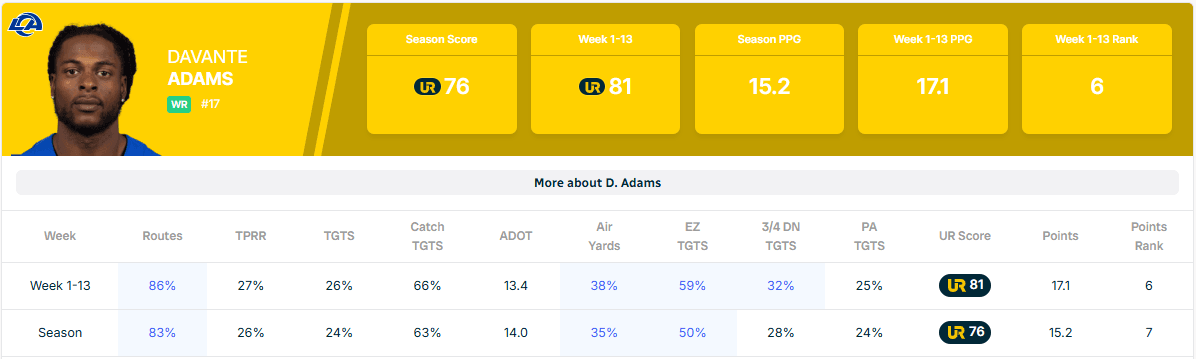
But he was highly TD-dependent. His 2.25 red-zone and 2.0 end-zone targets per game were elite, matching McVay's envisioned role. But his 57.4 YPG sat in mid-to-low-end WR3 territory.
Adams posted a career-high aDOT (13.6), which—paired with tight-window end-zone throws—resulted in a career-low 54% catch rate. He ranked 72nd in catchable target rate (65%), significantly depressing his YPG even while healthy. Theoretically, catch rate could improve if aDOT drops.
After his playoff return, Adams' role shifted. Route participation dipped from 86% to 80%, perhaps partly due to lingering hamstring issues. But the Rams also leaned into 13 personnel, where Adams registered 10% route participation versus 71% for Nacua.
Adams plays in an elite scheme with McVay and Stafford, making another boom season possible. The Rams project as my No. 2 passing offense (255 YPG) and No. 4 in offensive TDs (2.8).
But multiple paths to negative regression exist:
- Twilight age (see data under Evans above)
- Stafford TD regression
- End-zone target regression
- Less playing time due to 13 personnel
Additionally, the Rams pursued A.J. Brown this offseason and were prepared to move on from Adams. That doesn't mean they view Adams as bad—Brown is simply younger—but they don't see him as elite.
- Superpower: Generational WR with a prodigal schemer and a king-maker QB.
- Kryptonite: Clearly the No. 2 behind Nacua with multiple paths to negative regression.
Bottom Line: Adams is a borderline WR2 with low-end WR1 upside. He is a fade for me in Round 4 of drafts, but I'm willing to dabble in Round 5+.
 Terry McLaurin | Commanders
- Age: 31 (Post-Prime)
- Fantasy PPG (23-25): 12.3, 15.8, 11.4
- Receiving YPG: 58.9, 64.5, 58.2
McLaurin rewarded fantasy managers in 2024 with a 49% rostership rate on ESPN playoff rosters, finishing WR14 with Jayden Daniels fueling the offense. Injuries limited the duo to three games together in 2025, resulting in a WR32 finish.
McLaurin’s 2.24 YPRR ranked as high-end WR2 production, while his 0.44 fantasy points per route remained solid despite falling from 0.49. He also led Washington with a 23% TPRR.
Getting Daniels back is a huge lift for the offense, but McLaurin must now share targets with Stefon Diggs and Chig Okonkwo. He should remain Washington’s WR1, though he has never reached 16 PPG and has typically finished in WR3 territory.
- 2022: 13.5 PPG, 7.1 targets (23%), 4.5 receptions, 71.1 YPG, 0.29 TDs
- 2023: 12.3 PPG, 7.7 targets (22%), 4.7 receptions, 58.9 YPG, 0.24 TDs
- 2024: 15.8 PPG, 6.9 targets (23%), 4.8 receptions, 64.5 YPG, 0.76 TDs
Essentially, McLaurin has been the same WR, with 2024’s spike driven by touchdowns. Much of his value in 2026 could come down to a spike-TD season again. At 6'0", 210 pounds, he has the size to contribute in high-leverage scoring situations, but his track record has been sporadic.
- 2022: 0.65 RZ (WR4), 0.41 EZ (WR4)
- 2023: 0.47 RZ (WR5), 0.47 EZ (WR4)
- 2024: 0.82 RZ (WR3), 0.94 EZ (WR1)
If Daniels was the primary driver, that 2024 data point is good news. Daniels may have driven that surge, but it could prove an outlier. McLaurin’s other path is long touchdowns; his aDOT has typically exceeded 13 yards and was 13.3 with Daniels.
David Blough is installing a West Coast, wide-zone offense with more under-center snaps, motion and play action. The hope is to keep defenses guessing run vs pass and create more explosive plays. Under Kliff Kingsbury, Washington ranked 22nd in motion (46%) and fifth in play action (29%).
The Commanders project as my No. 24 passing unit (220 YPG) and 20th in offensive TDs (2.3).
McLaurin's median projection is similar to Evans and Adams. At age 31, he is younger, but his boom outcome isn't as high as Evans'.
- Superpower: Solid WR getting a boost from Daniels returning.
- Kryptonite: Aging WR who has never been an elite fantasy option with new target competition.
Bottom Line: McLaurin is a high-end WR3 with borderline WR1 upside.
 Mike Evans | 49ers
- Age: 33 (Twilight)
- Fantasy PPG (23-25): 16.6, 17.2, 10.6
- Receiving YPG: 73.8, 71.7, 46
Evans posted his lowest PPG of his career last season, battling hamstring, clavicle and concussion injuries across only eight games. He played over 70% of pass plays in seven contests and led the Buccaneers in every per-game metric:
- PPG: 12.1 (low-end WR3 territory)
- YPG: 52.3 (high-end WR4 territory)
- Receptions: 4.3 (low-end WR3 territory)
- Targets: 8.3 (mid-range to high-end WR2)
- Target Share: 27% (high-end WR1)
- Red zone: 1.14 (low-end WR1)
- End zone: 1.00 (high-end WR1)
Evans excelled in target departments, especially in the red zone/end zone. He remained versatile, posting 31% and 27% TPRR against man and zone.
But his 50.8% catch rate was a career low. His catchable target rates dropped from 73-74% in 2023-24 to 61% last season, cratering receptions, yards and PPG. Evans and Mayfield were rarely healthy together in 2025, a likely factor.
At age 33, Evans enters the twilight zone. Historical data on high-end WRs aged 32-35 (min. eight games) shows top age-32 performers regularly dip at 33.
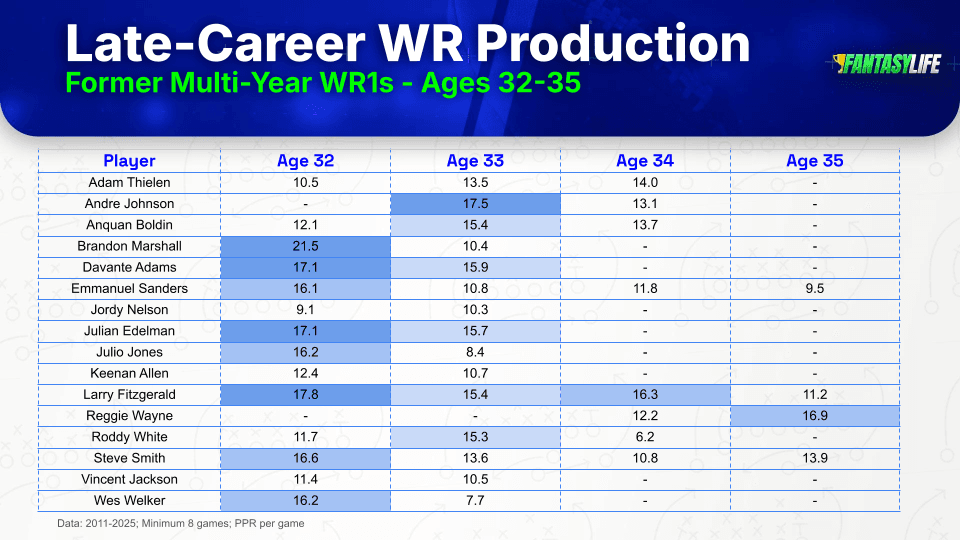
Takeaways:
- Only Andre Johnson delivered a 17+ PPG campaign. Adams, Edelman and Fitzgerald declined but remained borderline WR1 options. Marshall, Sanders, Jones and Welker hit cliff years.
- Struggling WRs rarely bounced back—Boldin and White did from 32-33, Reggie Wayne from 34-35 with Luck.
Despite the age concern, Evans is intriguing in San Francisco, potentially his best schematic fit yet.
As a man-beater, he should inherit the Brandon Aiyuk role, with Deebo Samuel and De'Zhaun Stribling working underneath in zone concepts. Expect more play action; motion usage is unclear, as Shanahan's X is typically stationary while Z and F move. Purdy will exploit pre-snap matchups.
Samuel isn't a spring chicken, Stribling is unproven, and Kittle returns from an Achilles at 33. There are many paths to a big role for Evans. The 49ers rank second in 2-WR sets (39%) over three years, funneling opportunities to WRs—Evans historically competed in 3-WR sets.
San Francisco projects as the No. 6 passing offense (241 YPG) and No. 5 scoring offense (2.8 TDs/contest)—bullish for the de facto red-zone option. Purdy has averaged 255 YPG over three seasons.
Note: The ADP on Evans is wide (Round 5 to Round 8) depending on site. Historically, we need 16-17.5 PPG to get league-winning WRs in those ranges.
Update (8/26): Evans used to sit at the top of this tier, but the injuries are becoming a concern. He picked up a quadriceps injury on Aug. 3 and returned on Aug. 11. Then he dealt with ankle and foot issues, missing more time. When he returned on Aug. 23, he suffered a groin injury and has missed practice since. I am not in full fade mode, but I have considered dropping him out of this tier completely.
- Superpower: One of the best WRs over the last 10 years in a strong scheme.
- Kryptonite: Father Time and the electrical substation can be real assholes.
Bottom Line: Evans is a mid-range WR2 with WR1 upside—a candidate to consolidate targets with massive TD potential. But the downside is massive; I am only targeting him after ADP now.
Chris Godwin | Buccaneers
- Age: 30 (Post-Prime)
- Fantasy PPG (23-25): 12.3, 19.7, 9.2
- Receiving YPG: 60.2, 82.3, 40
Godwin never got on track in 2025, recovering from a left ankle dislocation and fracture. But the season before, he boomed with 19.7 PPG in seven games before the injury. By the time Godwin was in a full-time role last year, Mayfield was also a shell of himself, battling a laundry list of injuries.
Godwin has three 17+ PPG seasons on his resume and nearly reached 16 in 2020 with 15.9. Moore reached 16+ PPG once. McLaurin has never reached 16+. This isn't to diminish Moore and McLaurin—they definitely had QB challenges—it is to point out that Godwin is good!
Reports from training camp are that Godwin looks more like his old self and will operate as a short-to-intermediate target, as the top option from the slot. He has been a favorite of Mayfield along with Egbuka in an offense that could consolidate strongly around the duo.
Tampa Bay switched play callers, moving on from Josh Grizzard for Zac Robinson. Robinson has reportedly retained successful plays from the 2024 scheme under Liam Coen. But the team will use more condensed formations and motion at the snap—a category Robinson ranked fourth during two years with Atlanta (61%).
Godwin figures to be one of the top motion players. He has a 2.27 YPRR with 0.53 fantasy points per route over the last three seasons when in motion. That is pretty pretty pretty good for his outlook. The Year 10 WR could see more work in the red zone and end zone—not historical calling cards for Godwin—with Evans gone.
Godwin is in his post-prime era, but checks several boxes that have unlocked surprise fantasy seasons:
- Coming off of an injury-limited season
- Target tree shakeup with Mike Evans gone
- QB coming off of an injury season
- Play-caller change
The Bucs project as my No. 15 passing offense (231 YPG) and 17th in offensive TDs (2.4).
Update (8/26): With Egbuka now battling turf toe, I am even more bullish on Godwin. But, unfortunately, the Egbuka injury has awoken the market. Godwin's ADP is climbing.
- Superpower: Multi-season 17+ PPG player with a healthy QB and Evans gone.
- Kryptonite: Must prove he is back from the 2024 injury that ruined 2025.
Bottom Line: Godwin is one of my most drafted WRs—he belongs in this tier yet goes ~30 spots later in drafts. He is a SMASH option in Rounds 7-8 of drafts.
Tier 7 Fantasy Football WRs for 2026
- Jameson Williams | Lions
- Rome Odunze | Bears
This group of WRs is in their prime with a clean path to ~90% route participation rates. While none have dominated their offense to this point, they have all flashed and offer big-play upside that could lead to a spike season or catapult them into fantasy stardom if more targets come their way.
Jameson Williams | Lions
- Age: 25 (Prime)
- Fantasy PPG (23-25): 6.7, 14.2, 12.9
- Receiving YPG: 29.5, 66.7, 65.7
Williams has settled into the WR2 role behind Amon-Ra St. Brown, averaging 13.5 PPG and 66.2 YPG over the last two years. However, he remains reliant on big plays.
- Receptions per game: 3.8 (mid-range WR4)
- Targets per game: 6 (mid-range WR4)
- Target share: 18% (mid-range WR4)
- TDs per game: 0.44 (mid-range WR2)
Still, he is in his prime—in a range where he could still ascend to new levels. Williams has the size and speed to boom with more opportunities. He scored 23+ points three times last year.
The biggest challenge: unlike many WR leaps we see in this range where a veteran option departs or ages out, Williams plays alongside three prime-age options with ARSB, Sam LaPorta and Jahmyr Gibbs.
Last season, Williams averaged 10.9 PPG with a 16% target share before the season-ending injury to LaPorta. There might not be a more crowded room in fantasy.
But the Lions' passing upside is undeniable. They have been one of the best over the last three years and project as my No. 2 passing offense (261 YPG) and No. 2 scoring offense (2.9 TDs per game).
If something happens to St. Brown, Williams would challenge for WR1 status. With St. Brown out in Week 13 last season, Williams exploded for 26.9 PPG.
- Superpower: Big-play threat in a top-three offense.
- Kryptonite: Extreme target competition with other prime options on his team.
Bottom Line: Williams is a boom-bust borderline WR2 who offers massive contingent upside should St. Brown miss time.
Rome Odunze | Bears
- Age: 24 (Prime)
- Fantasy PPG (24-25): 8.5, 12.2
- Receiving YPG: 43.2, 55.1
Odunze was breaking out with 15.5 PPG over the first eight games before he became a frequent flyer on the injury report in Week 9. His profile was strong:
- YPG: 67.6 (mid-range WR2)
- Targets per game: 8 (low-end WR1)
- Target share: 26% (mid-range WR1)
- Receptions per game: 4.4 (mid-range WR3)
- Red zone: 1.0 (borderline WR1)
- End zone: 0.7 (borderline WR1)
After the injury, route participation fell to 83%, target share dropped to 19%, and he averaged 7.2 PPG over the final seven games. He clearly wasn’t the same player, but he also returned to a different offense, with Colston Loveland and Burden taking bigger roles.
Odunze created panic when he discussed his foot stress fracture and “new normal.” He later said his foot feels amazing, but doubt remains. He is practicing without limitations and reportedly looking good at camp.
What if this breakout had arrived in the second half of Year 2, like Jaxon Smith-Njigba’s? The market would be more bullish. Instead, injury uncertainty is discounting a promising sample.
The ascending Bears have an elite play-caller, and as a Year 3 former Round 1 pick, Odunze should be a top option. I’m prioritizing Burden and Loveland, but Odunze could emerge as Chicago’s WR1.
- Superpower: Year 2 breakout was underway before injury.
- Kryptonite: Lingering foot concerns and target competition from Burden and Loveland.
Bottom Line: Odunze is a mid-range WR3 with low-end WR1 upside.
Tier 8 Fantasy Football WRs for 2026
- Carnell Tate | Titans
 Carnell Tate | Titans
- Age: 21 (Pre-Prime)
- Rookie Super Model Profile
Despite competing with Jeremiah Smith, Marvin Harrison Jr. and Emeka Egbuka at Ohio State, Tate's receiving yards per team pass attempt (RYPTPA) exceeded Round 1 picks in two of three seasons:
- Year 1: 0.79 (Round 1 WR average: 0.91)
- Year 2: 1.70 (Round 1 WR average: 1.98)
- Year 3: 2.74 (Round 1 WR average: 2.54)
Nerd Note: RYPTPA is the most predictive production metric for NFL success for WR prospects. It helps normalize varying styles of offenses (i.e., run-heavy vs pass-heavy).
The 21-year-old posted +0.56 RYPTPA over expected after adjusting for teammates, aligning with another recent Ohio State Round 1 pick in Egbuka (+0.46).
Tate's Rookie Super Model rating of 96 is a bit inflated due to the lack of high-end prospects at other positions in the NFL Draft, which pushed him up to pick 4.
He wasn’t an elite target earner (16%), but secured 69% of contested catches versus a 46% prospect average. His 130.6 QB rating when targeted ranked in the 79th percentile. That aligns with camp reports, where Tate has worked outside as a downfield threat. He could lead the Titans in TDs, but vertical roles rarely produce target volume, which is why I rank him below Tyson.
Tate will compete with Wan’Dale Robinson and Calvin Ridley, but still offers the most upside if integrated underneath. He’ll need Cam Ward to improve; Ward averaged 186 YPG as a rookie.
The Titans project 27th in passing (215 YPG) and 29th in scoring (1.9 TDs per game).
- Superpower: Above-the-rim virtuoso who could rack up TDs.
- Kryptonite: Ward must improve in Year 2, and Tate must be more than a vertical threat.
Bottom Line: Tate is a mid-range WR3 with mid-range WR2 upside as a Round 6 pick on most sites.
Tier 9 Fantasy Football WRs for 2026
- Brian Thomas | Jaguars
- Marvin Harrison | Cardinals
I don't have high confidence in Thomas or Harrison, but they are former Round 1 picks in their prime and have the size to be dominant.
Since 2016, we have seen eight Year 3 Round 1 or Round 2 NFL Draft picks go between picks 60-90 in fantasy drafts: Deebo Samuel, DeVante Parker, Jerry Jeudy, George Pickens, Jordan Matthews, Mike Williams, Rashee Rice and Zay Flowers.
Two outperformed their ADP by 7+ PPG: Samuel and Rice. But Rice was due to suspension. Both appeared on over 50% of league-winning rosters.
Flowers reached +2.0 PPG, but was not on over 45% of ESPN league-winning rosters.
Brian Thomas Jr. | Jaguars
- Age: 24 (Prime)
- Fantasy PPG (24-25): 16.7, 9.9
- Receiving YPG: 75.4, 50.5
BTJ was a colossal disappointment last year, finishing WR42 after costing drafters a Round 2-3 pick.
The challenge is Jacksonville’s suddenly crowded passing game and the possibility Thomas gets typecast as a downfield-only option, where targets can be scarce. Parker Washington and Jakobi Meyers are better fits for intermediate and underneath work, while Travis Hunter is reportedly preparing to contribute at X and F—the spots occupied by Thomas and Washington. That could squeeze Thomas’ routes.
Liam Coen is a plus schemer, using 52% motion over the last two seasons. His specialty has been elevating slot options: Chris Godwin averaged 19.7 PPG, while Washington posted 17.1 in healthy games after Hunter’s injury. Mike Evans owned a 19% target share and averaged 13.6 PPG before Godwin’s 2024 injury; afterward, those numbers spiked to 29% and 20.7.
Thomas was a Round 1 pick and ranks No. 24 among WRs in the Rookie Super Model, flashing in Year 1. But much of that production was backloaded after Christian Kirk and Evan Engram were injured, with Mac Jones throwing him the ball. Thomas averaged 22.6 PPG in Weeks 13-18, versus 11.5 before their injuries—closer to last season’s 9.9.
We still want to bet on a young player with Thomas’ profile, but he is difficult to flagplant amid this many variables. Even if another Jaguars WR goes down, Hunter likely absorbs a larger role, clouding the contingency upside.
Jacksonville remains an offense to target: my No. 9 projected passing unit (236 YPG) and No. 8 in total TDs (2.7 per game).
- Superpower: Prime WR with strong draft capital who flashed as a rookie in a strong offense.
- Kryptonite: Could be typecast as a deep-threat in a spread-out attack.
Bottom Line: Thomas is a mid-range WR3 with low-end WR1 upside, but his WR4-5 floor is real. This is a bet on age, NFL Draft Capital and a 2024 late-season flash.
 Marvin Harrison Jr. | Cardinals
- Age: 24 (Prime)
- Fantasy PPG (24-25): 11.6, 10.7
- Receiving YPG: 52.1, 50.7
Unlike Thomas, Harrison has not flashed in a significant way, even for a small stretch of time. But he grades out as one of the top three prospects in the history of the Rookie Super Model and is locked into an every-down role.
If we remove four games where Harrison played less than 70% of routes over the last two years due to injuries, his profile improves some, but still isn't great:
- PPG: 12.7 (mid-range WR3)
- YPG: 57.4 (mid-range WR3)
- Receptions per game: 3.9 (mid-range WR4)
- Targets per game: 7.3 (borderline WR2)
- Target share: 23% (mid-range WR2)
- TDs per game: 0.5 (mid-range WR2)
- RZ targets per game: 0.9 (mid-range WR1)
- EZ targets per game: 1.2 (high-end WR1)
Per-route data:
- YPRR: 1.62 (mid-range WR4)
- FDRR: 0.08 (low-end WR3)
- TPRR: 18% (low-end WR3)
Through two seasons, Harrison looks like a possession-style WR in the vein of a Courtland Sutton and Michael Pittman—a decent target-earner, but not a yardage maximizer. London is the ceiling case, but he had stronger per-route data. At 6'4", 220 pounds, Harrison has the size and RZ/EZ profile to make TD noise in a strong offense.
But that is the rub. The Cardinals project as the No. 23 passing unit (222 YPG) and the No. 27 scoring offense (2.0 TDs per game). And sharing isn't ideal, especially if Michael Wilson's late-season emergence translates into more targets in 2026.
There is a chance we get more offensive efficiency—Mike LaFleur has strong scheme pedigree, spending time under Shanahan and most recently with McVay the last two years:
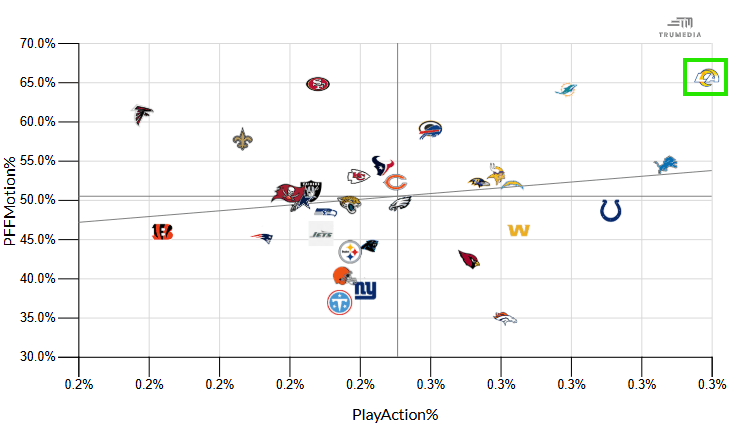
But Petzing was an underrated play caller last season for Arizona, using plenty of play action and 2-WR sets.
LaFleur could alter Harrison’s route tree and alignments. But when discussing roles, he referenced Nacua and Robert Woods for Wilson—suggesting Z/slot usage.
That matters: Z/slot receivers historically receive the most motion in the McVay scheme. Among WRs with 500-plus routes over three years, Nacua ranks eighth (23%). Adams was under 1% last year, which is a stylistic fit for Harrison. That returns us to a possession-style WR with red-zone chops in a questionable offense.
- Superpower: High-end prospect slated for a full-time role entering Year 3.
- Kryptonite: Looks more like a TD-dependent possession option in a questionable offense.
Bottom Line: Harrison is a pure bet on his prospect profile and age. He is a mid-range WR3 with WR2 upside.
Tier 10 Fantasy Football WRs for 2026
- Makai Lemon | Eagles
- De'Zhaun Stribling | 49ers
- KC Concepcion | Browns
- Jayden Reed | Packers
- Josh Downs | Colts
- Quentin Johnston | Chargers
—
- Jordan Addison | Vikings
- Michael Wilson | Cardinals
- Matthew Golden | Packers
- Alec Pierce | Colts
This tier splits into two buckets. The first offers talent and/or draft capital but uncertain playing time—some could clear 85% route participation and boom, while others may fall below 75% and disappoint.
The second offers more secure roles and has flashed PPG upside, but Wilson’s profile is tricky and Addison faces stiff target competition.
Makai Lemon | Eagles
- Age: 22 (Pre-Prime)
- Rookie Super Model Profile
The Eagles selected Lemon with the No. 12 pick in Round 1, hoping he can help offset A.J. Brown’s departure in a new-look offense under Mannion.
The 5'11", 192-pound WR did not break out until his third USC season after Zachariah Branch transferred to Georgia. But he was electric: 96 YPG, 11 TDs, and a dominant 28% target share. Despite more rotation in his first two years, his underlying YPRR (29%) was strong and closely mirrored Tyson’s (31%).
Lemon’s college home base was the slot (74%), where he thrived near the line of scrimmage and on short targets. He was a menace after the catch, posting 6.6 YAC—+1.4 yards over expected after adjusting for aDOT.
But he was not merely a low-aDOT merchant. Lemon earned 23% of his targets 20+ yards downfield, slightly above average for prospects since 2018, and secured 57% of contested-catch opportunities.
His closest comparisons in the Rookie Super Model: Smith-Njigba, Egbuka and Flowers.
Dealing with a hamstring injury is not ideal for a rookie learning a new offense, but Lemon opened camp with the starters as the WR2. Mannion has a heavy-motion pedigree (54%) and reportedly views Lemon as a movable chess piece, which early camp usage supported.
In this range of the draft, age 21-23 players have outperformed ADP by 4+ PPG most often at 20%. This is where we often find young options where the market's concerns around something like slot limitations can leave the door open for us to add upside to our roster.
Philadelphia’s passing attack has been lackluster over the last two years, but Mannion should bring more scheme boosters in 2026, particularly with an emphasis on attacking the middle of the field—where Lemon excels.
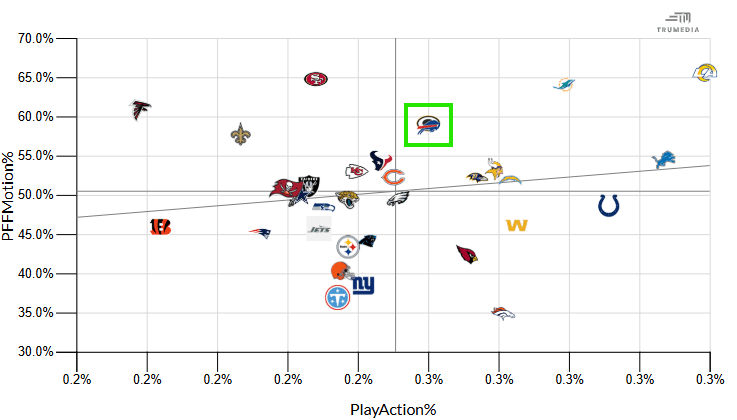
Lemon’s median projection is capped by an Eagles offense projected No. 28 in passing (218 YPG). Still, there is upside if Mannion succeeds, and Philadelphia projects as my No. 10 scoring offense (2.6 TDs per game).
- Superpower: Round 1 YAC maestro who can attack multiple field layers. Complements Smith's game well.
- Kryptonite: Must avoid a slot-only role in a questionable passing offense with target competition.
Bottom Line: Lemon is a borderline WR3 with WR2 upside. He is a strong Round 8-9 target and is a SMASH on ESPN, Yahoo and FFPC.
De'Zhaun Stribling | 49ers
- Age: 23 (Pre-Prime)
- Rookie Super Model Profile
The Rookie Super Model (76 rating) viewed Stribling as a reach at No. 33 overall. He earned early playing time in college but never turned average production into great production.
A Year 5 prospect, Stribling peaked in Year 4 before regressing at Ole Miss in Year 5. He missed most of Year 3 with a hand injury, and his adjusted career RYPTPA ranked in the 39th percentile.
The Super Model’s bust-identification track record is strong, and Stribling joins this group:
- Xavier Legette: Bust
- Jonathan Mingo: Bust
- Tyquan Thornton: Bust
- Tutu Atwell: Bust
- Van Jefferson: Bust
- Ja'Lynn Polk: Bust
- Denzel Boston: TBD
- Kadarius Toney: Bust
- Jack Bech: TBD
- Rashee Rice: Hit
Still, Stribling landed in an ideal spot to unlock his potential. The 6'2", 207-pound WR ran a 4.36 40-yard dash, matching his collegiate calling card: YAC.
His YAC was +1 yard over expected after adjusting for aDOT. Notably, Rice—the lone hit above—broke out as a low-aDOT YAC option with Kansas City.
Kyle Shanahan is an ideal schemer for that archetype, feeding YAC mavens underneath against zone and moving Stribling around to manufacture matchups and space.
Ricky Pearsall’s season-ending injury boosts Stribling, who currently sits behind Deebo Samuel (30) and Christian Kirk (29). After early hamstring tightness, he has worked with the first team since returning.
Patience may be required if Stribling opens in a part-time role. But San Francisco is aging—Mike Evans (33), George Kittle (33) and Christian McCaffrey (30)—giving him meaningful contingency upside in a great scheme with a good QB.
Update (8/26): Stribling looks at home in Shanahan's offense and could be the next WR to defy the Rookie Super Model. He is playing from the slot and moving all over the place, and earning massive targets. With an aging skill-position group, my money is on Stribling making a MASSIVE fantasy impact at some point this season. Throw caution to the wind—he catapults names like Reed and Downs in this tier for me.
- Superpower: YAC monster in a YAC-friendly scheme with aging veteran WRs.
- Kryptonite: Super Model bust alert.
Bottom Line: Stribling is a PRIORITY UPSIDE TARGET in Rounds 7-9 depending on site.
 KC Concepcion | Browns
- Age: 21 (Pre-Prime)
- Rookie Super Model Profile
The Browns selected Concepcion with the No. 24 pick in Round 1. The 6'0", 196-pound WR posted a 29% target share at NC State as a freshman, recording the eighth-best Year 1 receiving yards per team pass attempt (RYPTPA) in Rookie Super Model history.
For most of his career, Concepcion did damage near the line of scrimmage:
- Behind the Line of Scrimmage Target: 21% (+7 vs average prospect)
- Short (0-9): 42% (+6)
- Medium (10-19): 21% (-5)
- Deep (20+): 16% (-6)
But he showed another gear after transferring to Texas A&M. His aDOT jumped from 6.9 to 12.2 yards, and after aligning wide only 4% and 15% of the time at NC State, he did so 65% of the time at TAMU. The former three-star recruit averaged 70.6 YPG and scored nine TDs against SEC competition.
Concepcion is a multifaceted talent. His 6.6 YAC was 1.6 yards over expected based on a 9.3 aDOT, and his ball-in-hand ability translated to rushing and special teams:
- Rushing: 432 yards, 3 TDs
- Punt Returns: 505 yards, 2 TDs
His top Rookie Super Model (82 rating) comps are Brandon Aiyuk and Luther Burden.
When I wrote Concepcion’s prospect profile in March, I highlighted his fit in a Shanahan-style scheme capable of maximizing every part of his game. He did not land with Shanahan, but Todd Monken is a cheat-code dialer.
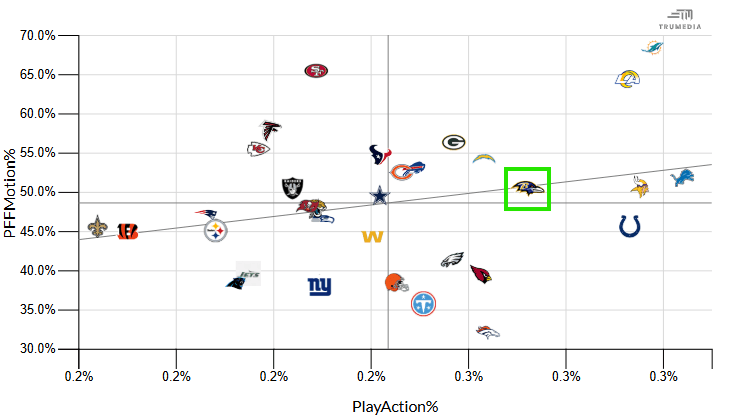
Monken plans to use Concepcion similarly to Zay Flowers, who ranked fifth in motion at the snap (24%) across two seasons under Monken.
There are three things that create question marks around Concepcion: 1) playing time, 2) target competition and 3) QB concerns.
Three concerns remain: playing time, target competition and QB play. The Browns’ best lineup is likely three WRs, but Monken ranks first in 2-WR usage over the last two seasons (43%). Cleveland reinforced that plan by drafting TEs Joe Royer and Carsen Ryan, signing Jack Stoll and adding FB Michael Burton. With Denzel Boston and Jerry Jeudy also present, Concepcion must earn at least a rotational role in 2-WR sets.
Harold Fannin Jr. is the de facto No. 1 target after a mind-boggling 25% target share as a rookie. Concepcion must win over his QB versus Jeudy and Boston. That could mean a slow start, but a non-contending Browns team could give him more Z-route work as the season progresses.
With Shedeur Sanders and Deshaun Watson battling for the job, passing volume is difficult to project. Cleveland is my No. 30 passing offense (206 YPG) and No. 31 scoring unit (1.8 TDs).
Update (8/26): The Browns are using Concepcion as promised. He could be the straw that stirs the drink in this passing attack thanks to favorable alignments, motion and heavy personnel. Concepcion has balled out in the preseason games and joint practices. Like Stribling, Concepcion is climbing in this tier.
- Superpower: Versatile Round 1 pick in a fantastic scheme fit.
- Kryptonite: Battle for routes in a low-expectation passing offense.
Bottom Line: Concepcion is a PRIORITY UPSIDE TARGET in Rounds 8-10 depending on site.
Jayden Reed | Packers
- Age: 26 (Prime)
- Fantasy PPG (23-25): 13.6, 11.6, 6.9
- Receiving YPG: 49.6, 50.4, 29.6
Reed is a near lock for more playing time with Doubs and Wicks gone. The key question is whether he can secure the WR2 role in 2-WR sets. He profiles as the starting F/slot option, with Golden at X, but camp reports have both WRs working in two-receiver personnel.
The 5'11", 187-pound WR has a strong underlying profile:
- Routes: 65% (low-end WR4)
- TPRR: 22% (WR2)
- YPRR: 2.10 (low-end WR1)
That is juicy. Reed hasn't been a highly utilized player in the red- and end-zone (0.68 and 0.33) but has just enough size to improve. Still, most of his high-end comps posted outlier WR1 seasons, rather than becoming mainstays. And much of that comes back to TD spike seasons. If we were certain about a full complement of snaps, Reed would be in Tier 5B alongside names like Flowers and Waddle.
Matt LaFleur’s scheme is favorable. Reed has been in motion on 29% of snaps, first among WRs over the last three years, and unlike many slot options, he sees a healthy 21% play-action target rate.
With Luke Musgrave on the active/PUP list due to a neck injury, we could see more 3-WR sets. When evaluating the impact of 2-WR sets on WR efficiency, the one with the lowest boost is 12-personnel.
WR fantasy points per route by personnel 2023-2025 (minimum 250 routes):
- 11 personnel: 0.31
- 21 personnel: 0.42 (+35% vs 11)
- 22 personnel: 0.58 (+87%)
- 12 personnel: 0.40 (+29%)
Ultimately, this hinges on Golden. If he rebounds, more 11 personnel is less helpful to Reed on a per-route basis. If not, Golden versus another TE could be close to a wash. I lean toward Golden being better than Musgrave or his backups.
The Packers project as my No. 12 passing offense (233 YPG) and No. 9 in TDs (2.6).
- Superpower: Strong part-time talent in prime with path to more playing time in a good offense.
- Kryptonite: Golden and two-TE sets could still limit Reed's playing time.
Bottom Line: Reed is a strong bet to pay off as the WR46 in drafts, offering WR2 upside. His 111 consensus ADP makes him a PRIORITY TARGET on most sites.
 Josh Downs | Colts
- Age: 25 (Prime)
- Fantasy PPG (23-25): 9.2, 13.1, 8.5
- Receiving YPG: 45.4, 57.4, 35.4
Downs is a straightforward proposition. He has posted solid underlying data in a part-time role and has a path to a full-time role, including 2-WR sets, per camp reports, with Michael Pittman traded.
2023-2025 underlying data:
- Routes: 68% (low-end WR4 territory)
- TPRR: 24% (borderline WR1)
- YPRR: 1.75 (mid-range WR3)
Last season, Downs battled a Grade 1 hamstring strain he picked up in training camp. The prior season, he notched a 29% TPRR and 2.21 YPRR (WR1 territory). When Downs has been on the field without Pittman, he has a 30% target share with a 1.83 YPRR for his career.
Downs has averaged 12.6 PPG in 16 games with an 80%+ route participation, with 58 YPG and 0.31 TDs per game. He has not been a highly utilized red-zone or end-zone option.
- RZ targets per game: 0.37 (WR5-6 territory)
- EZ targets per game: 0.74 (low-end WR4)
The 5'9", 171-pound WR doesn't offer the stature to expect consistent high-end TD production, but offers spike-season upside. And Shane Steichen knows how to get the most out of Downs, who ranks fifth in motion at the snap (24%) among WRs with at least 500 routes over the last three years. Steichen ranks fourth in play action (29%) over that span.
Downs will battle Tyler Warren and Alec Pierce for targets with Daniel Jones, who averaged 253 YPG in 12 healthy games last year. I am projecting passing-game regression given Jones' volatile history with 228 YPG (18th) and 2.5 TDs per game (13th). But Jones could beat the passing yardage projection in Steichen's scheme.
Update (8/26): The Colts added Keenan Allen. While reports still indicate that Downs will remain on the field in 2-WR sets, we have slightly less certainty. That makes him similar to Stribling and Concepcion, but I prefer their talent profiles and size slightly more than Downs. He is still a great pick in this range.
- Superpower: Solid TPRR player in his prime with a path to a full-time role.
- Kryptonite: Can Jones repeat 2025? Will Allen create a rotation?
Bottom Line: Downs is a high-end WR4 with WR2 upside if he can reach an 85% route share.
Quentin Johnston | Chargers
- Age: 25 (Prime)
- Fantasy PPG (23-25): 5.5, 11.7, 12.2
- Receiving YPG: 25.4, 47.4, 52.5
Johnston has not met Round 1 expectations, but he has improved in PPG and YPG each season. As a starter over the last two years, his profile largely matches WR4 production:
- YPG: 49.9 (mid-range WR4)
- Receptions: 3.7 (mid-range WR4)
- Targets: 6 (mid-range WR4)
- Target share: 17% (mid-range WR4)
- RZ targets: 0.90 (mid-range WR2)
- EZ targets: 0.62 (WR2)
- YPRR: 1.63 (mid-range WR4)
- TPRR: 19% (mid-range WR4)
The Chargers’ offensive line has had issues, but these numbers remain underwhelming considering Johnston’s draft capital and Justin Herbert. The exception is his high-leverage usage: the 6'2", 208-pounder has operated in WR2 territory in the red and end zones.
The bet is McDaniel, a cheat-code savant over the last three seasons:
- Play Action: 30% (2nd)
- Motion at Snap: 68% (1st)
- 2-WR Sets: 39% (3rd)
Johnston will play X, where McDaniel will look to accentuate his best collegiate trait: YAC. Expect more timing routes and quicker throws. The question is motion. Tyreek Hill was in motion 19% from 2022-24, while Waddle was at only 4%. Based on camp reports, I expect McConkey to be the primary motion option.
That does not mean Johnston cannot benefit from the scheme, but motion at the snap is McDaniel’s biggest cheat code. Heavy 2-WR usage could boost efficiency, though fewer 3-WR sets could suppress Johnston’s route participation—something we saw with Hill and Waddle.
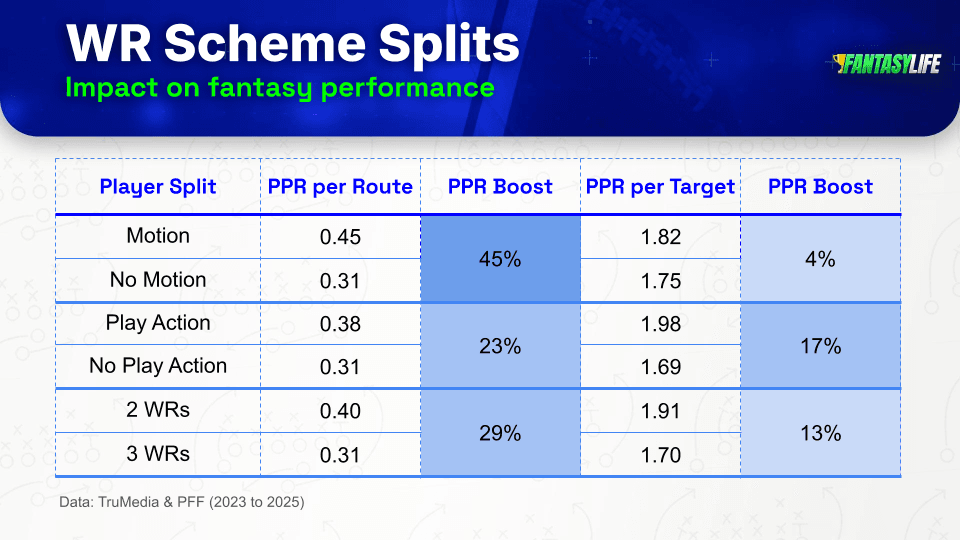
Tre Harris, last year’s Round 2 pick, is pushing for a role and brings blocking prowess, potentially earning heavy-personnel reps. Rookie Brenen Thompson should play as a field stretcher.
Charlie Kolar projects as the primary 21-personnel TE, which could push McDaniel to get creative with Oronde Gadsden, including potential work outside.
- Superpower: High-upside offense that could maximize his YAC + solid TD profile + prime.
- Kryptonite: Has been a WR4 to this point and playing time could get squeezed.
Bottom Line: Johnston is a WR4 option who goes after pick 100 on most sites. He offers TD-spike potential and WR2 upside if he runs hot.
Jordan Addison | Vikings
- Age: 24 (Prime)
- Fantasy PPG (23-25): 13, 14.2, 9.7
- Receiving YPG: 53.6, 58.3, 43.6
Addison posted WR2 fantasy finishes in his first two years before the Vikings’ passing-game implosion, when McCarthy cratered the offense last season. Still, his underlying profile more closely resembled a WR3:
- YPG: 55.8 (mid-range WR3)
- Receptions: 4.2 (low-end WR3)
- Targets: 6.5 (borderline WR3)
- Target share: 18% (mid-range WR4)
- TDs: 0.59 (mid-range WR1)
- RZ: 1.0 (borderline WR1)
- EZ: 0.78 (low-end WR1)
- YPRR: 1.61 (mid-range WR4)
Historically, WRs averaging 50-60 YPG score 0.34 TDs per game, making Addison a potential TD-regression candidate even if the offense rebounds. However, he has been highly active in scoring areas. The 5'11", 179-pounder has scored 14 of 22 career TDs in the red zone and added seven scores of 35+ yards.
Addison has been a downfield option with a 13.0-yard aDOT, but he has the wiggle to work every layer. He leads the Vikings in go routes (18%) while also seeing similar in-breaking usage to Jefferson: crossing (12% versus 12%), in (17% versus 18%) and slant (1% versus 3%).
It is difficult to evaluate teammates of alpha WRs like Jefferson. Addison’s target-earning and per-route data likely undersell a Round 1 talent who is probably closer to a WR2. We saw that as a rookie, when he averaged 14.7 PPG and 62 YPG in seven games without Jefferson.
If Kyler Murray wins the starting job, the offense should improve. O’Connell is sharp, and Minnesota’s passing output was much better in 2023-24:
- 2023: 276 YPG (1st), 1.8 TDs (4th)
- 2024: 258 (5th), 2.1 (5th)
- 2025: 189 (30th), 1.1 (29th)
O'Connell cheat-codes 24-25:
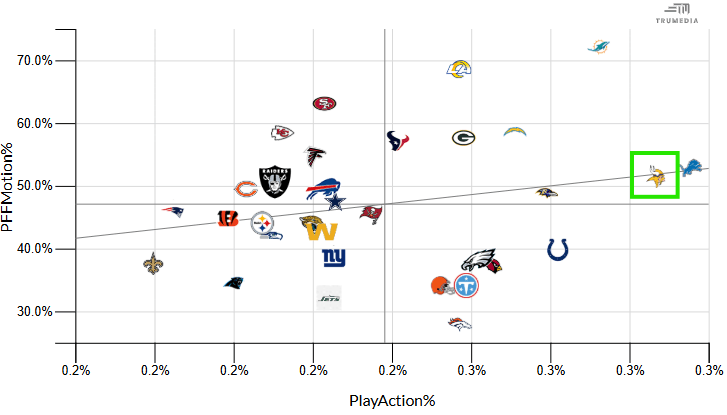
Murray is not elite, but with O’Connell, the Vikings should at least be average with upside. Addison resembles Tier 5B and Tier 7 options and is in his prime—he could take volume from Jauan Jennings and T.J. Hockenson.
- Superpower: Prime-age big-play magnet in a great scheme with a potential QB upgrade.
- Kryptonite: Jefferson is a volume vacuum, and there is some risk of McCarthy playing.
Bottom Line: Addison is a mid-range WR4 with WR2 upside. His contingency value is borderline WR1 territory.
Michael Wilson | Cardinals
- Age: 26 (Prime)
- Fantasy PPG (23-25): 8.8, 7.8, 13
- Receiving YPG: 43.5, 34.3, 59.2
Wilson went bonkers after Marvin Harrison's injury opened more playing time. From Weeks 10-18, he averaged 19.7 PPG (WR4) across nine contests, with an elite 92 Utilization Score and 27% target share.
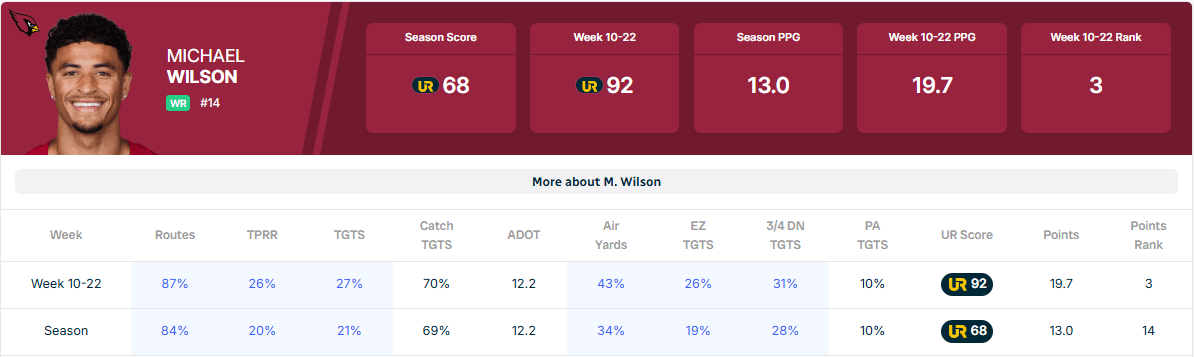
Over that span, Wilson averaged 90 YPG, 6.7 receptions, and 10.6 targets. He also dominated high-leverage usage, seeing 1.3 red-zone and 1.0 end-zone targets per game.
Arizona should trail often in 2026, creating passing volume. But Mike LaFleur added Jeremiyah Love and Tyler Allgeier, and is a balanced play-caller, so I expect less passing. The upshot: LaFleur has cast Wilson as the Z/slot, running routes similar to Puka Nacua.
That matters. Z/slot WRs historically receive the most motion in the McVay scheme; among WRs with 500-plus routes over the last three years, Nacua ranks eighth at 23%. Wilson is not Nacua, but he should see plenty of pre-snap motion and mismatch-friendly alignments.
The concern is that his second-half breakout was a mirage. The historical comps have a low follow-year hit rate (see the Parker Washington list above). And when Harrison was active last year, Wilson was abysmal:
- TPRR: 12%
- YPRR: 0.85
Those marks are so low they do not appear in my reference database, which charts through WR8 territory.
Wilson faces less playing-time competition than Washington in Jacksonville, but Trey McBride is a target hog, and Arizona’s upside is limited by QB uncertainty. The Cardinals project as my No. 23 passing offense (222 YPG) and No. 27 scoring offense (2 TDs per game).
Update (8/26): Preseason data and camp reports align with Wilson as the moveable chess piece in the Cardinals offense. He lands in this tier, but is one spot ahead of Harrison in my ranks (remember intro: tiers and ranks are slightly different exercises).
- Superpower: Flashed last season and the favorite to play the Z-slot roles in a friendly scheme.
- Kryptonite: Was not good his first 2.5 years + QB questions + target hog in McBride.
Bottom Line: Wilson's talent profile isn't great, but he is in the role that will manufacture easy looks in this scheme. He is a boom-bust WR4 option.
Matthew Golden | Packers
- Age: 23 (Early Prime)
- Fantasy PPG (25): 5
- Receiving YPG: 25.8
Golden bombed his Year 1 exam, failing to capitalize on a perfect early-season situation with Watson and Reed injured. However, Golden battled injuries of his own: ankle, hip, shoulder and wrist.
In nine games where he was not listed on the injury report, Golden averaged 8.3 PPG and 42 YPG. Those numbers are not great, but they place the 5'11", 191-pound speedster in a range where we have seen Year 2 hits.
Among 17 Round 1 or 2 WRs who averaged 7-9 PPG as rookies, PPG increased 20%, from 8.0 to 10.0, in Year 2. Several posted major jumps (2011-2025):
- Jaxon Smith-Njigba: 8.8 → 14.8 (Tyler Lockett faded)
- Rome Odunze: 8.6 → 12.2 (Keenan Allen left)
- Courtland Sutton: 8.5 → 13.8 (Demaryius Thomas traded)
- Alshon Jeffery: 7.9 → 17.7 (Marc Trestman implemented a pass-heavy offense)
- Michael Pittman: 7.6 → 13.9
- Michael Floyd: 7.1 → 12.4 (Bruce Arians hired as HC)
The 2025 Round 1 pick again has a massive 2026 opportunity with Doubs and Wicks gone. Golden will occupy the X role Doubs held last year, making increased playing time a near lock.
The unknown is whether Golden or Reed plays more in 2-WR sets. Both have worked with the starters in those looks, while Luke Musgrave’s neck injury could force more 3-WR personnel.
We could also see more 3-WR sets with Musgrave dealing with a neck injury.
In a plus scheme with Matt LaFleur, and a strong QB in Jordan Love—whom Golden is building strong chemistry with—the ingredients are present for a significant Year 2 jump.
Update (8/26): While Watson is getting the schemed-up looks, Golden is on track for a full-time role in Year 2. He has played the most snaps with the starters and looks better than his target share in the preseason. He moves up from Tier 12 to Tier 10.
- Superpower: Year 2 Round 1 pick + clear runway to increased playing time + good scheme + quality QB.
- Kryptonite: Multiple weapons to battle for targets.
Bottom Line: Golden is in line for a ton of playing time in a great scheme. He is an upside WR4 click in drafts.
Alec Pierce | Colts
- Age: 26 (Prime)
- Fantasy PPG (23-25): 5.6, 10.1, 12.2
- Receiving YPG: 30.2, 51.5, 66.9
Pierce has improved in PPG and YPG every season, earning a four-year, $114M extension. And the Colts traded Michael Pittman to the Steelers.
Historically, Pierce has not been a high-end target earner. His 18.7-yard aDOT ranks first among WRs with 500+ routes over the last three seasons. He and Christian Watson (17.0) have been the most productive players in that group, but high-aDOT options often struggle to secure the target volume needed to break fantasy leagues.
We saw that in Pierce's career year in 2025:
- Targets: 5.6 (low-end WR4)
- Receptions: 3.1 (low-end WR5)
- TPRR: 19% (mid-range WR4)
His 66.9 YPG was mid-range WR2 material, but consistently living on long plays is difficult due to highly volatile catch rates.
Reports indicate Indianapolis wants to diversify Pierce’s route tree after he ranked 12th in go routes (23%) over the last two years. He has flashed on crossers (13%) and in routes (17%), leaving room to grow. The Colts have 114 million reasons to make it happen, but it remains a major projection.
Since 2011, 24 WRs have posted 9.0+ PPG with a 16+ aDOT and sub-20% TPRR. Only two of them transformed into WR2s or better the following season: Vincent Jackson (14.3 → 16.2 PPG) and John Brown (9.0 → 14.3 PPG).
Jackson had already shown a ceiling, but both players also changed offensive environments: Jackson from the Chargers to the Bucs and Brown from the Cardinals to the Bills. Pierce isn't changing teams, but Pittman is gone.
Mike Williams is not on the list, but he underwent a dramatic 2020-21 role change under Joe Lombardi, with his aDOT dropping from 15.8 to 12.0:
- PPG: 10.2 → 15.4
- Targets: 5.4 → 7.6
- Receptions: 3.2 → 4.8
- RZ targets: 0.67 → 1.19
- EZ targets: 0.80 → 0.88
Williams was a better prospect, but his prior highs—11.3 PPG and 17% TPRR—were similar. As Lloyd Christmas would say, SO YOU'RE TELLING ME THERE'S A CHANCE.
At 6'3", 211 pounds, Pierce has red-zone potential, yet his 0.45 RZ and 0.58 EZ targets over two years sit in WR7 and WR4 territory. With Pittman gone, Pierce and Tyler Warren could absorb scoring opportunities, but he must prove capable.
His PUP status in camp, following offseason ankle surgery, costs him critical reps for a new role.
Steichen is a plus coordinator, and Pierce has thrived on play action: 2.39 YPRR and 21% TPRR over two years (21.8 aDOT). Those looks should remain in a balanced attack.
Update (8/26): Pierce is on track to return to practice soon, and the odds are improving that he will be ready for Week 1. He moves back into Tier 10, but with Allen on the team, he could be relegated back to his deep role. Playing a more integrated role is part of the hypothesis of his upside, which is shakier now with so many high-quality underneath and intermediate options on the team. His best way to help the team might be stretching the field.
- Superpower: Deep-ball king in a strong scheme with Pittman gone. Locked into routes.
- Kryptonite: High-end targets have been elusive and recovering from offseason ankle surgery.
Bottom Line: Pierce is a boom-bust WR4 with WR2 upside if his role expands.
Tier 11 Fantasy Football WRs for 2026
- Stefon Diggs | Commanders
- DK Metcalf | Steelers
- Courtland Sutton | Broncos
- Michael Pittman | Steelers
- Jakobi Meyers | Jaguars
This is our second unc tier, featuring players aged 29-33. Their strong median projections make them viable best-ball fits, but less compelling in managed leagues, where league-winning ceilings matter more. But they can stabilize early-season lineups.
Nerd Note: Older WRs can beat ADP: 15% of age-32-33 WRs outperformed ADP by 4+ PPG, versus 10% of prime-age (24-27) WRs. At this career stage, established talent makes favorable offensive changes especially important.
This specific group faces more target competition than last year, and/or now play in a worse passing offense. Thus, I prefer the prime options in Tier 10, where most have a new path to upside.
Stefon Diggs | Commanders
- Age: 33 (Twilight)
- Fantasy PPG (23-25): 16.1, 15.2, 12.4
- Receiving YPG: 69.6, 62, 59.6
If there is one player I could be wrong about in this tier, it is Diggs. He has a path to a full-time role in Washington after New England limited him to a 73% route participation rate last season. He could be an arbitrage play on the Evans/Adams tier.
Diggs’ underlying 2025 data remained strong:
- YPRR: 2.42 (mid-range WR1)
- TPRR: 24% (low-end WR1)
In Washington, Diggs will work inside and from the slot, using his veteran savvy on option routes. Over the last two seasons, his game has evolved toward a shorter-area role. His aDOT has declined: 11.2 → 10.4 → 8.7 → 8.5. His TD rate has also fallen: 0.69 → 0.47 → 0.38 → 0.24.
At this point, Diggs is an underneath, possession-style WR—not the multi-level threat he was in his prime. Still, targets are available behind Terry McLaurin, and Jayden Daniels returns under center in David Blough’s new scheme. Blough plans to use more motion and play action, which I buy given his time under Ben Johnson and Kevin O’Connell as a QB.
I did not move Diggs higher because, despite liking Washington’s offense, he is almost certainly due for a major decline in team passing yards. New England ranked No. 4 with 262 YPG last year. Washington projects as my No. 24 passing offense (220 YPG) and ranks 20th in offensive TDs per game (2.3).
I project Diggs for an 83% route participation rate and 22% TPRR, making him a mid-range WR4. At 90% and 23%, he would rise to a mid-range WR3—not far behind Evans and Adams.
Zain Dhanani is the bullish voice on our rankings team, projecting Diggs as a mid-range WR3. He also knows a thing or two about WRs and stays on top of the latest camp news, y'all!
- Superpower: Former 20+ PPG player with strong underlying data despite age.
- Kryptonite: Father time is undefeated + likely downturn in passing YPG vs. 2025.
Bottom Line: Diggs projects as a mid-range WR4 and ranks similarly. Of this tier, he is the one where situation change has the best *chance* to catapult him higher.
 DK Metcalf | Steelers
- Age: 29 (Late Prime)
- Fantasy PPG (23-25): 14.1, 12.8, 12.5
- Receiving YPG: 69.6, 66.1, 56.7
Last season, Metcalf had a prime opportunity to dominate: the receiving corps behind him was lackluster, and Pittsburgh used the seventh-most 2-WR sets (34%). Yet he underperformed his ADP (49) by 1.6 PPG.
Metcalf has only one 17+ PPG finish (Year 2) and has settled into mid-range WR3 territory over the last two years. Now Pittman and rookie Germie Bernard raise the target competition, while Aaron Rodgers remains at QB.
Mike McCarthy, historically a 3-WR proponent, takes over as play caller. Metcalf has the size and athleticism for a spike season, but his path is tougher than last year. In 2-WR sets, he will share the field with two TEs: Pat Freiermuth and Darnell Washington ($42M extension). Connor Heyward is gone, with Round 5 pick, Riley Nowakowski, slotted at fullback.
McCarthy was not an average cheat-code spammer during his final three years in Dallas.
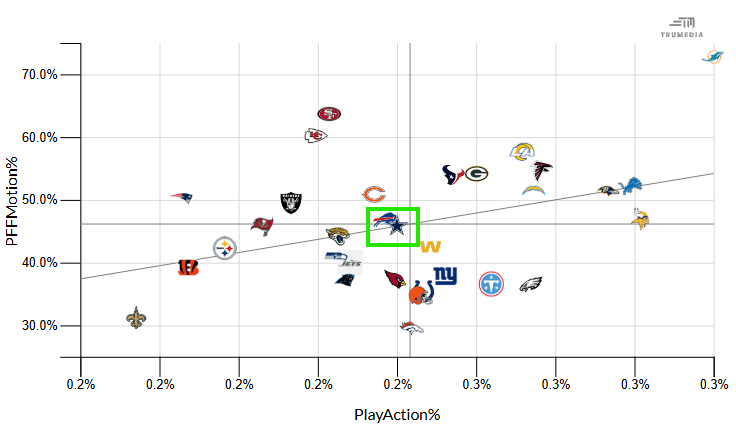
The Steelers project as my No. 20 passing unit (226 YPG) and the No. 24 scoring offense (2.2 TDs).
- Superpower: Size-speed freak with big-play potential locked into full-time role.
- Kryptonite: Only one smash season + crowded offense + below-average pass game.
Bottom Line: Metcalf projects as a mid-range WR3, but is a high-end WR4 in my ranks. He is fine in best ball, but it's hard to see him smashing fantasy leagues in 2026.
Courtland Sutton | Broncos
- Age: 31 (Post-Prime)
- Fantasy PPG (23-25): 11.9, 14.1, 12.9
- Receiving YPG: 48.3, 63.6, 59.8
Sutton has never posted a 17+ PPG season. In two seasons with Bo Nix, he has been a WR2/WR3 fantasy option—a downfield possession receiver who earns his money in the red zone and end zone.
- PPG: 13.5 (low-end WR2)
- YPG: 61.7 (high-end WR3)
- Receptions: 4.6 (high-end WR3)
- Targets: 7.6 (mid-range WR2)
- RZ targets: 1.12 (low-end WR1)
- EZ targets: 0.91 (mid-range WR1)
With Waddle joining the offense, Sutton’s volume could take a hit. Year 2 WR Pat Bryant could also challenge for playing time in 2026.
- Superpower: TD-spike potential.
- Kryptonite: Not a yardage maximizer and now faces more target competition with Waddle.
Bottom Line: Sutton projects a mid-range WR3 but is a low-end WR4 in my ranks.
Michael Pittman Jr. | Steelers
- Age: 29 (Late Prime)
- Fantasy PPG (23-25): 15.6, 10.4, 11.9
- Receiving YPG: 72, 50.5, 46.1
Pittman’s production withered amid increased target competition and injuries over the last two seasons. A trade sends him to Pittsburgh, but he joins Metcalf and an aging Aaron Rodgers.
The 6'4", 233-pound receiver works underneath and intermediate areas, potentially making him a Rodgers favorite. Over the last two years, Pittman has posted a 9.6-yard aDOT and 22% TPRR (mid-range WR2).
He has never been a high-end TD scorer, but his size offers scoring-position appeal. He has been strong in the red zone but less effective as an end-zone target. From 2021-23, he recorded at least 0.85 red-zone targets per game (WR2-3 territory).
Pittman can be a solid PPR starter, but it is difficult to envision a 2026 outcome where he crushes fantasy leagues outright.
- Superpower: Potential stylistic match with Rodgers.
- Kryptonite: Not a big-play threat + meh passing offense + decent target competition.
Bottom Line: Pittman projects as a low-end WR3 but is a low-end WR4 in my ranks.
Jakobi Meyers | Jaguars
- Age: 30 (Post-Prime)
- Fantasy PPG (23-25): 13.7, 14.5, 11
- Receiving YPG: 50.4, 68.5, 52.9
Meyers got off to a hot start in Jacksonville, but ultimately, Washington emerged as the top option down the stretch. Meyers averaged 11 PPG with a 23% target share in 10 games with the Jags, including the playoffs.

Over that span, he averaged 49.5 YPG (mid-range WR4), 6.5 targets (low-end WR3), and 4.3 receptions (borderline WR2).
With a three-year, $60M contract, Meyers should remain involved, but his 90% route share is fragile given all the options at WR.
The Jaguars are an ascending offense, which is a plus for Meyers over other options in this tier, but he has far more pressure for playing time. That ultimately balances things out. And with Hunter on the roster, the contingency upside is muted.
- Superpower: Long-standing good possession WR in a high-octane offense.
- Kryptonite: Route participation fragility and target competition.
Bottom Line: Meyers projects as a low-end WR4; he is a borderline WR5 in my ranks.
2026 Fantasy Football WRs - Tier 12
- Jordyn Tyson | Saints
- Xavier Worthy | Chiefs
- Ja'Kobi Lane | Ravens
- Denzel Boston | Browns
- Omar Cooper | Jets
- Travis Hunter | Jaguars
OK, we are back to our ageist ways. Since 2016, there have been seven WRs taken between picks 100-150 who reached 15+ PPG. None of them were over the age of 27, with three coming from the age 21-23 range and the remaining five from the 24-27 bucket.
This group of WRs represents players with a path to significant roles and/or strong talent profiles, and they are still in their prime. My goal is to leave every draft with 2-3 of these players as my WR4-7 options.
Jordyn Tyson | Saints
- Age: 22 (Pre-Prime)
- Rookie Super Model Profile
Tyson was an absolute target hog in college, notching a 28% career target share (77th percentile) and a 38% best-season target share (83rd percentile). Oink. Oink, y'all.
He dominated versus man and zone coverage with 39% and 27% TPRRs, and his 86 Production Rating in the Rookie Super Model is the top mark out of the 2026 NFL Draft Round 1 WRs.
Nerd Note: Production Rating normalizes prospect data based on team pass attempts in games played, year of eligibility, teammate target competition, quarterback play, and strength of schedule. Production in Years 1-3 correlates more strongly with future NFL success and gets more weight in the model.
His 88 Rookie Super Model Rating ranks 15th all-time since 2018.
Since 2018, 12 WRs have notched a Rookie Super Model Rating between 84 and 94, with 75% securing a top-24 finish by Year 3. And 25% went on to become top-six WRs.
Tyson can line up anywhere in the formation, providing alignment versatility for an imaginative play-caller like Kellen Moore. With a barren WR depth chart behind Chris Olave, look for Tyson to carve out a full-time role immediately in an offense that is highly concentrated around their top two WRs.
- Superpower: Target monster who can beat man and zone coverage.
- Kryptonite: Small sample of success for Shough.
Bottom Line: Tyson is a mid-range WR3 with high-end WR2 upside, but drops to Tier 12 from Tier 8 now that he is sidelined for at least two months.
Xavier Worthy | Chiefs
- Age: 23 (Early Prime)
- Fantasy PPG (24-25): 11, 7.9
- Receiving YPG: 37.5, 38
Worthy’s Year 2 campaign was derailed in Week 1 by a dislocated right shoulder and torn labrum. He missed two games, then played through the injury, making his performance difficult to evaluate. Ankle injuries further complicated matters.
The 5'11", 165-pound receiver owns the NFL Combine 40-yard dash record (4.21 seconds) but is again managing a shoulder sprain in camp. The team says it is being cautious, and testing revealed no serious setback. Still, durability concerns have pushed Worthy down my ranks.
The Chiefs need another playmaker, and Worthy has Patrick Mahomes. They have also hinted at a more balanced attack featuring more motion and play action. That could unlock efficiency for an offense that has stagnated over the last two seasons in key situations.
With Worthy, we want a fast start. If he struggles early, we can move on quickly.
- Superpower: Early Prime Round 1 pick + speed to burn + Patrick Mahomes at QB.
- Kryptonite: Small-framed WR with injury concerns.
Bottom Line: Worthy is a WR5 stash option with upside.
Ja'Kobi Lane | Ravens
Update (8/26): Lane has been the standout of training camp. He is in the driver's seat for the WR3 position and could quickly push Rashod Bateman—who also has off-field concerns—aside. The rookie could be the centerpiece of the Ravens' red-zone plans in 2026.
Bottom Line: Lane is a PRIORITY UPSIDE TARGET in Rounds 11+ depending on the site.
Denzel Boston | Browns
- Age: 22 (Pre-Prime)
- Rookie Super Model Profile
Boston also made the Rookie Super Model bust-alert list (see Stribling above) as the No. 39.. He was not productive early in his career, even after adjusting for the stiff target competition at Washington.
His RYPTPA arc most closely matches historical Round 3-6 picks. He lagged behind the curve for an early Round 2 selection in every season until Year 4, which carries the least weight in the model.
His closest career-arc comps are Cedric Tillman (R3), Javon Baker (R4), Devontez Walker (R4), Jalen Nailor (R6) and Jakobi Meyers (UDFA).
At 6'4", 212 pounds, Boston projects as Cleveland’s perimeter X and a red-zone focal point. That fits his possession-receiver profile: his YAC over expected was -0.3. But he secured 61% of contested-catch opportunities and posted a 2.5% drop rate, well below the 5% prospect average since 2018.
His closest model comps were Michael Pittman Jr. and N’Keal Harry.
Boston likely will not benefit much from Todd Monken’s motion, but he could thrive on play action, where chunk plays are available. He is the early favorite to remain on the field in 2-WR sets, though that role could shift. Given his archetype, it makes sense.
Expectations should remain low for Cleveland’s passing offense given the QB uncertainty. Still, there is room to surprise if Sanders or Watson figures things out in Monken’s scheme with plenty of weapons.
Boston has a stronger path to median production than other names in this tier, but his upside is capped by the offense.
- Superpower: Big-bodied possession WR with red zone upside.
- Kryptonite: Super Model bust alert + bad QB situation + target competition.
Bottom Line: I don't take Boston as much as the other WRs above in this tier, but he qualifies thanks to a consensus ADP in the 150s.
Omar Cooper Jr. | Jets
- Age: 22 (Pre-Prime)
- Rookie Super Model Profile
New York bolstered its weaponry in Round 1, adding Kenyon Sadiq at pick No. 16 and Cooper at No. 30.
Cooper battled fellow draft pick Elijah Sarratt for opportunities at Indiana. He flashed solid YPRR numbers (2.14 and 2.52) in Years 2 and 3 as a boundary field stretcher in a part-time role, with 40% and 58% route participation. But he did not truly break out until Year 4.
Nerd Note: Early-career production is a much stronger signal for future NFL production than Years 4 and 5. Late-college breakouts actually carry a negative correlation with NFL production because elite players typically declare early.
In his final season, Cooper’s role shifted dramatically. After playing outside on 83% and 90% of snaps, he lined up in the slot on 83% of routes. His aDOT dropped from 15.1 and 16.0 to 9.7, and he flourished, averaging 56.6 YPG with 13 TDs.
From the slot, Cooper unlocked his YAC ability, posting 2.1 yards over expected per reception. He is a rugged runner after the catch whom Lance Zierlein compared to Deebo Samuel. Zooming out, the 6'0", 199-pound WR has shown he can win in multiple ways.
His 79 Rookie Super Model rating ranks 45th since its inception in 2018. His top comps are Ladd McConkey and Matthew Golden, both of whom followed similar career arcs.
The Jets have enough weapons to improve substantially if Geno Smith returns to average-or-better QB play. But Garrett Wilson is the clear No. 1, leaving Cooper to battle Adonai Mitchell for snaps.
Early camp reports have Mitchell as the primary WR2, with Cooper operating from the slot. That could suppress Cooper’s route participation if New York pairs Sadiq with 2025 Round 2 pick Mason Taylor in 12-personnel. Still, Cooper’s versatility gives him a path to challenge Mitchell as the season progresses.
Frank Reich is the new OC and not a modern scheme booster—an important risk factor. Draft Cooper with patience, or be ready to scoop him from waivers if your league mate cuts him after Week 3.
Update (8/26): Adonai Mitchell is the starting WR2. Cooper will work from the slot, but his role could grow as the season progresses. He will require patience and is a better option in leagues with 20+ roster spots as a late pick (he is falling).
- Superpower: Multifaceted Round 1 talent falling into the 150s in ADP.
- Kryptonite: Late breakout facing crowded competition in an uninnovative scheme with an aging QB.
Bottom Line: Cooper is a Round 1 pick going late in drafts—a worthwhile upside WR6/7 swing. His ADP has fallen to last-round territory.
Travis Hunter | Jaguars
- Age: 23 (Early Prime)
- Fantasy PPG (25): 9.1
- Receiving YPG: 42.6
Just when Hunter moved into a full-time role and delivered a 24.1-point performance, he suffered a season-ending knee (LCL) injury.
The No. 2 pick in the 2025 NFL Draft will focus more on defense in 2026, targeting 30-40% offensive snap participation. That will not crack managed-league starting lineups.
But Hunter is the No. 9 WR prospect in Rookie Super Model history. He is a better receiver than many players drafted ahead of him, and the hit rates for prospects in that range have been very strong.
Jacksonville’s WR room is crowded, but Hunter is talented enough to create multiple paths to more playing time. If the receivers struggle, his role could grow. If an injury strikes, it certainly will. The 6'1", 185-pound WR is currently focusing on X and F, the roles occupied by BTJ and Washington.
Hunter is a long-game fantasy bet requiring patience. But when you run pure, the payoff can be massive. If he were projected for a full-time role, I would rank him inside the top 24 WRs.
Update (8/26): Hunter is the Jaguars' No. 1 cornerback and has focused primarily on those duties in joint practices. He still has contingent upside, but even that is murky with so many weapons in the mix. He is only an option in 20-roster-spot leagues.
- Superpower: Great WR prospect.
- Kryptonite: Snaps.
Bottom Line: Hunter is a late-round stash in deep leagues.
Tier 13 Fantasy Football WRs for 2026
- Romeo Doubs | Patriots
- Wan'Dale Robinson | Titans
- Khalil Shakir | Bills
- Jalen Coker | Panthers
- Rashid Shaheed | Seahawks
- Deebo Samuel | 49ers
- Adonai Mitchell | Jets
All of these WRs outside of Samuel are in their prime years and have a clear path to playing time. The upside cases vary, but they pair well with Tier 12 players. If you need projectable points for Week 1 after taking upside bets earlier in the draft, a lot of this group could fill the need.
Romeo Doubs | Patriots
- Age: 26 (Prime)
- Fantasy PPG (23-25): 10.3, 10.2, 10.3
- Receiving YPG: 39.7, 46.2, 45.3
Doubs has remained in low-end WR4 territory through three seasons, never exceeding 80%, 83% and 77% route participation. That could change after he signed a four-year, $68M deal with New England.
He is only a WR4-level target earner, but a better passing offense and weak post-A.J. Brown route competition help. Doubs has posted WR1-worthy red-zone usage in two of the last three seasons.
Breakouts often follow environmental changes. Even as New England’s No. 2, Doubs could finally reach WR3 territory.
- Superpower: High-end offense with a wide-open WR2 path.
- Kryptonite: Meh target earner.
Bottom Line: Doubs projects as a WR4 with WR3 upside. Glimmer of WR2 upside if pass game booms and he hits TD ceiling.
Wan'Dale Robinson | Titans
- Age: 26 (Prime)
- Fantasy PPG (23-25): 8.9, 10.8, 13.6
- Receiving YPG: 35, 41.1, 63.4
Robinson is a high-end target earner who has improved in each of the last three seasons, posting 8.2 and 8.8 targets per game with back-to-back 26% target shares. He now reunites with Brian Daboll in Tennessee.
The 5'8", 185-pound WR will work from the slot and Z, likely maintaining the high route participation he showed under Daboll in New York (87% over the last two years).
Last season, his aDOT jumped from 5.1 to 9.1 yards, boosting YPG from 41.1 to 63.4 and air yards from 40 to 74 per game. He is best in PPR formats given his 0.25 career-high TD rate.
- Superpower: PPR cheat code.
- Kryptonite: TD ceiling.
Bottom Line: WR4 with WR3 potential.
Khalil Shakir | Bills
- Age: 26 (Prime)
- Fantasy PPG (23-25): 6.7, 12.2, 10.4
- Receiving YPG: 35.9, 54.7, 44.9
Shakir hasn’t earned a full-time role in Buffalo’s run-heavy offense, a poor fit for a low-aDOT WR who rarely scores. The 6'0", 190-pounder has a WR3-worthy 20% TPRR but needs more routes or deeper targets to break out. DJ Moore and Skyler Bell make that unlikely. He is a PPR fill-in and better in best ball.
- Superpower: Open WR2 role with Josh Allen.
- Kryptonite: Part-time + low aDOT + run-heavy scheme.
Bottom Line: WR5 with WR4 upside for fantasy managers seeking a floor.
Jalen Coker | Panthers
- Age: 25 (Prime)
- Fantasy PPG (24-25): 8.4, 8.2
- Receiving YPG: 43.5, 35.8
Coker signed a three-year, $35M extension and is set to operate as the WR2 behind Tetairoa McMillan. While Bryce Young’s Panthers passing attack is uninspiring, Coker is in his prime.
- Superpower: Prime-age WR with size.
- Kryptonite: Below-average underlying data in a poor passing game.
Bottom Line: Low-end WR5 option with low-end WR3 upside.
Rashid Shaheed | Seahawks
- Age: 28 (Late Prime)
- Fantasy PPG (23-25): 10.4, 13.3, 8.7
- Receiving YPG: 47.9, 58.2, 38.2
Shaheed signed a three-year, $51M extension and reportedly has a larger 2026 role, though he still splits 2-WR reps with Cooper Kupp so far in camp. The 5'11", 185-pounder offers more upside but less route certainty than others in this tier. His field-stretching playmaking and prior WR2 flashes fit Brian Fleury’s Shanahan-tree scheme.
- Superpower: Explosive playmaker with WR2 flashes.
- Kryptonite: Hint of role uncertainty opposite target hog JSN.
Bottom Line: WR5 with WR3 upside. Glimmer of WR2 hope.
Deebo Samuel | 49ers
- Age: 31 (Post-Prime)
- Fantasy PPG (23-25): 16.3, 10.2, 11.8
- Receiving YPG: 59.5, 44.7, 45.4
- Rushing YPG: 15, 9.1, 4.7
Samuel is on the downside of his career, but Ricky Pearsall’s injury reunites him with Shanahan and San Francisco. He was a low-end WR3 in Washington, a mark he could beat in a superior scheme and offense. I prefer Stribling, but Samuel should open as the starter and can retain the role if he performs.
- Superpower: Back in the scheme that fueled his peak.
- Kryptonite: Age.
Bottom Line: A WR5 who could deliver WR2 numbers early when the gas tank is full.
Adonai Mitchell | Jets
Update (8/26): Mitchell has won the WR2 role in camp and should see healthy playing time right away. The former Round 2 NFL Draft pick has a chance to establish himself as the No. 2 option on the team with Kenyon Sadiq and Omar Cooper in more limited roles to begin the year.
Bottom Line: Mitchell is a WR5 with WR3 upside.
Tier 14 Fantasy Football WRs for 2026
I remember when he was healthy and good:
- Tank Dell | Texans: Flashed big upside two years ago with 16.3 PPG. In prime.
Priority Rookie Sleeper WRs:
- Cyrus Allen | Chiefs: Path to playing time isn't that far-fetched. He has handled the Rice role in the preseason. PRIORITY SLEEPER.
- Chris Bell | Dolphins: Bell is practicing and targeting a Week 1 return. He is the best WR talent on the team in a scheme tailor-made for his skill set as a YAC player in the middle of the field. PRIORITY SLEEPER.
- Caleb Douglas | Dolphins: Favorite to start outside as the vertical threat in Week 1.
- Malachi Fields | Giants: Might be in a rotation, but should be in the WR2 mix right away in Week 1.
Change of Scenery WRs:
- Jalen Nailor | Raiders: Meh prospect. Meh career. But it was alongside Justin Jefferson and Jordan Addison. With Klint Kubiak in a weak room, there is a chance.
- Tre Tucker | Raiders: See Nailor.
- Jalen McMillan | Buccaneers: Evans gone and Egbuka ailing. Must hold off Ted Hurst.
- Kayshon Boutte | Texans: Moves into the WR2 role with Higgins out. But remember: sketchy option last year in one of the best passing attacks in the NFL.
- Dontayvion Wicks | Eagles: Might start the year as their WR2 and offers contingent upside.
- Malik Washington | Dolphins: Currently the WR2 in Slowik's offense, but could get reduced to slot role by Bell. Better in PPR.
- Keenan Allen | Colts: New WR3 for Indianapolis.
- Rashod Bateman | Ravens: Reports of more motion and aligning everywhere under Doyle. But a lot of pressure from Lane and has off-field questions.
Year 2 WRs:
- Tre Harris | Chargers: Depth chart WR3 but could push Johnston at some point—strong contingent upside.
- Pat Bryant | Broncos: Looks like the No. 3. Could challenge Sutton.
- Isaac TeSlaa | Lions: Depth chart WR3 with poor Year 1 marks—some contingent upside.
- Jaylin Noel | Texans: Trending toward starting slot role.
- Jalen Royals | Chiefs: Battling for playing time.
Super Deep League Stash Rookie WRs:
- Ted Hurst | Buccaneers: Behind McMillan but Bucs are banged up, and Hurst can stretch out defenses.
- Germie Bernard | Steelers: Round 3 pick with a path to a slot role, but battling Roman Wilson.
- Zachariah Branch | Falcons: Might not have a full-time role, but the WR2 depth is weak.
- Elijah Sarratt | Ravens: Behind Lane, but great production rating in RSM.
- Antonio Williams | Commanders: Path to the WR3 role as a rookie, but the addition of Diggs hurts.
- Skyler Bell | Bills: Open depth chart behind Moore and Shakir.
Handcuff WRs:
- Ryan Flournoy | Cowboys: Lamb/Pickens.
- Jauan Jennings | Vikings: Jefferson/Addison. But Tai Felton might be the actual handcuff.
Should be on the field early:
- Jerry Jeudy | Browns: Currently the WR2, but expect Concepcion to snatch this chain quickly.
- Calvin Ridley | Titans: The WR3 on a troubling offense with more target competition.
- Devaughn Vele | Saints: The favorite to be the WR2 until Tyson returns.
- Cooper Kupp | Seahawks: WR2-3 rotation with Shaheed.

Join Our Newsletter
Trusted by 400,000+ fantasy football players. Get access to Fantasy Life's free award winning newsletter and tools, all in one step.
By registering or logging in, you agree to our Terms of Use and Privacy Policy.
Players Mentioned in this Article




Published Updated