
Omar Cooper Prospect Profile With The New York Jets From The 2026 Rookie Super Model
Dwain McFarland breaks down what the 2026 Wide Receiver Rookie Super Model has to say about Indiana WR Omar Cooper for the 2026 NFL Draft.
Indiana's Omar Cooper helped the New York Jets double up on pass catchers in the first round, going 30th in the NFL Draft to beef up the WR room for the team. For the full WR class, check out the 2026 WR Rookie Super Model.
If you're new to the model, here is an introductory breakdown of the Rookie Super Model, which rates players on a scale of 50 to 100 based on a composite score across Draft Capital, Production and Film. All of this data is integrated into our free NFL Draft Guide, full of big board rankings, mock drafts and more.
You can find a glossary of terms and stats used in this breakdown at the bottom of the prospect profile.
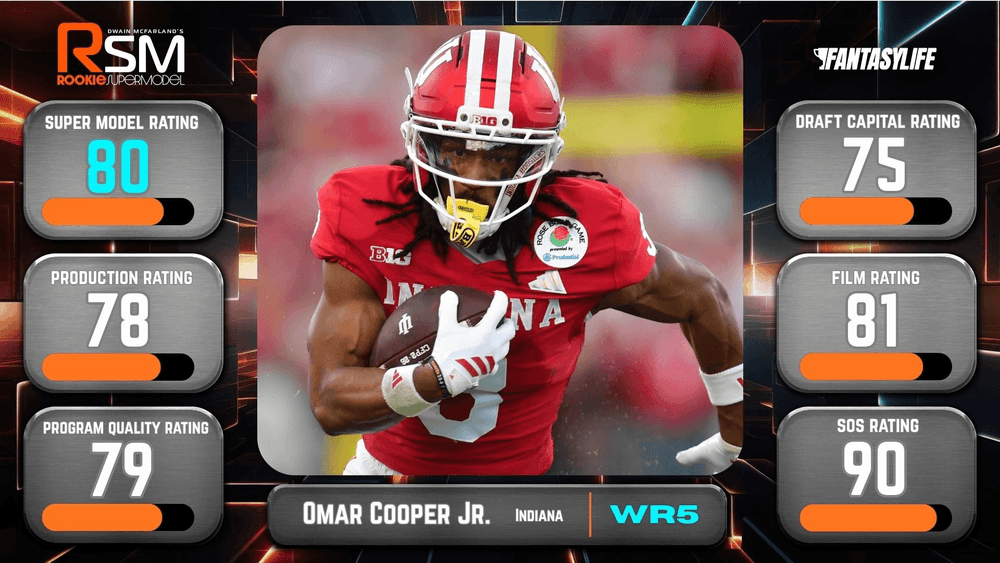
Omar Cooper Jr. Rookie Super Model Prospect Profile
- Super Model Rating: 79.4 (45th since 2018)
- Draft Pick: 30
- Rookie Age: 22.7
- Height: 72 inches
- Weight: 199 pounds
Cooper was rated as a three-star recruit by ESPN and 247Sports in the 2022 recruiting class, while Rivals rated him as a four-star prospect. He went to high school in Indianapolis and stayed in-state, signing with Indiana University.
He redshirted as a freshman and didn't have much impact as a sophomore, but that all changed with the arrival of Curt Cignetti in 2024 and Fernando Mendoza in 2025. Cooper scored 20 receiving TDs over his final two years and helped the Hoosiers bring home a national championship last season while playing with Mendoza.
Over his final two seasons, Cooper had to compete with Day 2 NFL Draft hopeful Elijah Sarratt. Many film analysts see Cooper as the better player than Sarratt, despite Cooper's lower production. He is one of the bigger risers in the pre-draft process. Cooper was considered a late Round 2 prospect in late January.
What the Production Says
Cooper's 78 Production Rating is in a similar range to many late first-rounders and early second-rounders in the NFL Draft. However, his rating is heavily reliant on his targeted QB passer rating. Cooper was an underperformer in RYPTPA.
- Adjusted Career RYPTPA: 39th percentile
- Targeted QB Passer Rating: 130.7, 79th percentile
Adjusted Career RYPTPA: Career receiving yards per team pass attempt adjusted for age, strength of schedule, QB play, teammate competition, aDOT, and alignment. Doesn't count games missed.
The Hoosier WR's first meaningful season didn't occur until his third season on campus, with 45.7 yards per game and seven TDs. He posted a 1.64 RYPTPA with a 14% target share—well below Year 3 marks for Tate (2.74), Lemon (2.94), Tyson (3.46) and Concepcion (2.24).
Cooper upped his game to a new level in his fourth season at Indiana with a 2.30 RYPTPA on a 24% target share. He averaged 58.6 yards per game and scored 13 TDs. While this was a positive step, it's important to remember that WR performances over their first three years correlate more strongly with future success.
RYPTPA by collegiate year → correlation to fantasy points per game in Years 1 to 3 in the NFL:
- Year 1 RYPTPA: 0.26
- Year 2 RYPTPA: 0.32
- Year 3 RYPTPA: 0.28
- Year 4 RYPTPA: -0.15
- Year 5 RYPTPA: -0.18
Cooper not posting a strong RYPTPA until Year 4 is the biggest red flag in his profile. But it doesn't mean a prospect will fail in the NFL. It is just one component in the model.
Ladd McConkey is a recent example of a player with a similar profile. He had a 77 Production Rating, with a 35th-percentile adjusted career RYPTPA and a 79th-percentile targeted QB passer rating. There are also two big misses from this profile type: Kadarius Toney and Parris Campbell, but both were low-aDOT players highly dependent on targets behind the line of scrimmage.
When players have profiles like this, I like to look at additional data points for context. Cooper's 40% and 58% route participation rates in his second and third years at Indiana are puzzling. He was healthy, and the team didn't have any other star receiving options. And Cooper was solid when given a chance to get on the field.
- Year 2: 2.14 YPRR, 26% TPRR
- Year 3: 2.52 YPRR, 20% TPRR
His career YPRR of 2.47 (54th percentile), 0.11 FDPRR (57th percentile), and best target share season of 24% (49th percentile) aren't elite, but paint him in a slightly better light. But those data points aren't included in the model because they overlap significantly with RYPTPA.
Beyond the Production
Cooper received a healthy diet of targets at all depths of the field, with a slight lean to medium and deep looks.
- Behind the Line of Scrimmage Targets: 15% (+1 vs. avg)
- Short Targets (0-9 yards): 32% (-4 vs. avg)
- Medium Targets (10-19 yards): 30% (+4 vs. avg)
- Deep Targets (20+ yards): 23% (+1 vs. avg)
In 2023 and 2024, Cooper played primarily on the outside (83% and 90%) as a field stretcher (15.1- and 16.0-yard aDOTs). But in his final and best season, he moved into the slot (83%) and attacked more underneath (9.7-yard aDOT).
It is worth noting that when Cooper finally reached a near full-time role (79% routes), it was playing from the slot 83% of the time. My first question: Does he have issues beating press coverage, which players are more exposed to on the outside?
So, I turned to Lance Zierlein's scouting report, which cited Cooper's ability to "stem and drive past press with his strength" as a positive aspect to his game. His prospect write-up also described Cooper as good enough to be more than a slot. But this comment also caught my attention: "routes lack polish, and he has average in-and-out quickness at break-points."
Interestingly, Cooper posted strong YAC-over-expected numbers as a deep threat and underneath option with +2.7 and +2.1 marks over his final two seasons. Of course, having a QB like Fernando Mendoza helps!
Zierlein also praised Cooper as a rugged player who can create yards after contact and has his comp as Deebo Samuel. His prospect grade is 6.36 (62nd percentile).
Cooper also tested well at the NFL Combine, running a 4.42-second 40-yard dash (73rd percentile) and posting a 37-inch vertical leap. While athletic testing is a small input in the Rookie Super Model, the performance is another positive data point for NFL teams.
When you add it all up, Cooper might be scheme-dependent—at least early in his career. If he lands somewhere that lets him play the Z and moves inside in three-WR sets, he could see early success as a YAC monster.
Fantasy Outlook For Omar Cooper Jr.
Since 2018, 47 WRs have posted a Super Model rating between 75 and 85, with 47% delivering a top-36 finish by Year 3.
- Top-six finishes: 4%
- Top-12 finishes: 11%
- Top-24 finishes: 34%
- Top-36 finishes: 47%
Cooper's closest Super Model comps:
- Ladd McConkey
- Matthew Golden
- Terrace Marshall Jr.
Bottom Line: The Rookie Super Model rates Cooper as an early Round 2 pick. A slow starter whose production never met Round 1 expectations until Year 4, when he moved inside and became a YAC monster on Indiana's National Championship team. With the Jets, he fits best as the Z WR who kicks inside in three-WR sets, battling Adonai Mitchell for time opposite Garrett Wilson. The Jets have short-term QB questions, but three Round 1 picks next year give them a path to fix it. Cooper is a borderline WR3 with WR2 upside.
Glossary of Terms In The Prospect Profile
- Adjusted Career RYPTPA: Career receiving yards per team pass attempt adjusted for age, strength of schedule, QB play, teammate competition, aDOT, and alignment. Doesn't count games missed.
- aDOT: Average depth of target in yards.
- Career Targeted QB Passer Rating: Passer rating on WR's targets.
- Contested catch rate: Percentage of contested targets caught.
- Contested catch rate over expected: Percentage of contested targets caught after adjusting for aDOT.
- Draft Capital Rating: Based on Chase Stuart's Draft Value Chart, an improved version of what many know as the Jimmy Johnson trade chart. It accounts for the larger drop-off in the first round and a flatter drop-off around the end of the second round.
- FDPRR: First downs per route run. Often shown as a percentage (first downs divided by routes).
- Film Rating: Based on NFL.com prospect grades from Lance Zierlein.
- Production Rating: A combination of adjusted career RYPTPA and career targeted QB passer rating.
- Program Quality Rating: ESPN's College Football Power Index is used to assess program quality. The model accounts for each school a prospect attended.
- RYPTPA: receiving yards per team pass attempt.
- SOS Rating: Based on strength of schedule (SOS) from Sports Reference. The model accounts for each school the prospect attended.
- Target Share: A player's percentage of team targets in games played.
- TPRR: Targets per route run.
- YAC: Average yards after the catch.
- YAC over expected: YAC over expected after adjusting for aDOT.
- YPG: Yards per game.
- YPRR: Yards per route run.

Join Our Newsletter
Trusted by 400,000+ fantasy football players. Get access to Fantasy Life's free award winning newsletter and tools, all in one step.
By registering or logging in, you agree to our Terms of Use and Privacy Policy.
Published Updated