
Week 10 Fantasy Football Utilization Report: Breece Hall, Jordyn Tyson & More Key Takeaways
Welcome to the Utilization Report, where Dwain McFarland recaps all of last week's NFL action to get you ready for Week 10 in fantasy football.
Welcome to the Utilization Report, where Dwain McFarland recaps all of last week's NFL action to get you ready for Week 10 in fantasy football.
The Top Fantasy Football Takeaways for Week 10
Let's follow the data to identify the top waiver wire options, trade targets, upgrades, and downgrades based on what we learned in Week 9.
If you love the sweet Utilization data below, you can access it all for yourself!
- Comparison tool
- Team-based views with game logs
- League-wide views for NFL leaders
- Customizable time periods and sample sizes
- Seasons: 2020 to 2026
Fantasy points tell you what happened, while Utilization Score tells you what’s likely to happen next.
It’s built on role data that predicts future production better than the box score does, so you’re not getting jerked around by every one-week spike or dud.
Plus, it'll show you a player’s realistic range of outcomes, so you can make the move that fits your league. The same guy might be a sell-high at one price and a buy-low at another.
And unlike expected fantasy points, which grade the opportunities a player already got, Utilization Score measures the role underneath them: the routes, snaps, and high-value touches that keep the opportunities coming.
Use the Utilization Report suite of tools to dominate your league, y'all!
 1. Breece Hall Returns With A 65% Opportunity Share
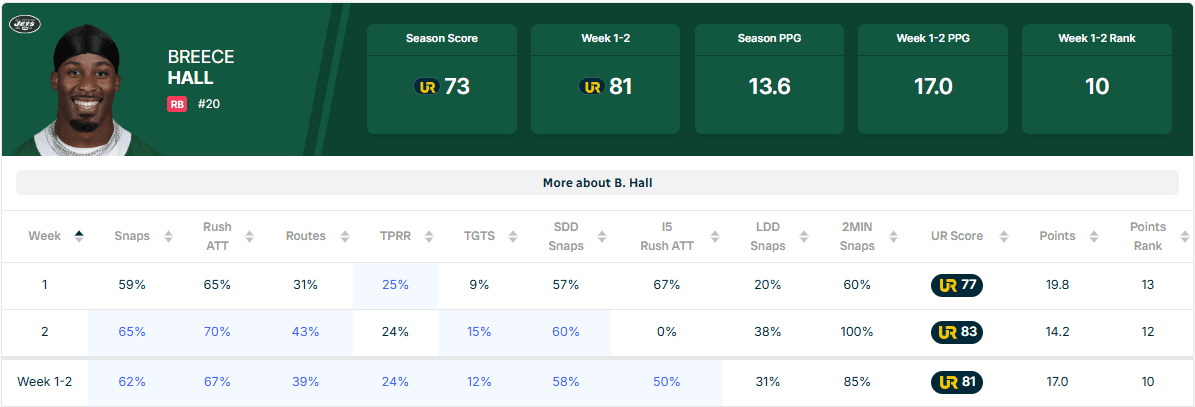
In Weeks 1-2 (Hall's healthy games), he averaged 17 PPG with an 81 Utilization Score: 62% snaps, 67% attempts, 39% routes, 12% targets, 58% short-yardage snaps, 85% 2-minute offense snaps.
In Week 9, he returned from a 5-game absence due to a quad injury. After strong performances from Braelon Allen over that span, concerns grew that Hall might not reclaim his early-season role.
That was partially true. Hall remained the lead ball carrier with a 63% attempt share, carrying the rock 15 times. He was also the primary short-yardage option, controlling 67% of the short-yardage snaps (SDD). He also continued as the 2-minute RB (75%).
But he notched season-low snap shares (44%) and route shares (26%). However, his 14% target share matched his early-season numbers. He finished Week 9 with 11.7 points and a 68 Utilization Score.
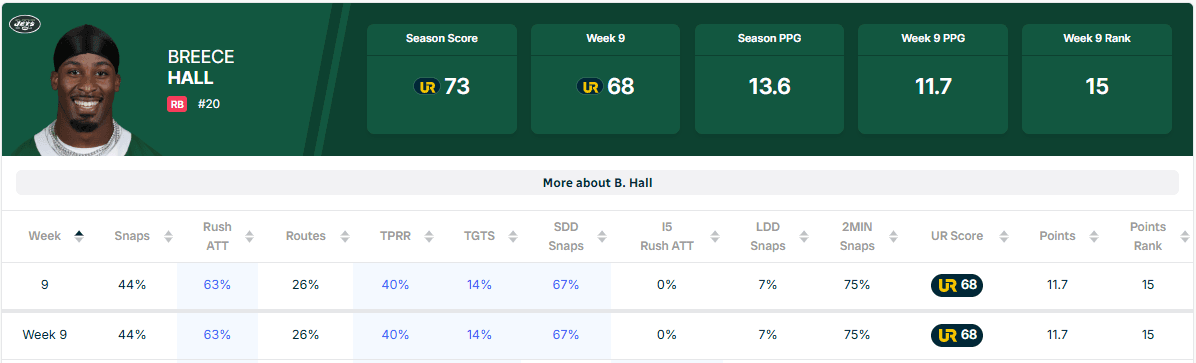
In summary, the Jets prioritized getting Hall touches when on the field. He had a 65% opportunity share (attempts + targets) for the backfield. Hall's main downturn was long-down-and-distance snaps (7%), which are low-impact in fantasy.
If you are a Hall manager, you should be happy with the first data point. Allen will be involved, but Hall's 19 opportunities weren't far from his 22.5 average over the first two games. Lower snap shares bring some fragility—as much as LDD work is less important, the role still associates with targets to some degree. But the Jets appear committed to feeding Hall a fantasy-relevant role.
Plus, the team might have capped Hall's workload in his first game back. We can't rule out a snap share increase in the coming weeks. Another positive: Isaiah Davis only played special teams in Week 9. The team did not use a three-RB rotation.
Hall hasn't been very efficient on the ground in 2026, but has been exceptional in the passing game.
- Yards per attempt: 3.4 (35th among 37 RBs with 60+ attempts)
- Yards after contact: 2.0 (37th)
- 10+ yard attempts: 9.1% (21st)
- Yards per route run (YPRR): 2.51 (1st)
- Targets per route run (TPRR): 28% (2nd)
If the Jets find a way to get their best receiving RB on the field for more routes (which ties back to snaps), it would be the easiest path to improving Hall's fantasy value.
Hall has a 76 Utilization Score in his three healthy outings. His historical comparisons averaged 14.7 PPG, with 30% reaching top-12 RB status.
- RB1-6 finishes: 6% (outlier ceiling outcome)
- RB7-12: 24% (realistic ceiling outcome)
- RB13-18: 32% (high-end median outcome)
- RB19-24: 32% (low-end median outcome)
- RB25-30: 5% (outlier floor outcome)
Hall UPGRADES to mid-range RB2 status. But it could be a fluid situation as we get more data over the next few games.
Braelon Allen is a mid-range RB3.
 2. Jordyn Tyson Flashes High-End Target-Earning Upside
Tyson (hamstring) played his first action of 2026 with a 35% route share in Week 9. The Round 1 NFL pick is obviously still in a ramp-up phase, but he was highly involved when on the field with a 25% TPRR.
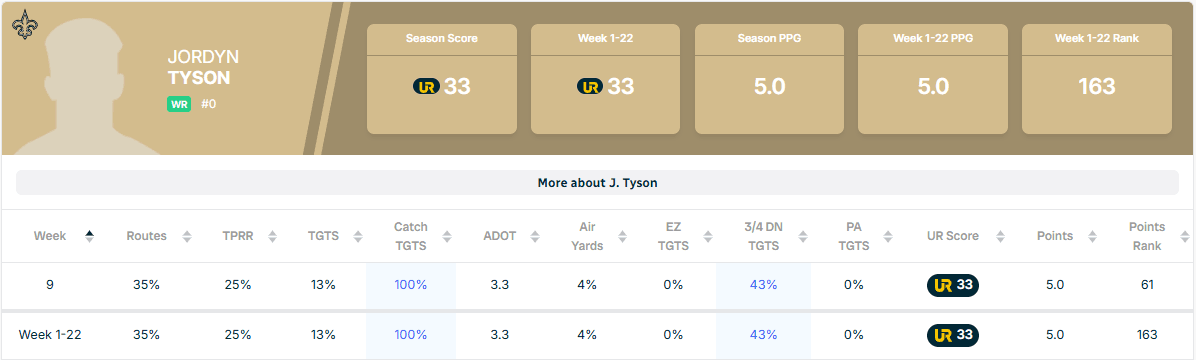
He operated from the slot on 50% of snaps and notched a 7.3 average route depth. He was in motion 28% of the time. And the team is stacking him for free releases. This is all highly encouraging. Tyson could operate in a very friendly role as the Saints' mismatch weapon down the stretch.
Tyson graded out as the No. 2 prospect in the 2026 WR class in the Rookie Super Model (89 on a scale of 50 to 99). The 6'2", 203-pound WR had the highest Production Rating.
He broke out as an 18-year-old freshman at Colorado and dominated the Arizona State passing attack over his final two seasons. His career 28% target share falls in the 77th percentile for prospects since 2018.
In college, Tyson demonstrated an ability to beat man and zone coverage. He owns the No. 2 man (39%) and zone (27%) target shares in the model's history.
We don't know how long it will take for Tyson to ramp up to a full-time role, but Kellen Moore noted his role was limited in the first game back and he will "continue to build".
Tyson has a ton of outs in the short- and long-term view. First, the Saints utilize 11-personnel fourth most in the NFL (72%). In New Orleans, securing the WR3 role provides an immediate path to viable fantasy playing time.
Second, the Saints rank 8th in plays per game (63.8) and 9th in dropback rate over expected (DBOE) at 2%. This helps his short-term outlook. Tyson's routes as the WR3 could be on par with some WRs in lower-passing-volume offenses who are the WR2.
Finally, if Tyson continues to perform well, he should eventually supplant Devaughn Vele. Vele has done a nice job filling in as the WR2, but he is not a high-end NFL WR. Among 77 WRs with at least 150 routes this year: 16% target share (50th), 1.15 YPRR (55th). Those are not starting WR caliber numbers—Vele has been largely carried by the Saints' passing-game volume.
Tyson is the path to unlocking a newfound upside in the Saints' passing attack. And the Saints are in a battle for the NFC South, tied for 1st place at 3-5.
After scoring just 5 fantasy points, he was the 7th-most cut WR in early waiver action and is available in 46% of Yahoo leagues. He should be rostered in almost all formats. In high-stakes leagues, Tyson is available 0%.
Tyson is HOLDING STEADY as a boom-bust WR4 in the short term, but will quickly ascend to WR3 status with a 70% route share. If he reaches 85%+, he will enter WR2 territory.
I prefer him over Rome Odunze, Denzel Boston, KC Concepcion, DK Metcalf, and Germie Bernard, in terms of upside for the rest of the season.
Now is the time to BUY LOW.
Per FantasyCalc, here are some recent trades I would consider if you need WR upside:
- RB - Blake Corum (Corum is a strong asset, but movable if strong at RB)
- RB - Omarion Hampton
- RB - Rachaad White
- RB - Ollie Gordon II (assuming you are strong at RB)
- QB - CJ Stroud (likely this manager's QB2)
 3. Zach Charbonnet: Improved Week 9 Role, But Is It Enough?
Charbonnet was limited to a 36% snap share and 35% attempt share in Week 8, but upped almost all of his Utilization data points in Week 9. He took over the team lead in snaps (56%), attempts (55%), routes (41%), short-yardage snaps (43%), LDD snaps (70%), and 2-minute snaps (57%).
He finished the day with 9.6 points and a 56 Utilization Score, totaling 16 attempts and 1 target.
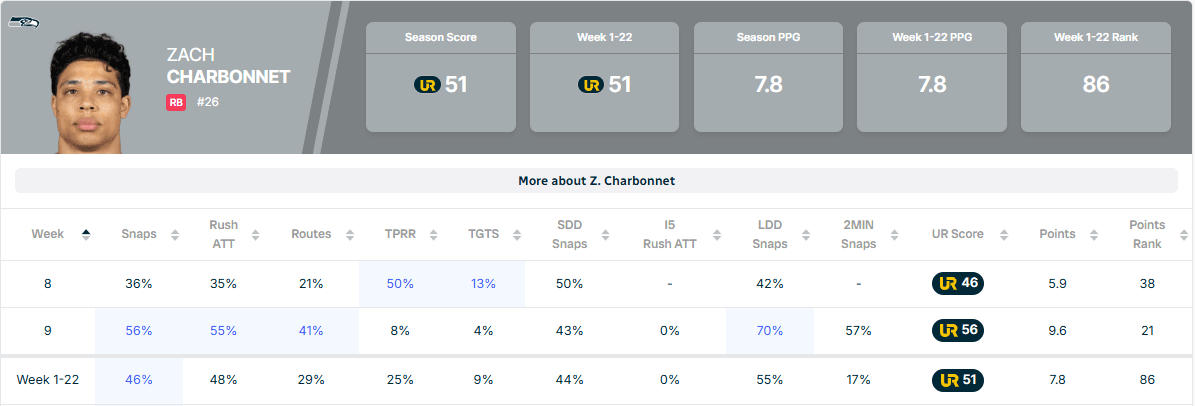
While this is a good step forward from Charbonnet, we will need more to unlock fantasy goodness. Essentially, he locked down the first two drives and then shared the rest of the drives with rookie Jadarian Price.
Below, you can see the snap shares for both RBs over all 9 drives. In parentheses, you can see the number of plays on each drive.

Note: If you want access to the drive-by-drive data, you can find it on Paydirt, and you can get 50% off the first month with the code: PDWELCOME.
Over the last two years, Charbonnet has shown he can compile fantasy points, but only when the backfield has consolidated to him.
- 70% snaps: 19.2 PPG (6 games)
- 60-69%: 4.7 PPG (1 game)
- 50-59%: 11.9 PPG (10 games)
Theoretically, there could be enough rushing work to split between two RBs on a team that wants to lean into its defense and run the ball. The Seahawks are the sixth-most run-heavy team (-3% DBOE).
Seattle is running more plays than in 2025, when Charbonnet and Kenneth Walker were fantasy duds when both were healthy.
- 2025 regulation plays per game: 59.7 (20th)
- 2026 regulation plays per game: 62.1 (11th)
In neutral situations, the Seahawks rank 6th in average seconds remaining on the play clock (9.7) this year.
Those things help Charbonnet, but I am not sure it will be enough. The Seahawks rank 28th in average yards before contact on RB attempts (0.70). Efficiency could be an issue.
Charbonnet's historical Utilization Score comps averaged 11.4 PPG, with most finishing as RB3s.
- RB1-12 finishes: 4% (outlier ceiling outcome)
- RB13-24: 25% (ceiling outcome)
- RB25-36: 57% (median outcome)
- RB37-48: 15% (floor outcome)
The Seahawks have the 5th-best rest-of-season schedule (+1.0 PPG), but Charbonnet needs a larger workload to become a fantasy difference maker. That could happen, but with a Round 1 pick invested in Price, it is hard to see the rookie fading away.
Charbonnet is a mid-range RB3 but would climb into RB2 territory if he can overtake a 65%+ snap share. SELLING now on the upward trend is not a bad move unless you think Price's role will fade.
 4. Denzel Boston's Role Is Evolving, And His Target Volume Is Up
For the first six games of the season, Boston was playing in a vertical role. Over that span, he had the 14th-highest average route depth (11.0) among 87 WRs with at least 100 routes. In that type of role, it is hard to earn targets. Boston's 20% target share was impressive, all things considered.
But we have seen a shift over the last three contests. He is still running go routes (22%), but his average route depth has decreased dramatically (10.0). Boston has been below 10 in two of the last three contests (9.1, 11.6, 8.8). Over those games, he has a 27% target share. His targets per game have jumped from 5.5 to 8.7.
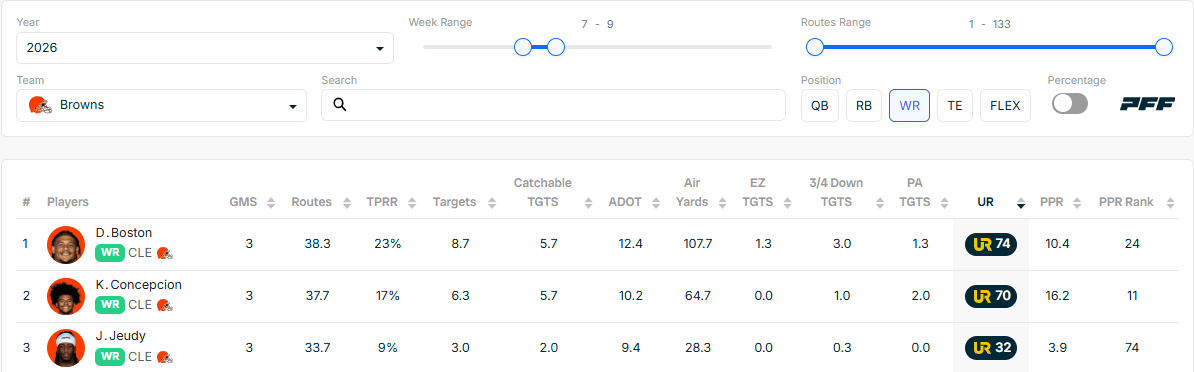
Boston has accumulated 26 targets and 323 air yards over the last three weeks. He ranks 4th in end-zone targets per game (1.1) this season.
We can't say for sure that Boston's new role is here to stay. It might be matchup-induced. But the team may also be rewarding his strong early-season play with opportunities to win at more levels of the field.
The offense remains crowded with KC Concepcion coming on strong and Harold Fannin still in the mix. But the Browns have quietly passed for 308, 326, and 297 yards over the last three weeks. And they did it with Deshaun Watson and Shedeur Sanders. The team could be hitting their stride with maturing weapons in Todd Monken's scheme.
Let's take a look at two potential scenarios.
Scenario 1: Boston's Recent Role Was Matchup-Induced
In this scenario, we can simply use Boston's season-long Utilization Score (67) to build a range of outcomes. We could see the role emerge again some weeks, but he could also have plenty of games stuck in a vertical role.
His historical comparisons averaged 12.9 PPG, which is above his 11.4 PPG this season. Most finished as WR3s.
- WR12-24 finishes: 28% (ceiling outcome)
- WR25-36: 46% (median outcome)
- WR37-48: 25% (floor outcome)
In this runout, Boston is due for positive regression and is a WR3 with WR2 upside.
Scenario 2: Boston's Recent Role Is The New Normal
For this scenario, we will use Boston's 73 Utilization Score over the last three games. It helps us understand how his rest-of-season outlook would change.
His historical comps averaged 14.4 PPG, and the majority secured WR2 campaigns.
- WR1-12: 13%
- WR13-24: 56%
- WR25-36: 29%
- WR37+: 3%
In this version of reality, Boston offers realistic WR2 potential and a hint of WR1 upside.
The Browns have the second-best QB schedule (+1.4 PPG) for the rest of the season, and they are battling for a playoff spot.
Bottom line: Boston UPGRADES to mid-range WR3 status and offers WR2 upside.
 5. Nico Collins Remains A Buy-Low Candidate
The Texans are heavily rotating their WRs since acquiring Marvin Harrison Jr. That has resulted in an 80% route share over the last three games for Collins. Over that span, he has averaged 9.7 PPG with a 45 Utilization Score.
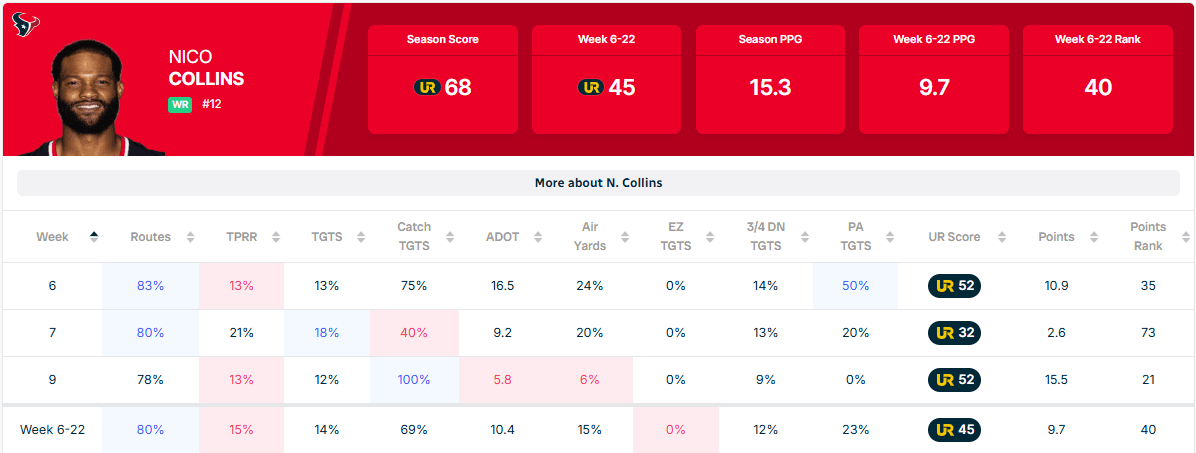
But here's the thing: Collins is still in his prime and remains the best WR (by far) on the Texans. In fact, his target competition is downright terrible. It is a mishmash of options that wouldn't be the WR4 or WR5 on many teams outside of Tank Dell.
Over the first two games this season, Collins notched 28% and 31% target shares. In 2024 and 2025: 26% and 25%. Do we really believe that Xavier Hutchinson, Harrison, and Kayshon Boutte are going to stand in the way of this 27-year-old stud? Count me out on believing that.
And here's the other thing: C.J. Stroud ranks 3rd in passing YPG (281) and is tied for 6th in passing TDs per game (2.0). And the Texans are leaning into the pass, ranking 6th in DBOE (3%). This is the best passing environment of Collins' career.
With a player like Collins, I am actually fading his 68 Utilization Score for the season. That represents his worst-case outcome in my mind. And even then, you would be getting a low-end WR2 most often. That is the floor.
I am leaning into his last two seasons and the robust nature of the Texans' passing game. Since 2011, WRs still in their prime with a 24-28% target share in an offense averaging 250-275 passing yards: 18.3 PPG. On average, they finished as the WR9.
The Texans have the 8th-best WR schedule in Weeks 14-17 in the fantasy playoffs (+1.5 PPG).
Collins is a borderline WR1 with high-end WR1 upside. I am willing to BUY LOW at mid- to low-end WR2 prices.
Looking to access the rest of the Utilization Report? Use code BF40 for 40% off FantasyLife+ to unlock the Utilization Report and everything else on FantasyLife.com!
 6. Matthew Golden Is Officially A Superstar
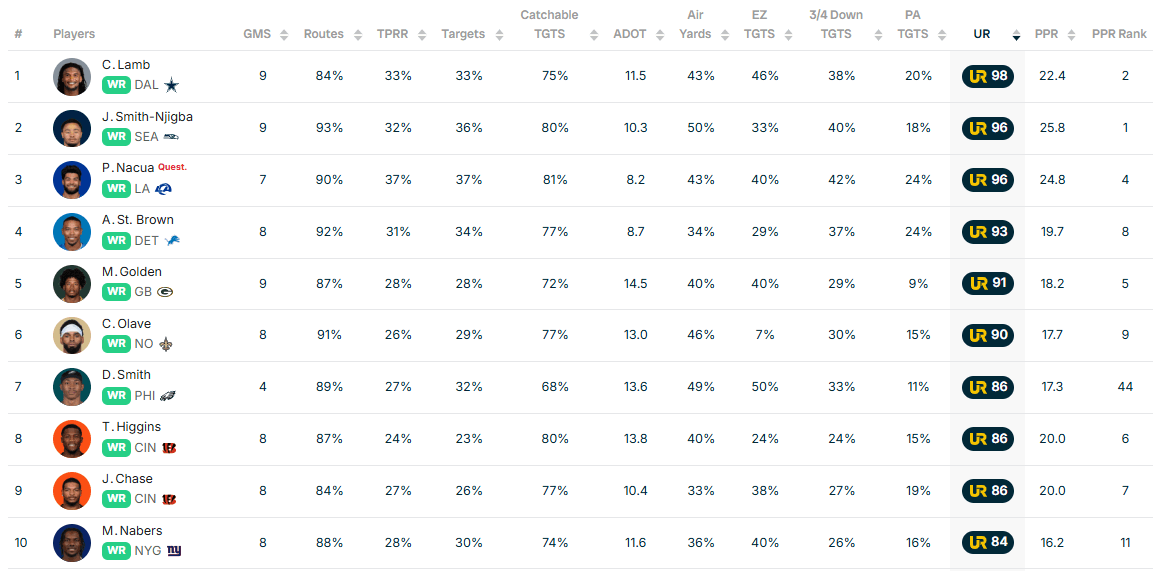
Golden has the fifth-highest Utilization Score (91) among all WRs in the NFL, ranking highly in multiple Utilization categories:
- Target share: 29% (10th)
- Targets per game: 10 (6th)
- Air yards per game: 145 (1st)
- Catchable air yards per game: 81.4 (4th)
- Endzone targets per game: 1.3 (T-1st)
The Packers are the most pass-heavy team in the NFL (9% DBOE) and the No. 12 scoring offense (24 PPG). Over the last four games, they are the No. 7 offense (28 PPG). Jordan Love is having a career year, ranking 2nd in passing YPG (291) and 5th in passing TDs per game (2.11).
With the Packers unable to run the ball, even the recent improvements by their defense don't seem capable of derailing their fantastic offensive season. Their passing game is the strength of the team.
Golden is averaging 18.2 PPG, and his historical Utilization Score comparisons have averaged 19.8 PPG. And 100% of them finished as top-12 WRs, with 88% securing top-6 campaigns.
Golden UPGRADES to low-end WR1 status. He has a tough matchup in Week 10 against the Vikings, followed by a bye week. But has the 7th-best WR schedule after the bye (+1.1 PPG).
7. Defenses Are Mean Mugging More In 2026
We are seeing more defenses aligning in all of the gaps with 7+ defenders in the box, otherwise known as MUG looks. This isn't necessarily new—it was popular about ~10 years ago—but offenses are struggling with it in 2026. It can confuse blocking assignments, and the QB and o-line must identify which players are coming or dropping into coverage. It adds another layer of movement on top of the safeties rotating post-snap, which can create hesitation. That can lead to more pressures, sacks, and turnovers.
The Vikings have been dominant with this look in 2026, so more teams are naturally trying it. Teams use it most often in obvious passing situations. Below are the criteria I used to quantify the heaviest MUG look teams:
- Play type: Pass
- Defenders in the box: 7 or more
- Field position: between the 20s
- Distance to first down: 4+ yards
- Downs: 3rd & 4th
This isn't a perfect way to do this research. Ultimately, we would want to isolate to plays where defenders are all on the line of scrimmage, but I am still working on a data source for that. For now though, isolating to defenders in the box on obvious passing downs is the next best thing. Typically, this would mean showing blitz.
From 2023 to 2025, NFL teams used MUG looks on 21% of plays in these scenarios. That number has skyrocketed to 30% in 2026. Below are the teams using MUG looks the most often based on our criteria above. These teams have had varying degrees of success, so I have bolded the categories where each has performed well.
- 2023-2025 NFL Average: 21%
- 2026 NFL Average: 30%
- Lions: 48% → 104.2 passer rating; 22% blitz, 49% pressure, 49% success
- Cowboys: 46% → 85.5 passer rating; 24% blitz, 46% pressure, 53% success
- Buccaneers: 42% → 57.7 passer rating; 56% blitz, 44% pressure, 71% success
- 49ers: 41% → 84.8 passer rating; 36% blitz, 33% pressure, 64% success
- Packers: 41% → 96.6 passer rating; 41% blitz, 39% pressure, 55% success
- Texans: 40% → 103.1 passer rating; 35% blitz, 60% pressure, 50% success
- Chiefs: 39% → 75.9 passer rating; 53% blitz, 39% pressure, 65% success
- Vikings: 36% → 46.6 passer rating; 65% blitz, 39% pressure, 74% success
- Bears: 34% → 50.7 passer rating; 46% blitz, 52% pressure, 79% success
The Buccaneers, Vikings, and Bears have found the most success.
I am still fleshing out this research, but the next step is to figure out which offenses are best suited to handle these looks. But for now, I asked SumerBrain which route types by position have the most success against these looks in 2025-2026:
- WR: Hitch (62%), Slant (57%), Out (56%), Post (55%)
- TE: Hitch (66%), Post (65%), Corner (63%), Cross (63%)
- RB: Flat (51%), Wheel (53%)
For WRs, the quick-hitting routes are the most successful, which makes sense. With LBs and safeties crowding the line, their goal is to beat the cornerback quickly, who may or may not be in a press look.
For TEs, the results are mixed. Some are quick-hitting, but the post and corner concepts are great ways to make the defense play. Good TEs can use the crowded box to their advantage, quickly gaining leverage on their defender downfield. This data also shows that TEs are the best way to beat MUG looks.
RBs are not optimal options in these scenarios, with defenders able to quickly track down check-down plays. The wheel route has had some success this season, which makes sense if an athletic RB can get downfield quickly and leave their defender trailing. But the sample is small and could be problematic when the defense blitzes. Wheel routes are probably best against MUG defenses that blitz less often.
8. Utilization Score Underperformers
The Utilization Score is made up of the fantasy data points that have historically correlated the most strongly with future fantasy success. It's similar to, but different from, expected fantasy points. How it differs:
- Accounts for snaps and routes in addition to attempts and targets.
- Accounts for catchable targets and catchable air yards.
- The underlying role accounts for ~75% of a player's Utilization Score.
- Uses fantasy points per game (PPG) as a proxy for talent (i.e., has the player done something with their opportunities). Fantasy PPG is worth ~25% of a player's Utilization Score.
 Zay Flowers | WR | Ravens
Flowers got a downgrade last week in the Utilization Report, but the team signed Jacoby Brissett after publishing. While I don't think that Brissett is an amazing NFL QB, I do think he is good enough to support Flowers, who plays in a cheat-code role.
The entire passing game centers on Flowers, who gets maximum protection from opposing defenses through alignment, route combinations, route depth (7.4 yards), and motion at the snap. Among 77 WRs with at least 150 routes this season, Flowers ranks 4th in motion rate (25%).
He has played some partial games due to injuries, but Flowers is the 5th-most targeted WR per route: 28% TPRR. Michael Wilson isn't as talented as Flowers and played a lesser version of this role with Brissett. That resulted in a 23% TPRR with 9.5 looks per game.
In three starts with Tyler Huntley, Flowers averaged 18.3 PPG with an 83 Utilization Score.
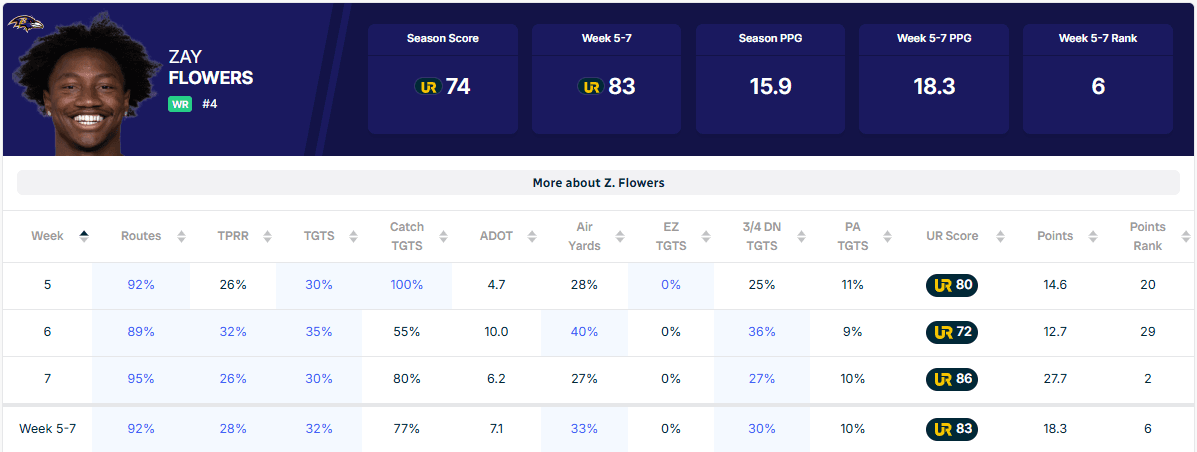
Brissett offers a higher passing YPG ceiling than Huntley. This year, Brissett averaged 229 in seven full games with the Cardinals. Last year, he averaged 281 in 12 games. While I don't expect him to reach 281 again, he can operate a competent offense. And that is all we need for Flowers, who doesn't have much target competition.
Flowers' historical comparisons averaged 16.8 PPG, with 78% reaching top-12 territory.
- WR1-6 seasons: 23% (ceiling outcome)
- WR7-12: 53% (median outcome)
- WR13-18: 16% (floor outcome)
- WR19-24: 5% (outlier floor outcome)
- WR25+: 2%
Flowers UPGRADES to low-end WR1 status and is a BUY LOW target after back-to-back duds with 0 and 5.3 points.
Note: For more buy-low options, check out the Utilization Bytes below.
9. Utilization Score: Overperformers
 Bryce Young | QB | Panthers
Young had a great bounceback game, passing for 276 yards and 3 TDs against a tough Broncos defense. That led to 20.3 points after 5.4- and 10.4-point outings the two weeks prior.
While it was encouraging for Young and the Panthers' passing game outlook, I am betting the unders on his current averages for the rest of the season (274 YPG, 2.0 TDs). The offensive line is dealing with multiple injuries, and he has the hardest remaining QB schedule (-2.1 PPG):
- Week 10: NO (+1.9 PPG)
- Week 11: BAL (-0.7 PPG)
- Week 12: TB (-5.6 PPG)
- Week 13: MIN (-7.5 PPG)
- Week 14: NO (+1.9 PPG)
- Week 15: CIN (+3.5 PPG)
- Week 16: PIT (-3.4 PPG)
- Week 17: SEA (-6.9 PPG)
Young has 4 of the top 5 QB defenses on his schedule. At minimum, you need a QB2 available for those games.
Shopping him now is the best solution—especially if he is your QB2. Four teams are on bye this weekend, including the Bears. Then six teams have a bye in Week 11, including the Packers, Rams, and Patriots.
Young is a mid-range QB2 the rest of the way, but the QB11 for the season. He will be a low-end QB2 in the tough matchups. See if you can flip him coming off a 20-point outing against Denver.
Note: For more sell-high options, check out the Utilization Bytes below.
10. Week 10 Fantasy Football Waiver Wire Roundup
QB WAIVER WIRE OPTIONS FOR WEEK 10 IN FANTASY
- Jacoby Brissett | Ravens: If you are in a tight spot, Brissett will start for Baltimore in Week 10 against the Chargers. Many of the concepts and cheat codes from Mike LaFleur's offense are present with Declan Doyle. Expect Brissett to lock onto Flowers and let him do the heavy lifting. Brissett is a low-end QB2, but offers QB1 upside in the right matchups while Lamar Jackson is out.
RB WAIVER WIRE OPTIONS FOR WEEK 10 IN FANTASY
- Corey Kiner | Patriots: Rhamondre Stevenson is undergoing a knee MRI, leaving his status undetermined for the foreseeable future. Kiner is the next man up and could handle a large workload until Stevenson or TreVeyon Henderson returns. New England has the 4th-hardest RB matchup against the Lions (-2.4 PPG) before a bye week. He is a borderline RB2 until one of Stevenson or Henderson returns. Kiner is available in 96% of leagues.
- Audric Estime | Saints: With Kendre Miller cut and the Saints still not opening Travis Etienne's 21-day practice window, Miller could provide fantasy managers with a short-term bye-week/injury filler. In Week 9, the recently added RB was the lead early-down option: 49% snaps, 60% attempts, 73% short-yardage snaps, 50% attempts inside the five-yard line. Alvin Kamara was the primary pass-down option, which makes Estime's role game-script dependent. But he has the 4th-best RB matchup (+3.9 PPG) against the Panthers in Week 10. With four teams on bye in Week 10, and six on bye in Week 11, he will be a borderline RB2. He is available in 96% of leagues.
- Green Bay RBs | Packers: What a mess. Josh Jacobs suffered a fractured ring finger and could miss up to three games. MarShawn Lloyd should be the next option, but he missed Week 9 after a late-week knee issue surfaced. Available in 68% of leagues.
- Lloyd: The likely RB1 if healthy enough. Lloyd is available in 68% of leagues.
- Kaleb Johnson: Handled 48% of rushing attempts in Week 9 with Jacobs injured and scored 12.8 points. Johnson is the current favorite to operate as the early-down option in a committee in Week 10. He is available in 99% of leagues.
- Chris Brooks: 21-day practice window opened last week and trending towards playing in Week 10. Brooks should be the RB2 if Lloyd is out. And Johnson could be on a short leash. Brooks is available in 99% of leagues.
- Pierre Strong: Strong has been the passing-down RB2 since Jacobs returned, but took a back seat on the ground behind Johnson in Week 9. Strong will have a role, but isn't the favorite to see a large role shift with Jacobs out.
The Packers have the hardest RB schedule over the next three games with matchups against the Vikings (-3.7 PPG) and Rams (-2.8 PPG) sandwiched around a Week 11 bye. None of these options are worth big FAAB bids. It is a massively volatile depth chart without schedule appeal. None will rank higher than mid-range RB3 territory this weekend.
- Bam Knight | Cardinals: Knight didn't play in Week 9 due to a concussion, but could force a committee with Tyler Allgeier upon his return. It's hard to get too excited about an offense that just lost Michael Wilson for the season and probably Gardner Minshew as well. Knight was handling some passing-down work before his injury, which could help in PPR leagues as the Carson Beck experiment begins. The Cardinals have the third-worst RB schedule over the next three games (-1.7 PPG): Rams (-2.8 PPG), Chiefs (-0.7 PPG), Commanders (-1.7 PPG, but missing top two DTs out for the season). Knight is a mid-range RB3 at best until Jeremiyah Love returns. He is available in 88% of leagues.
- Tier 1 Handcuffs: Emmett Johnson (79%), Kaelon Black (61%), Chris Rodriguez Jr. (67%), Seth McGowan (68%), Kenny Gainwell (53%), Mike Washington Jr. (51%), Tyler Goodson (98%)
- Tier 2 Handcuffs: Ray Davis (96%), Justice Hill (95%), Marshawn Lloyd (68%), Samaje Perine (85%), Sione Vaki (98%)
- Longview Players Your Leaguemates Could Cut: Samaje Perine (89%).
- IR Stash: Jonathon Brooks (62%). Expected to return between Weeks 10 and 11.
WR WAIVER WIRE OPTIONS FOR WEEK 10 IN FANTASY
- Davante Adams | Rams: Just a reminder to check your waiver wire for Adams. He was available in some of my high-stakes leagues over the last two weeks. With Puka Nacua placed on IR with ACL, MCL, and turf toe injuries, Adams offers massive upside. He averaged 30.1 PPG in two games without Nacua earlier this season—he is a mid-range WR1 without Nacua. Adams could return in late November or early December. He probably isn't available (rostered in 84% of Yahoo leagues) but is by far the No. 1 waiver priority if on the wire.
- De'Zhaun Stribling | 49ers: Stribling is a long-view target. He probably won't return to the field before December, but could offer significant upside for the fantasy playoffs. The 49ers are the No. 3 scoring offense (29.4 PPG), and their WR room is extremely fragile, with Mike Evans (Achilles) as the only high-talent option. He offers WR2 upside upon his return. In deep leagues and ones with an IR spot, he should be rostered now. Stribling is available in 75% of leagues.
- Caleb Douglas | Dolphins: Douglas has solidified himself as a top-two option for the Dolphins. Over five healthy games, he has averaged 12.1 PPG with a 22% target share. He has a 60 Utilization Score for the season. His comps averaged 11.3 PPG, with most finishing as low-end WR3s (25%) or WR4s (44%). The Dolphins have the 8th-best WR schedule the rest of the season (+0.8 PPG). Douglas is available in 71% of leagues and is the top WR option if you need immediate help.
- Tank Dell | Texans: Dell's route share jumped from 20% to 55% in his second game back from injury. He remains in a rotational role, but his 36% TPRR was elite—he and Stroud have a history. Dell scored 20.5 points and could continue to push for more playing time in a pass-centric offense. Dell is a low-end boom-bust WR4 but will climb higher with more playing time. He is available in 87% of leagues.
- Pat Bryant | Broncos: Bryant scored 15.6 points in Week 9 with Jaylen Waddle exiting early due to a concussion. The second-year WR took over the slot role, notching a 15% target share. Ultimately, Bryant has yet to flash high-end target-earning ability, but he is still young. The Broncos have a Week 10 bye, so he falls a little lower on the list. Bryant is a WR5-6 stash option and is available in 97% of leagues.
- Los Angeles WRs | Rams: Puka Nacua was placed on IR with MCL, PCL, and turf toe injuries after a late-game injury in Week 9. The team could be active ahead of tomorrow's trade deadline and the TEs will likely get a bump (see below). But one of the names below could emerge—they are all WR6 dart throws:
- Tutu Atwell: Atwell is a non-factor in the run-blocking game, which hurts his playing-time ceiling. But he has the third-highest route share (61%) since the Davante Adams injury. His 13% TPRR isn't good, but Atwell offers big-play ability and has performed okay in short stints as a starter for McVay in the past. Atwell has been in motion on 25% of routes—he could benefit from the scheme.
- Konata Mumpfield: Mumpfield has the highest route share since the Davante Adams injury (65%), but has a lackluster 6% TPRR. But he moves around the formation, playing from the slot 36% of the time. Mumpfield is a WR6 dart throw.
- Jordan Whittington: Whittington has been the odd-man out over the last three games with a 4% route share. But he is a sturdier interior option than Atwell. Whittington has played from the slot on 60% of plays in 2026. But his 7% TPRR is also lacking.
- Tutu Atwell: Atwell is a non-factor in the run-blocking game, which hurts his playing-time ceiling. But he has the third-highest route share (61%) since the Davante Adams injury. His 13% TPRR isn't good, but Atwell offers big-play ability and has performed okay in short stints as a starter for McVay in the past. Atwell has been in motion on 25% of routes—he could benefit from the scheme.
- Arizona WRs | Cardinals: Michael Wilson suffered a season-ending neck injury in Week 9. He leaves behind a highly underqualified WR room that will try to fill his shoes: Simi Fehoko, Reggie Virgil, Zay Jones, and Devin Duvernay. Fehoko, Virgil, and Duvernay rotated across the WR2-3 roles last weekend. Jones is on the practice squad, but offers the most NFL experience. Ultimately, your guess is as good as mine, and the answer is most likely just NO, with Minshew also probably done for the season. Jones and Fehoko seem like the best bets to play Wilson's role based on their alignment and scheme data year-to-date, but Virgil is their Round 5 draft pick.
Short-term bye-week fillers:
- Demarcus Robinson | 49ers: Robinson returned from IR (high-ankle sprain) and notched a 63% route share and led the WRs with a 21% TPRR. He is still my favorite bet to provide fantasy value until Evans—who is unlikely to play in Week 10—returns. But he could have company in Deebo Samuel in Week 10. The 49ers get a great matchup against the Cowboys (+2.4 PPG). Robinson is available in 89% and is a WR4 until Evans is back.
- Jordan Watkins | 49ers: In the last two games without Evans, Watkins has averaged 13.6 PPG with a 65 Utilization Score. He has a 78% route share with a 17% target share. He has been the downfield threat with a 17.9 aDOT and is also active in the endzone, averaging one target per game. Will have to battle Robinson to stay on the field if Samuel returns in Week 10. Watkins is a WR4 if Samuel is out, but a boom-bust WR5 when he returns. Watkins is available in 98% of leagues.
- Mack Hollins | Patriots: Hollins scored 12.6 points on six targets in his first game back from IR. His playing time could improve in his second game back, but A.J. Brown will travel with the team to Germany for their Week 10 game, clouding Hollins' fantasy outlook. If Brown is out, Hollins is a WR4 option against the Lions (+2.1 PPG) in a game with shootout potential. If Brown returns, Hollins shouldn't be in starting lineups. The team also has a bye in Week 11. Hollins is available in 95% of leagues.
- Not interested: Kayshon Boutte (35% routes).
- Jordyn Tyson: See No. 2 above.
- Antonio Williams: Williams was the fifth-most-cut WR in early waiver-wire action. He leads the Commanders in routes (88%) and targets (20%) in two games without Terry McLaurin, who is out for the season. Williams is HOLDING STEADY as a WR4 with WR3 upside. Williams is available in 69% of Yahoo leagues.
- Adonai Mitchell: Mitchell disappointed fantasy managers with 0 points in a matchup better suited to Omar Cooper's role in Week 9. He was the most-dropped WR in rage-cut action (available in 50% of leagues now, but that number will grow). He had a 92% route share and 25% target share. Mitchell is averaging 8 targets and 180 air yards over the last two games. Cooper may have aggravated his high-ankle sprain again, which could mean a more versatile route tree for Mitchell alongside Garrett Wilson as the No. 2 option. Mitchell is a boom-bust WR4 with Cooper, but could provide WR3 value if Cooper is out.
- IR Stashes: Alec Pierce (56%, TBD)
TE WAIVER WIRE OPTIONS FOR WEEK 10 IN FANTASY
- Chig Okonkwo | Commanders: Okonkwo has averaged 7.4 PPG with a 72 Utilization Score in two games without Terry McLaurin. His historical comps averaged 10.6 PPG with 63% finishing between TE6 and TE12. Okonkwo is a high-end TE2 and is available in 78% of leagues.
- Los Angeles TEs | Rams: With Nacua injured and an extremely fragile WR corps, we could see more work for Tyler Higbee and Colby Parkinson with heavy TE packages. Higbee has been the leader in the route department since Adams was injured (70%), but Parkinson has been the more-targeted option (27% TPRR) despite battling injuries.
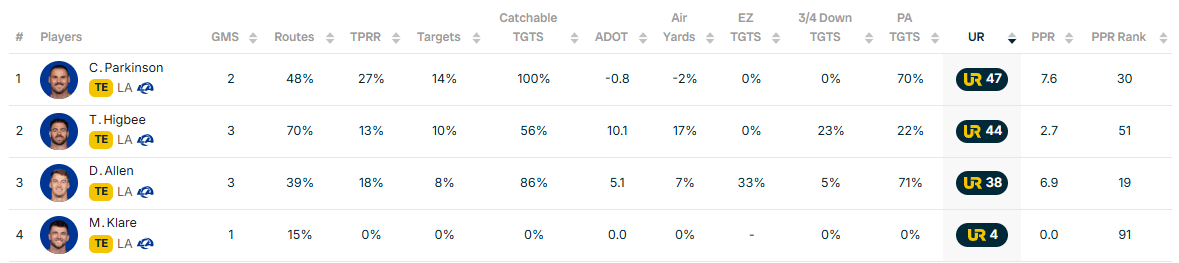
Both options offer low-end TE1 upside in the short-term, but the floor is barf-bag territory. The Rams offense is not going to score as many points without Nacua.
Utilization Bytes
Quarterbacks
- C.J. Stroud | Texans: Stroud ranks 3rd in passing YPG (281) and is tied for 6th in passing TDs per game (2.0). And the Texans are leaning into the pass, ranking 6th in DBOE (3%). Stroud now ranks as the QB6 on the season with 20.8 PPG, with three top-five finishes in his last six games. He has the sixth-hardest QB schedule (-0.8 PPG) the rest of the way. Stroud UPGRADES to low-end QB1 status.
Running Back
- Ashton Jeanty | Raiders: Jeanty led the team with a 66% snap share and 70% route share in Week 9, but managed only 7.0 fantasy points with a 67 Utilization Score. Mike Washington and Jeanty split the rushing workload evenly, with Jeanty getting 43% of the attempts. Jeanty has a 71 Utilization Score over the last five games since his role began shrinking. His historical comps averaged 13.8 PPG: 20% RB1s, 58% RB2s, 22% RB3s. He has the 3rd-hardest rest-of-season RB schedule (-1.0 PPG). Jeanty DOWNGRADES to low-end RB2 status.
- Bucky Irving | Buccaneers: Tampa Bay now boasts the third-most-run-heavy offense (-7%) DBOE, leaning into their No. 1 ranked EPA-per-play defense (-0.21). The Buccaneers rank 2nd in rushing plays per game (28), and Irving is handling 64% of the designed attempts, leading to 18.3 attempts per contest. Irving is cooking: 4.9 YPC (8th among 37 RBs with at least 60 attempts), 3.87 yards after contact (YCO, 3rd), 10.8% 10-plus-yard attempts (14th). He has averaged 17.7 PPG with an 80 Utilization Score. His historical comps averaged 15.8 PPG with 55% finishing inside the top 12. Irving UPGRADES to low-end RB1 territory.
- Chase Brown | Bengals: Brown's role has taken a hit over the last four games, sharing more of the rushing workload: 67% snaps, 52% attempts, 61% routes, 14% targets, 43% short-yardage snaps, 40% attempts inside the five-yard line, 29% 2-minute offense. In Week 9, some of that was due to a blowout lead, pushing his attempt share down to 44% with Samaje Perine handling mop-up duties in the fourth quarter. But at halftime, Brown's 52% attempt share was in line with recent weeks. Brown is averaging 10.9 PPG with a 74 Utilization Score over that span. His historical comps averaged 14.4 PPG: 32% RB1s, 54% RB2s, 15% RB3s. This still points to positive regression for Brown, who plays in the second-highest scoring offense (30 PPG). But he is slipping—Brown DOWNGRADES to mid-range RB2 status.
- Devin Singletary | Giants: Singletary busted in Week 9 with 5.9 points despite 21 attempts and 3 targets. He monopolized the backfield with Skattebo out: 92% snaps, 78% attempts, 75% routes, 12% targets. Skattebo is tracking to play in Week 10, which means a return to a split backfield. Singletary is a low-end RB4.
- Jadarian Price | Seahawks: Price scored 11.8 points in Week 9, operating as the RB2 in a two-way committee: 38% snaps, 31% attempts, 31% routes, 15% targets, 29% short-yardage snaps, 0% attempts inside the five-yard line, 30% LDD snaps, 29% 2-minute offense snaps. The first-round NFL pick finished with a 55 Utilization Score. His historical comps averaged 10 PPG, with most finishing as RB3s (43%) or RB4s (40%). He needs more playing time. Price is a borderline RB3 with contingent RB1 upside if Zach Charbonnet misses time.
- Javonte Williams | Cowboys: After falling below a 70% rush share in one game over the first six, Williams has two such games in the last three. Tyler Goodson has emerged from the shadows to lighten the load. Ultimately, it hasn't cost Williams because Brian Schottenheimer is leaning into the run, trying to shorten the game for his atrocious defense. Over the last three games, Dallas ranks 28th in DBOE (-5%). Williams is averaging 22.7 attempts and 2 targets, with 16.9 PPG and an 80 Utilization Score over that span. The Cowboys have the hardest rest-of-season RB schedule (-1.3 PPG). Williams is HOLDING STEADY as a low-end RB1.
- Jonah Coleman | Broncos: Coleman controlled his largest workload of the season in Week 9: 82% snaps, 65% attempts, 71% routes, 12% targets. He also handled all of the short-yardage and 2-minute snaps on his way to 18.8 points with an 89 Utilization Score. Coleman has an 87 score with 19.6 PPG over the last two games without RJ Harvey. His historical comps averaged 17.1 PPG. The Broncos have the 2nd-best rest-of-season RB schedule (+1.4 PPG). Coleman UPGRADES to low-end RB1 territory until Harvey returns; then we will re-evaluate.
- Kyren Williams | Rams: Williams is averaging 17.7 PPG with an 86 Utilization Score this year. He continues to lead the team in snaps and routes thanks to his two-minute role, but the team hasn't used it as much over the last month. The challenge is the split rushing workload in non-shootout games. His historical comps have averaged 16.7 PPG, with most finishing as low-end RB1s (40%) or high-end RB2s (29%). Williams DOWNGRADES to borderline RB1 status.
- Ollie Gordon | Dolphins: Gordon has failed to find the end zone over the last two games, which hurts given his lackluster receiving role (6%). He is the true definition of a TD-dependent RB. But his role hasn't changed. Over five games without De'Von Achane: 73% snaps, 69% attempts, 55% routes, 86% short-yardage snaps, 82% attempts inside the five-yard line, 70% 2-minute offense. He has averaged 12.9 PPG with a 72 Utilization Score. His historical comps averaged 13.9 PPG, with most finishing as RB2s (57%). The Dolphins have the best rest-of-season RB schedule (+1.6 PPG). Gordon is HOLDING STEADY as a low-end RB2.
- Woody Marks | Texans: Marks is one of the most underproductive RBs I have ever studied. Over the last three games without David Montgomery, he has a 76% snap share, 72% attempt share, 57% route share, and has played almost all of the short-yardage and 2-minute snaps. The result: 9.2 PPG. That is very hard to do when averaging 19.2 opportunities. Marks should be a mid-range RB2 at worst, but he is setting a new standard. Marks DOWNGRADES to high-end RB3 status until Montgomery returns.
Wide Receiver
- Drake London | Falcons: London scored 11.8 points coming off of a 1.8-point dud in the rain game. Still, he is averaging 15.3 PPG in seven games with Michael Penix this season. If you exclude that crazy weather game, he is averaging 17.6 PPG with a sizzling 31% target share. London is HOLDING STEADY as a low-end WR1 but has the 5th-hardest WR schedule (-0.9 PPG).
- Emeka Egbuka | Buccaneers: Egbuka returned to action in Week 9 and played a limited role with a 77% route participation rate. He should work his way back up to a full-time role, but Tampa Bay's new identity is a run-first offense. The 2025 Round 1 NFL pick will need to get back to his elite target shares in the two weeks before injury (39% and 40%) to turn his 2026 campaign around. The Bucs have the 2nd-best rest-of-season schedule (+1.4 PPG). Egbuka is a mid-range WR3 with mid-range WR2 upside.
- Josh Downs | Colts: The matchup against Dallas was the last chance for Downs to give us a reason to remain on our fantasy rosters. He failed the test, scoring 5.4 points. Despite a full-time role, Downs has a lackluster 17% TPRR, with 8.3 PPG and a 55 Utilization Score. His historical comps averaged 9.9 PPG, with most finishing as low-end WR4s (25%) or WR5s (41%). Downs DOWNGRADES to WR5 territory.
- Rashee Rice | Chiefs: Rice has yet to work his way back up to his career-high early-season route share (85% over the first three weeks). But in the last two games since returning from a hamstring injury, his TPRRs (26% and 29%) look more like the Rice that delivered big-time fantasy production. In those two games, he has 14.1 PPG. Rice is HOLDING STEADY as a low-end WR2, but offers WR1 upside if his routes push toward 80%. The Chiefs have the 5th-best rest-of-season WR schedule (+1.3 PPG). I like Rice as a BUY-LOW candidate.
Tight End
- George Kittle | 49ers: Kittle didn't boom (9.8 points) in a good matchup against the Raiders in Week 9. But he has an elite 90 Utilization Score in six healthy games in 2026. He is averaging 15.5 PPG with a tantalizing 27% target share. His historical comparisons averaged 14.8 PPG with 70% finishing as top-3 TEs. The 49ers have the 2nd-hardest TE schedule (-2.0), including matchups against the Vikings, Seahawks, and Rams. But he is just too good in a mini-tier just below Brock Bowers. I don't have confidence in lower options outperforming him even with good schedules. Kittle is a top-4 TE the rest of the way.
- Isaiah Likely | Giants: If there is a TE not named Bowers or McBride (maybe) that I like better than Kittle, it is Likely. He has a 91 Utilization Score with a 26% target share, averaging 16.1 PPG with the Giants. In Week 9, he notched another big outing, scoring 16.3 points. His historical comps averaged 15.5 PPG with 80% finishing as top-3 TEs. Plus, the Giants have the 2nd-best TE fantasy playoffs schedule in Weeks 14-17 (+3.2 PPG). Likely is my TE3 the rest of the way, and he could surpass Trey McBride given the Cardinals' offensive concerns at QB.
- Kenyon Sadiq | Jets: With Garrett Wilson out in Week 9, the Jets utilized 12 personnel more, unlocking a 53% route share for Sadiq. That was his highest mark since Week 4. He has a 21% TPRR on the season—mid-range TE1-worthy, but needs more playing time. Wilson should return in Week 10, but Omar Cooper could miss time with an ankle injury. We could see the Jets move to 12 as their top personnel grouping until Cooper returns. That would make Sadiq similar to Michael Mayer. Sadiq is a mid-range TE2 with mid-range TE1 upside if Mason Taylor suffers an injury.
- Trey McBride | Cardinals: McBride will continue to get fed targets with Wilson out for the season. But it will make it easier for defenses to focus all of their attention on McBride. The big question mark is whether Carson Beck can avoid turning the Cardinals into one of the worst passing offenses in the NFL. McBride is averaging 10 targets per game, so he has a solid cushion for his 18.1 PPG. But we will have to monitor his progress with Beck. McBride gets a small DOWNGRADE but is HOLDING STEADY as a high-end TE1 for now. Thankfully, the Cardinals have the 7th-best TE schedule (+1.0 PPG).
Team Trends To Watch For Fantasy Football Week 10
Let's examine the team-level trends that affect fantasy production. You can find the data across all 32 NFL teams in the Team Styles tab of the Utilization Report tools.
Dropback Over Expected (DBOE): How often teams pass the ball compared to their peers when considering the score differential over the last six weeks:
- Packers: 9%
- Bengals: 6% (-1)
- Panthers: 4% (-1)
- Steelers: 4%
- Eagles: 4%
- Texans: 3%
—
- Chargers: -5%
- Ravens: -5% (-1)
- Buccaneers: -7% (-1)
- Dolphins: -9%
- Falcons: -9%
Neutral Playclock: Teams that are leaving more or less time on the play clock when the score is within three points (neutral situations). The NFL average is 8.3 seconds.
- Cowboys: 11.69
- Chiefs: 10.89
- Browns: 10.68
- Patriots: 10.14
—
- Steelers: 7.16
- Giants: 6.91
- Bucs: 6.91
- Commanders: 6.42
Play action pass rate: Teams that are utilizing play action the most per dropback over the last five weeks, which adds value to WRs and TEs on a per-route basis in fantasy:
- 2026 NFL Average: 26%
- Bills: 38%
- Bears: 36%
- Lions: 34%
- Vikings: 33% (pre MNF)
- Panthers: 32%
- Chiefs: 31%
—
- Cardinals: 19%
- Steelers: 19%
- Saints: 18%
- Bengals: 18%
- Eagles: 17%
Personnel: When teams deploy more heavy personnel, with extra TEs and RBs on the field, the pass-catchers who remain face less target competition. For example: WRs saw a 29% boost in PPR points per route with two WRs on the field vs. three WRs over the last three seasons. Game scripts can impact this data over small samples.
21 Personnel (2 RB, 1 TE, 2 WR) – large boost
- 2026 NFL Average: 6%
- 49ers: 35%
- Chargers: 29%
- Dolphins: 25%
- Vikings: 16% (pre MNF)
- Giants: 13%
- Raiders: 12%
- Seahawks: 13%
22 Personnel (2 RB, 2 TE, 1 WR) – large boost
- 2026 NFL Average: 3%
- Giants: 19% (21 + 22 = 32%)
- Raiders: 15% (21 + 22 = 27%)
- 49ers: 10% (21 + 22 = 45%)
- Seahawks: 8% (21 + 22 = 21%)
- Vikings: 7% (21 + 22 = 23%) (pre-MNF)
- Chargers: 7% (21 + 22 = 36%)
11 Personnel (1 RB, 1 TE, 3 WR) – negative boost
- 2026 NFL Average: 55%
- Titans: 78% → 83% last four games
- Eagles: 76%
- Browns: 73% → 79% last four games
- Saints: 69%
- Cowboys: 67%
12 Personnel (1 RB, 2 TE, 2 WR) – small boost
- 2026 NFL Average: 23%
- Raiders: 48% → 60% last four games
- Bengals: 41%
- Chiefs: 32%
- Bears: 32%
- Lions: 30% → 37% last four games
13 Personnel (1 RB, 3 TE, 1 WR) – large boost
- 2026 NFL Average: 9%
- Rams: 37% (12 + 13 = 46%) → 51% 13P in 3 games without Adams
- Bills: 27% (12 + 13 = 49%) (pre MNF)
- Cardinals: 27% (12 + 13 = 35%)
- Bears: 17% (12 + 13 = 49%)
- Ravens: 15% (12 + 13 = 42%)
- Jaguars: 13% (12 + 13 = 37%)
- Lions: 20% last 4 games (12 + 13 = 57% last 4 games)
Offensive Lines: Pressure rates are huge for QBs. Most signal callers who are constantly harassed will struggle to find consistent fantasy value. QBs partially own pressures, so it isn't all an offensive line issue. The NFL average pressure rate is 36% over the last three seasons.
Yards before contact matters for RBs. Backs who get better blocking have a better chance to thrive in fantasy. RBs also impact this number with their vision, acceleration, and elusiveness. The NFL average yards-before-contact on RB attempts is 1.28 over the last three years. It is important to remove QBs since scrambles often come with defenders' backs turned and can inflate these numbers.
Pressure Rate Allowed:
- 3-Year NFL Average: 36%
- 2026 NFL Average: 36%
- Change from last week in parenthesis
- Falcons: 29% (+1)
- Rams: 29%
- 49ers: 31% (+1)
- Bengals: 31%
- Cardinals: 31% (-1)
- Lions: 32%
- Titans: 32%
- Jaguars: 32%
—-
- Seahawks: 40% (-1)
- Eagles: 42%
- Chargers: 43% (-1)
- Browns: 44% (+2)
- Panthers: 44% (-1)
- Dolphins: 45% (+1)
- Patriots: 45% (+2)
Average Yards Before Contact Rushing
- 3-Year NFL Average: 1.28
- 2026 NFL Average: 1.15
- Bills: 2.13 ⬇️
- Rams: 1.76 ⬇️
- Chiefs: 1.60 ⬆️
- 49ers: 1.58 ⬇️
- Cowboys: 1.50 ⬆️
- Lions: 1.45
- Vikings: 1.45 (pre MNF)
- Steelers: 1.40
—
- Seahawks: 0.70 ⬆️
- Raiders: 0.66 ⬇️
- Jaguars: 0.65 ⬇️
- Eagles: 0.63 ⬇️
- Packers: 0.59 ⬇️
Defensive Tendencies
Pressure Rate: Defenses with high pressure rates can dramatically impact QB performance. Under pressure, QB statistics become much more unstable and decline at the macro level.
- 3-Year NFL Average: 36%
- 2026 NFL Average: 35% ⬇️
- Vikings: 45%
- Broncos: 40%
- Falcons: 40% ⬇️
- Seahawks: 40% ⬇️
- Texans: 40% ⬆️
—
- Colts: 30%
- Buccaneers: 30% ⬆️
- Eagles: 30% ⬇️
- Titans: 30%
- Saints: 30% ⬆️
- Giants: 29% ⬆️
- Cardinals: 29% ⬇️
Pass Blitz Rate: Defenses that blitz often can impact how often TEs and RBs run routes. Against heavy blitz teams, they can remain in to block more often. Teams that get pressure without blitzing can be tough to pass against.
- 3-Year NFL Average: 26%
- 2026 NFL Average: 30%
- Vikings: 71% → Last 4: 80%
- Buccaneers: 43% ⬆️ → 45%
- Commanders: 41% → 35%
- Jets: 40% ⬇️ → 38%
- Giants: 39% ⬇️→ 41%
- Panthers: 37% ⬇️ → 38%
- Bills: 45% (Last 4) - pre-MNF
- Cardinals: 42% (Last 4)
- Patriots: 39% (Last 4)
—
- Falcons: 23%
- Lions: 22% → 19%
- Colts: 21%
- Dolphins: 20% → 14%
- Cowboys: 20% ⬇️ → 17%
- Bengals: 19% ⬇️
Man Coverage: Targets skew toward the top WR options against man coverage, while TE and RB opportunities decline at the macro level. Of course, there are exceptions for elite TEs. Also, many teams that utilize man concepts have a shut-down corner, which can be problematic for WRs—especially if the CB shadows.
Scrambling QBs also benefit from man coverage. When defenders turn their backs, QBs can tuck the ball and run. And it can take defenders longer to realize it is happening (i.e., Jayden Daniels vs. the Giants in Week 5).
- NFL Average in 2026: 23% (Trending down from previous seasons)
- 2025: 24%
- 2024: 27%
- Browns: 41% (Denzel Ward. Will shadow.)
- WR units: +0.2 PPG boost (13th-best matchup)
- Giants: 33% (Deonte Banks. Will shadow.)
- WR units: -3.9 PPG (5th-hardest matchup)
- Jets: 32%
- WR units: -2.8 PPG (8th-hardest matchup)
- Patriots: 31% (Christian Gonzalez. Will shadow.)
- WR units: +5.2 PPG (2nd-best matchup)
- Lions: 30% (D.J. Reed. Occasionally shadows.)
- WR units: +2.1 PPG (11th-best matchup; but -3.6 over last three games)
- Bears: 28%
- WR units: -1.2 PPG (13th-hardest matchup)
- Broncos: 28% (Patrick Surtain II. Will shadow.)
- WR units: -3.1 PPG (7th-hardest matchup)
- Steelers: 28%
- WR units: -1.9 PPG (10th-hardest matchup)
- Bengals: 27% (DJ Turner II. Will shadow)
- WR units: +1.0 PPG (13th-best matchup)
Zone Coverage: Targets spread out against heavy zone teams. RBs and TEs get more involved, while WR targets tend to take a hit. There are exceptions. Underneath, WRs can benefit from zone.
- NFL Average in 2026: 71%
- Seahawks: 80%
- QB: -6.9 PPG (2nd-hardest)
- RB: -3.2 PPG (3rd-hardest)
- WR: -5.2 PPG (3rd-hardest)
- TE: -4.1 PPG (3rd-hardest)
- Packers: 79%
- QB: -3.4 PPG (5th-hardest)
- RB: +1.1 PPG (10th-best)
- WR: +1.2 PPG (above-average matchup)
- TE: -3.9 PPG (3rd-hardest; but have linebacker injuries)
- Saints: 79%
- QB: +1.9 PPG (above-average matchup)
- RB: +6.0 PPG (best matchup)
- WR: +4.0 PPG (6th-best matchup)
- TE: +0.0 PPG (average matchup)
- Vikings: 78% - Pre-MNF
- QB: -7.5 PPG (hardest matchup)
- RB: -3.7 PPG (2nd-hardest matchup)
- WR: -5.7 PPG (hardest matchup)
- TE: -3.4 PPG (4th-hardest matchup)
- Cardinals: 77%
- QB: +5.4 PPG (best matchup)
- RB: -1.9 PPG (12th-hardest matchup)
- WR: -1.8 PPG (12th-hardest matchup)
- TE: +2.0 PPG (8th-best matchup)
- Panthers: 81% (fired defensive coordinator after Week 8)
- QB: +2.6 PPG (7th-best matchup)
- RB: +3.9 PPG (4th-best matchup)
- WR: +0.3 PPG (average matchup)
- TE: +2.1 PPG (7th-best matchup)
Additional Defensive Trends:
- Buccaneers: Behind the Vikings and Seahawks as a bad matchup for most positions. The weather helped some in Week 8, so we will continue to monitor. They are also a highly valuable fantasy defense—they might be matchup-proof
- QB: -5.6 PPG (3rd-hardest matchup)
- RB: -5.6 PPG (hardest matchup)
- WR: -3.8 PPG (6th-hardest matchup)
- TE: 0.0 PPG (average matchup)
- Packers: Rapidly improving defense that should get Micah Parsons back sometime in late November. They also offer DST fantasy appeal. The data below is for the last five games:
- QB: -4.1 PPG (5th-hardest matchup)
- RB: -2.5 PPG (9th-hardest matchup)
- WR: -0.2 PPG (average matchup)
- TE: -3.9 PPG (3rd-hardest matchup)
- Jaguars: The Jaguars are a tier below the teams above, but tough against all positions. Jacksonville's offense is great at building leads, putting offenses in predictable passing situations. They traded for Jordan Davis from the Eagles (2027 Round 1 pick, 2029 Round 1 pick) and Jesse Bates from the Falcons (2027 Round 2 pick, 2028 Round 5 pick) on Monday. They have a solid schedule over the next three games but get HOU and DAL in the fantasy playoffs.
- QB: -4.5 PPG (4th-hardest matchup)
- RB: -2.3 PPG (7th-hardest matchup)
- WR: +0.0 PPG (average matchup)
- TE: -2.2 PPG (8th-hardest matchup)
Players Mentioned in this Article
Presented by

Published Updated