
Nicholas Singleton Prospect Profile With The Tennessee Titans From The 2026 Rookie Super Model
Dwain McFarland breaks down what the Rookie Super Model has to say about incoming rookie RB Nicholas Singleton and what his fantasy football outlook looks like.
Nicholas Singleton clocks in as the RB4 in the Rookie Super Model for 2026. For the full RB class, check out the 2026 RB Rookie Super Model.
If you're new to the model, here is an introductory breakdown of the Rookie Super Model, which rates players on a scale of 50 to 100 based on a composite score across Draft Capital, Production and Film.
You can find a glossary of terms and stats used in this breakdown at the bottom of the prospect profile.
Prospect Profile For RB Nicholas Singleton From The Rookie Super Model
- Team: Titans
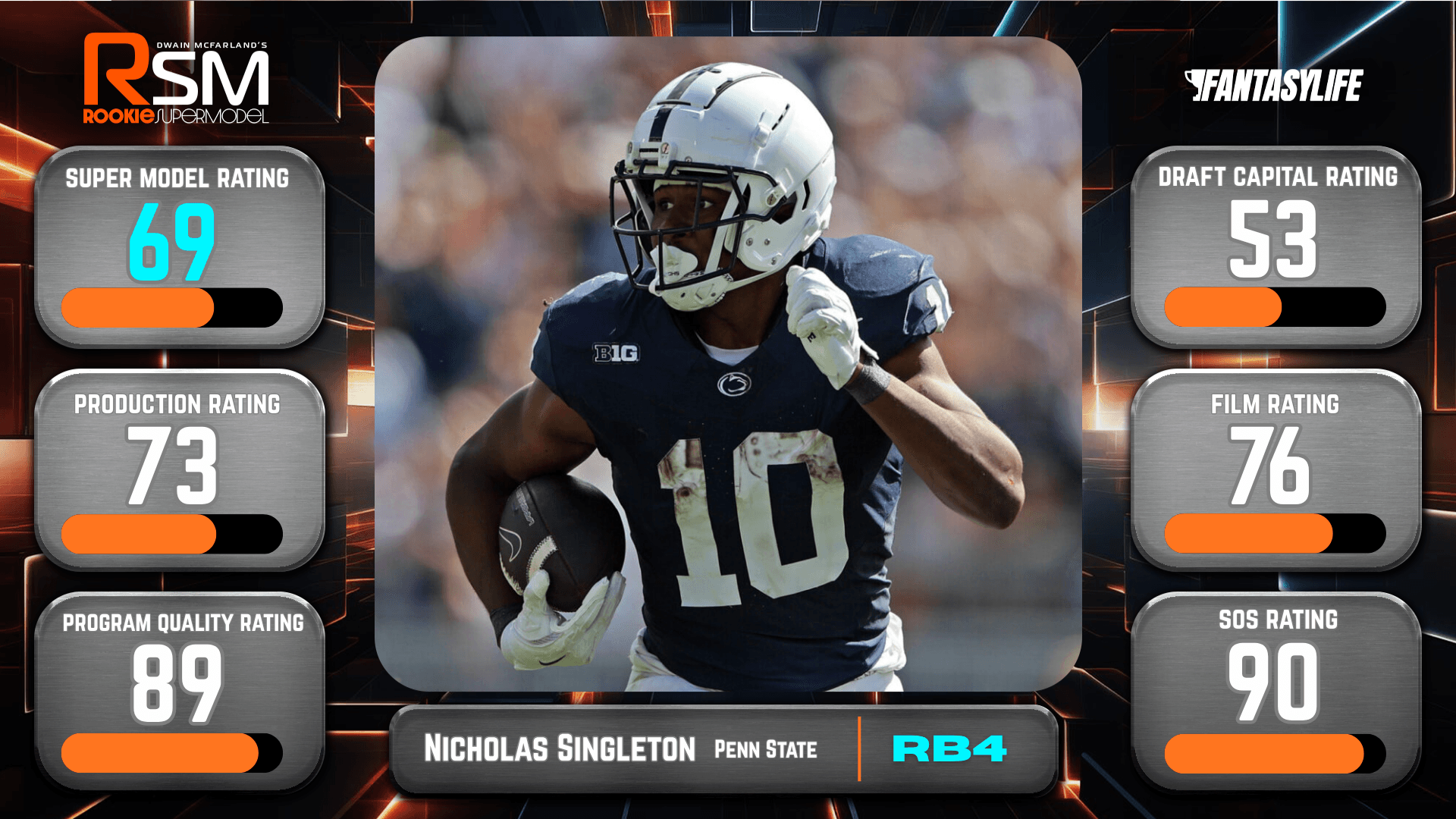
- Super Model Rating: 68.8
- Draft Pick: 165
- Rookie Age: 22.7
- Height: 72 inches
- Weight: 219 pounds
Singleton was the No. 1 RB recruit in the 2022 class as a five-star recruit out of Reading, Pennsylvania. As a senior in high school, he rushed for 2,043 yards and 41 TDs as the Gatorade National Player of the Year.
The highly coveted recruit chose Penn State, where he churned out 81 rushing yards per game and 12 TDs in Year 1, winning Big Ten Freshman of the Year. Singleton formed a dynamic duo with four-star recruit Kaytron Allen during his four seasons with the Nittany Lions.
What the Production Says
Singleton collected good-enough early-career numbers, but in the long run was never able to distance himself from Allen. In a tandem backfield, he never notched elite numbers, holding his Production Rating (70) in check.
- Year-Weighted YPTA: 1.57 (54th percentile)
- Best YPTA: 1.81 (47th percentile)
- Best RYPTPA: 0.91 (44th percentile)
 Nerd note: What do these numbers mean?
- YPTA: Adjusted yards per team attempt (pass + rush), with receiving yards double-weighted. Normalizes production across teams with different play volumes.
- Year-Weighted YPTA: Weights Years 1-3 more heavily, where college production best predicts NFL success. Year 4 carries a negative correlation. Good players show up early.
- Best YPTA: Career-high yards per team attempt season.
- Best RYPTPA: Peak-season receiving yards per team pass attempt, normalizing production across run-heavy vs. pass-heavy offenses.
While Singleton never matched his rushing yardage production from his freshman season, he grew as a receiver, helping push his Year 2 and Year 3 YPTA and RYPTPA numbers higher.
- Year 1: 1.38 YPTA, 0.20 RYPTPA → 81 ru YPG, 12 TDs; 7 rec YPG, 1 TD
- Year 2: 1.50 YPTA, 0.74 RYPTPA → 58 ru YPG, 8 TDs; 24 rec YPG, 2 TD
- Year 3: 1.81 YPTA, 0.91 RYPTPA → 74 ru YPG, 12 TDs; 25 rec YPG, 5 TD
- Year 4: 1.31 YPTA, 0.72 RYPTPA → 46 ru YPG, 13 TDs; 18 rec YPG, 1 TD
Singleton gets credit for attending a good school with an 89 Program Quality Rating, which offsets some of the timeshare. However, high-end tandem backfields leave us wondering how high Singleton (or Allen) might have soared on separate teams.
The high school superstar left Happy Valley as the record holder for total TDs (55), rushing TDs (45) and all-purpose yardage (5,586). The all-purpose yardage includes 1,138 kick return yards, where he also tacked on a TD.
Singleton isn't a high-end receiving prospect, but in an RB-poor class, he has the fifth-highest best RYPTPA. He also ranks fifth in best target share season, career YPRR, and career TPRR in 2026.
- Best Target Share: 13% (46th percentile)
- Career YPRR: 1.38 (49th percentile)
- Career TPRR: 18% (44th percentile)
Beyond the Production
With a production profile like Singleton's, to really pop in the model, they need a strong Film Rating. Unfortunately, his inputs are split, leading to a 76 Film Rating. That ranks eighth in a weak class.
- NFL.com Prospect Grade: 6.00 (38th percentile)
- Career PFF Rushing & Receiving Grade: 72.6 (73rd percentile)
Lance Zierlein views Singleton as a prospect with the traits to eventually be an "above-average backup." He cites his explosive speed and build as positives, but notes that Singleton is more of a straight-line runner who doesn't offer high-end elusiveness. Zierlein also notes concerns about his vision, but calls out his ability to play on third downs and return kicks as pluses.
Zierlein's film assessment aligns with Singleton's advanced rushing profile data:
- Rushing Missed Tackles Forced: 17% (25th percentile)
- Rushing Average Yards After Contact: 3.44 (38th percentile)
- 10-Plus Yard Attempts: 13% (35th percentile)
Interestingly, these career data points align closely with Mike Washington Jr., who has climbed the consensus draft boards by leaps and bounds since exploding at the NFL Scouting Combine. Unfortunately, Singleton suffered a broken fifth metatarsal in his right foot at the Senior Bowl, which kept him from running in Indianapolis.
According to Bruce Feldman's "Freaks List", Singleton ran a 4.35-second 40-yard dash at Penn State. Had Singleton timed at 4.40 seconds, his Speed Score would be 116.9 (81st percentile), which would have bumped his Super Model Rating up one point to 71.
Nerd Note: Bill Barnwell invented Speed Score. It helps us understand how fast a player is relative to their weight. A 180-pound RB running a 4.40-second 40-yard dash isn't the same thing as a 215-pound back with the same time. Of all the testing data points from the NFL Scouting Combine, Speed Score carries the most signal for NFL RB production. Formula: Weight*200/(40-yard dash)4.
Singleton did a good job of protecting the football with a 0.8% career fumble rate, just below the 0.9% average for RB prospects. However, he let the pigskin touch the grass on too many targets with an 8.6% drop rate versus 6.8% average for NFL Draft prospects.
Despite being a big-bodied RB at 219 pounds, he was below average as a pass protector with a 44.0 career PFF Pass Block Grade (38th percentile). He allowed pressure on 8% of his pass-block reps, above the 7% average. However, Zierlein notes an understanding of pass protection assignments and "good mirror and hand usage to keep rusher in front of him."
Injury notes:
- Battled lingering injuries throughout Year 3; missed game against UCLA (lower body); exited against Washington, and snaps were down for the next two games (Weeks 11 and 12) before returning to his regular role.
- Broke his fifth metatarsal in his right foot at the Senior Bowl.
Fantasy Football Outlook For Nicholas Singleton
For Singleton's range-of-outcomes analysis, we will give him a one-point bump in the model (70) for his speed, since that is one of his biggest positives, and his Senior Bowl injury kept him from running at the NFL Scouting Combine.
There have been 73 RBs who have garnered a Super Model rating between 66 and 76 since 2017, with 38% delivering a top-36 finish by Year 3.
- Top-six finishes: 5%
- Top-12 finishes: 9%
- Top-24 finishes: 27%
- Top-36 finishes: 38%
Skill set: Potential Every-down RB.
Singleton's closest Super Model comps:
- Rhamondre Stevenson
- DJ Giddens
- Zach Evans
Bottom line: The Rookie Super Model views Singleton as an early-Day 3 pick. A time-share with Kaytron Allen clouds his ceiling, but he's a better receiver than Mike Washington and has the size-speed combo NFL teams covet. He must improve his feel for the game to unlock his potential. In Tennessee, he has a shot at a growing Year 1 role, and with Tony Pollard's contract expiring after 2026, the long-term door is open. His low draft capital, however, leaves him vulnerable to getting leapfrogged by a higher pick next year. Singleton is a boom-bust RB4 with RB2-RB3 upside.
Glossary of Terms In The Prospect Profile
- Adjusted Career RYPTPA: Career receiving yards per team pass attempt adjusted for age, strength of schedule, QB play, teammate competition, aDOT, and alignment. Doesn't count games missed.
- aDOT: Average depth of target in yards.
- Career Targeted QB Passer Rating: Passer rating on WR's targets.
- Contested catch rate: Percentage of contested targets caught.
- Contested catch rate over expected: Percentage of contested targets caught after adjusting for aDOT.
- Draft Capital Rating: Based on Chase Stuart's Draft Value Chart, an improved version of what many know as the Jimmy Johnson trade chart. It accounts for the larger drop-off in the first round and a flatter drop-off around the end of the second round.
- FDPRR: First downs per route run. Often shown as a percentage (first downs divided by routes).
- Film Rating: Based on NFL.com prospect grades from Lance Zierlein.
- Production Rating: A combination of adjusted career RYPTPA and career targeted QB passer rating.
- Program Quality Rating: ESPN's College Football Power Index is used to assess program quality. The model accounts for each school a prospect attended.
- RYPTPA: receiving yards per team pass attempt.
- SOS Rating: Based on strength of schedule (SOS) from Sports Reference. The model accounts for each school the prospect attended.
- Target Share: A player's percentage of team targets in games played.
- TPRR: Targets per route run.
- YAC: Average yards after the catch.
- YAC over expected: YAC over expected after adjusting for aDOT.
- YPG: Yards per game.
- YPRR: Yards per route run.

Join Our Newsletter
Trusted by 400,000+ fantasy football players. Get access to Fantasy Life's free award winning newsletter and tools, all in one step.
By registering or logging in, you agree to our Terms of Use and Privacy Policy.
Players Mentioned in this Article

Published Updated