Quentin Johnston Fantasy Football Outlook For 2026: A Fourth-Year Breakout On Tap
Are we on the cusp of witnessing a fourth-year breakout from wideout Quentin Johnston? Adam Pfeifer breaks down how to approach the Chargers WR in 2026 fantasy football.
Hey, it could happen …
That’s basically been the sentiment surrounding both Quentin Johnston’s real and fantasy football potential through three NFL seasons. Following an uninspiring rookie campaign, Johnston has now flashed in consecutive seasons, though the consistency has been the issue. He’s now scored eight touchdowns in back-to-back seasons, but still hasn’t finished better than WR34 in fantasy either year. And yet, my stance on QJ hasn’t changed.
It. Could. Happen.

Join Our Newsletter
Trusted by 400,000+ fantasy football players. Get access to Fantasy Life's free award winning newsletter and tools, all in one step.
By registering or logging in, you agree to our Terms of Use and Privacy Policy.
 How We Got Here With Quentin Johnston In Fantasy Football
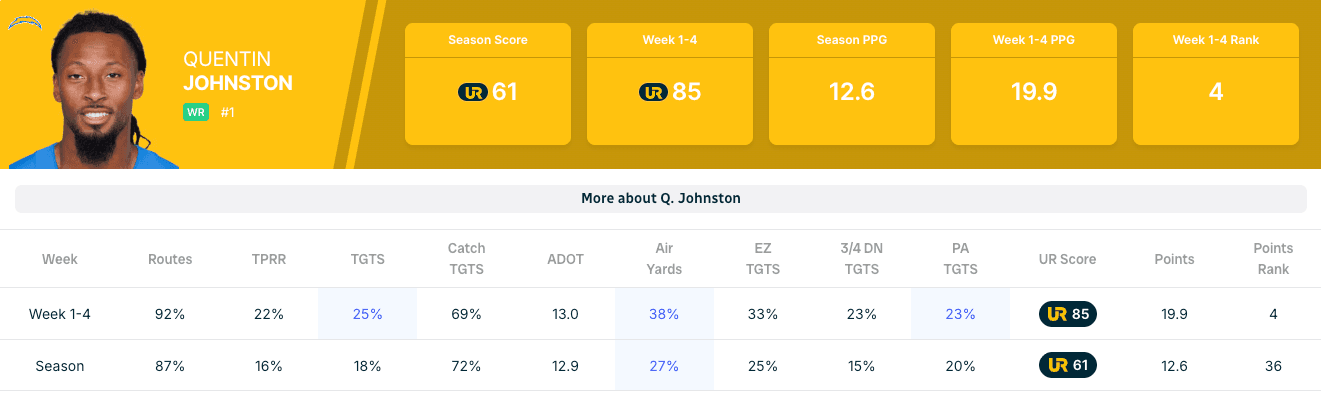
Through the first four weeks of last season, it sure as hell looked like it already was. During Weeks 1-4, Johnson was on a tear, scoring four touchdowns, while averaging 9.0 targets, 5.5 receptions, 84.3 receiving yards and 19.9 PPR PPG. In that small sample, Johnson was the WR4 in fantasy points per game, while his 25% target share led the Chargers. Meanwhile, his 38% air yardage share not only led the team but was also a top-20 rate among qualified receivers during that span. Of course, Johnston slowed down quite a bit after his hot start, while missing Weeks 6 and 8. He returned in Week 9, recording a solid game (4-53-1), but it was that week that the Chargers' season really changed.
Already without Rashawn Slater, the Chargers’ stomachs collectively turned when Joe Alt re-injured his ankle in Week 9. He wouldn’t play the rest of the season, and Los Angeles’ offense never got back on track. From Week 10 on, the Chargers were pressured on 44.1% of dropbacks, the third-highest rate in the NFL. In particular, Justin Herbert was sacked 12.2% of the time during that span, the second-highest rate among all quarterbacks. That’s a problem for this entire offense, but especially Johnston, who has mainly been used as a vertical target so far in his career. During the final 10 weeks of the year, Johnston’s aDOT sat at 13.3, while 28.3% of his routes were go routes, the 13th-highest rate in football. With Herbert constantly under duress, vertical looks in this offense were difficult to come by, especially when your quarterback is being pressured between one and two seconds from the snap over 10% of the time.
Here are some of QJ’s splits with and without Alt:
w/ Joe Alt | w/o Joe Alt | |
|---|---|---|
| FPts/Route | 0.42 | 0.31 |
| Yards Per Catch | 15.2 | 14.0 |
| Catch Rate | 64.3% | 58.9% |
Heading into the 2026 season, the Chargers will have both starting tackles back in action.
But it isn’t the only addition that will help Johnston.
Quentin Johnston’s 2026 Fantasy Football Outlook
There are a select few of play callers that truly move the needle when it comes to NFL offenses and fantasy impact. Sean McVay, Kyle Shanahan and Ben Johnson, to name a few.
Mike McDaniel is absolutely on that list.
After four seasons as the head coach in Miami, McDaniel is now calling plays for the Chargers. His offenses are as fantasy-friendly as they get, implementing a ton of shifts, motions and play-action. And while they aren’t in the same stratosphere as players, I’ve been very interested to see which Chargers wideouts play the roles of Tyreek Hill and Jaylen Waddle in this offense. But regardless, both roles should be a lot more conducive to fantasy scoring.
During McDaniel’s four seasons calling plays in Miami, the Dolphins have ranked first, second, first and first in shift-motion rate, averaging out to 73.5% during that stretch. The Chargers, meanwhile, utilized motion 50% of the time last year, the 20th-highest rate in football. In that same span, Miami also ranked 2nd, 3rd, 5th and 5th in play-action rate, averaging out to 31.5%. With all of the movement in this offense, yards after the catch tend to be a staple.
For QJ, it’s about time.
Once a stellar YAC wideout in college, Johnston hasn’t been asked to showcase that skill set very much in the NFL. Since entering the league, Johnston ranks 27th in YAC/reception (4.8), largely due to his usage. During that span, over 25% of his routes have been go routes, but just 2.3% have been WR screens (62nd). In Johnston’s final season at TCU, he was second in the entire nation in yards after the catch per reception (8.9). It’ll be interesting to see how McDaniel plans on reviving that ability. My guess?
More motion.
Last season, Johnston’s usage wasn’t exactly creative. His 11 routes run as the motion man ranked outside the top-100 receivers in all of football, while he operated from the slot for just 14.5% of his routes. QJ mostly lined up on the perimeter, which led to him being pressed after the snap on 212 of his routes, the 10th-most in the league. And since entering the NFL, Johnston has faced pressed coverage on 44% of his routes, averaging 13.2 pressed routes per game (7th). If McDaniel moves Johnston around the formation more this season, he’ll see way more free releases, along with plenty of schemed looks. Johnston is more than capable of hitting 30-foot three-pointers. But McDaniel will put him in positions for a lot more layups.
There’s certainly been hype surrounding Johnston as of late. And the idea of what he can become in a scheme that perfectly complements what he’s best at is inherently exciting. Ladd McConkey still projects as the WR1 in Los Angeles, but it can’t completely be overlooked that QJ operated as this team’s lead wideout during the first four weeks of last season. Keep in mind that was with Keenan Allen (now gone) soaking up 24% of the targets.
Admittedly, fourth-year receiver breakouts aren’t the most common. But Johnston is still just 24-years old, and with McDaniel elevating this entire offense?
Yeah. It could happen.
Join Our Newsletter
Trusted by 400,000+ fantasy football players. Get access to Fantasy Life's free award winning newsletter and tools, all in one step.
By registering or logging in, you agree to our Terms of Use and Privacy Policy.
Players Mentioned in this Article

Published