

Jack Endries Prospect Profile With The Cincinnati Bengals From the 2026 Rookie Super Model
Dwain McFarland breaks down what the 2026 Rookie Super Model has to say about Texas TE Jack Endries.
Jack Endries landed in the loaded pass-catching group of the Cincinnati Bengals in the seventh round of the 2026 NFL Draft. For the full TE class, check out the 2026 TE Rookie Super Model.
If you're new to the model, here is an introductory breakdown of the Rookie Super Model, which rates players on a scale of 50 to 100 based on a composite score across Draft Capital, Production and Film. All of this data is integrated into our free NFL Draft Guide, full of big board rankings, mock drafts and more.
You can find a glossary of terms and stats used in this breakdown at the bottom of the prospect profile.
Scouting Report and Rookie Super Model Prospect Profile For Jack Endries
- Super Model Rating: 63 (74th since 2018)
- Draft Pick: 221
- Rookie Age: 22.4
- Height: 77 inches
- Weight: 245 pounds
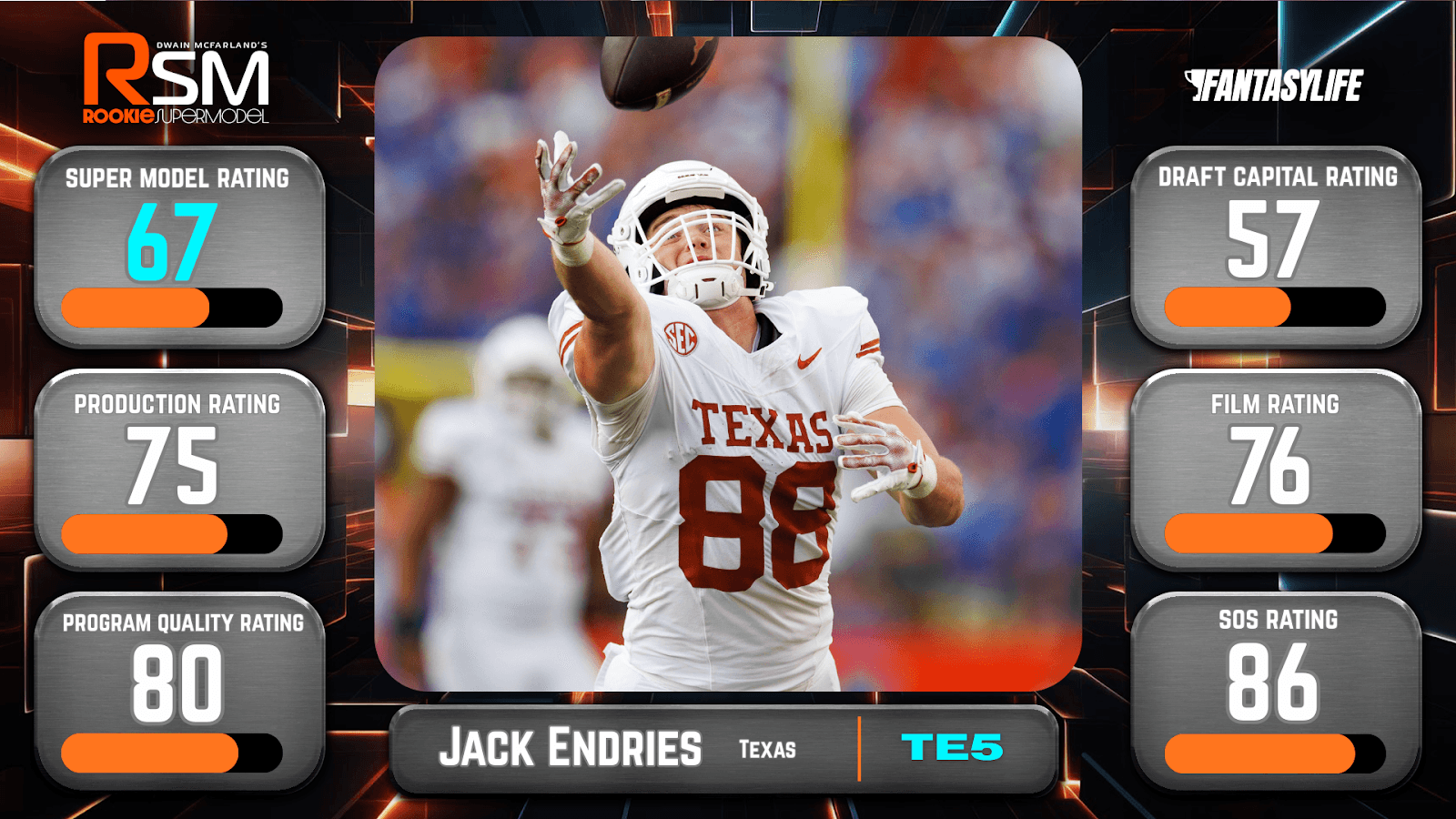
Endries was a three-star recruit from California in 2022, but ultimately walked on at Cal. He became the starter as a freshman, averaging 31 YPG before posting his best season in Year 2 with 48 YPG.
He entered the transfer portal as a four-star recruit ahead of Year 3. The University of Texas had a need after Gunnar Helm left for the NFL and signed the No. 4 TE in the portal.
What the Production Says
Endries got off to a hot start at Cal, delivering the 10th-highest Year 1 RYPTPA (0.94) and the 15th-highest Year 2 RYPTPA (1.34) in the database. However, he struggled in his final season at Texas, posting a 0.82 RYPTPA, which ranked 85th.
- Adjusted Career RYPTPA: 44th percentile
- Targeted QB Passer Rating: 106.1, 65th percentile
Adjusted Career RYPTPA: Career receiving yards per team pass attempt adjusted for age, strength of schedule, QB play, teammate competition, aDOT and alignment. Doesn't count games missed.
He never topped three TDs in a season, and his best receiving year was 48 YPG in Year 2. At Texas—a stronger program—Endries was the No. 4 passing game option with a 12% target share.
In summary, Endries flashed potential, but a stronger season at UT would have gone a long way toward improving his adjusted career RYPTPA.
Endries' per-route data points fell within similar percentiles, suggesting he was a slightly below-average collegiate producer.
- Career YPRR: 1.41 (47th percentile)
- Career FDPRR: 7% (47th percentile)
- Career TPRR: 17% (41st percentile)
Beyond the Production
Endries was primarily a threat in the short area of the field, rarely earning deep targets. His 6.8 aDOT (31st percentile) accurately portrays his target-depth breakdown.
- Behind the line of scrimmage: 11% (+0 vs avg)
- Short (0-9 yds): 62% (+12 vs avg)
- Medium (10-19 yds): 22% (-5 vs avg)
- Deep (20+ yds): 5% (-7 vs avg)
His data profile suggests a plus-hands player with limitations as a playmaker. He was an average YAC player with a mark of -0.1 over expected after adjusting for aDOT. But his 3.1% drop rate was great, and his contested catch rate of 59% on 32 contested targets was strong.
Similar to some of our other receiving-archetype TEs in this class, Endries aligned detached from the line more often than not (43% in-line snaps). He also has massive questions as a run blocker with a career PFF Grade of 50.1 (22nd percentile).
For a slightly below-average receiving profile, this is a red flag. Most of the lower-rated blockers who found their way onto the field at the next level were so good as receiving prospects that their teams were willing to make a tradeoff. Endries isn't in that category.
Lance Zierlein of NFL.com has a 6.18 prospect grade (52nd percentile) for Endries. Zierlein highlights Endries' contested-catch ability as a strength, but also notes concerns about blocking and play strength. He also sees him as a player who can stress the intermediate areas of the field, which isn't how he was deployed in college. Ultimately, Zierlein sees him as an "F" option that should develop into a starter.
Fantasy Football Outlook For TE Jack Endries
Since 2018, 49 TEs have posted a Super Model rating between 62 and 72, with 12% delivering a top-12 finish by Year 3.
- Top-six finishes: 4%
- Top-nine finishes: 8%
- Top-12 finishes: 12%
Endries' closest Super Model comps:
Bottom line: Endries profiles as a mid-round NFL Draft pick in the Rookie Super Model. He flashed solid production early in his career and will only be 22 when the next NFL season kicks off. However, his production regressed at a stronger program after transferring to Texas. Endries has good hands and is a proven underneath receiver, but is an average operator after the catch. His blocking needs work, which could limit playing time early, but he has potential to develop into a full-time player based on his Film Rating. Endries is a borderline TE2 prospect with low-end TE1 upside in fantasy football. Going to Cincinnati, he'll be well behind even Mike Gesicki for targets.
Glossary of Terms In The Prospect Profile
- Adjusted Career RYPTPA: Career receiving yards per team pass attempt adjusted for age, strength of schedule, QB play, teammate competition, aDOT, and alignment. Doesn't count games missed.
- aDOT: Average depth of target in yards.
- Career Targeted QB Passer Rating: Passer rating on WR's targets.
- Contested catch rate: Percentage of contested targets caught.
- Contested catch rate over expected: Percentage of contested targets caught after adjusting for aDOT.
- Draft Capital Rating: Based on Chase Stuart's Draft Value Chart, an improved version of what many know as the Jimmy Johnson trade chart. It accounts for the larger drop-off in the first round and a flatter drop-off around the end of the second round.
- FDPRR: First downs per route run. Often shown as a percentage (first downs divided by routes).
- Film Rating: Based on NFL.com prospect grades from Lance Zierlein.
- Production Rating: A combination of adjusted career RYPTPA and career targeted QB passer rating.
- Program Quality Rating: ESPN's College Football Power Index is used to assess program quality. The model accounts for each school a prospect attended.
- RYPTPA: receiving yards per team pass attempt.
- SOS Rating: Based on strength of schedule (SOS) from Sports Reference. The model accounts for each school the prospect attended.
- Target Share: A player's percentage of team targets in games played.
- TPRR: Targets per route run.
- YAC: Average yards after the catch.
- YAC over expected: YAC over expected after adjusting for aDOT.
- YPG: Yards per game.
- YPRR: Yards per route run.

Join Our Newsletter
Trusted by 400,000+ fantasy football players. Get access to Fantasy Life's free award winning newsletter and tools, all in one step.
By registering or logging in, you agree to our Terms of Use and Privacy Policy.
Players Mentioned in this Article





Published Updated