
Fantasy Football Tight End Rankings For 2026: Brock Bowers, Tucker Kraft and More
Adam Pfeifer breaks down each of the top-12 tight ends in Fantasy Life's consensus fantasy football rankings.
Last week, we broke down the top 12 wide receivers in our consensus fantasy football rankings.
This week? It’s tight end time.
Though often famous last words, I do believe (again) that tight end is kind of, sort of, possibly deep this season? I know, I know. There are usually only a few true difference-making players at the position. But I really like a bunch of players that are outside the consensus top 12.
We’ll see how that works out for me. But for now, let’s dive into the top 12 fantasy tight ends as we head into June.

Unlock Our Tools!
Stop hitting the paywall. FL+ gives you access to our premium in-depth content, expert rankings & projections, mock draft simulator, and all the tools you need – all personalized to your league.
Tight End Rankings For 2026 Fantasy Football
 1. Trey McBride | ARI
Once upon a time, there was a really, really talented tight end who just couldn’t score touchdowns. He tried, and he tried, and he tried, but no matter how often he called, he just couldn’t make reservations for six. But one year, after seasons of misfortune, everything broke right, and the touchdowns poured in.
And it was awesome.
After scoring a combined five touchdowns on 192 receptions from 2023-24, McBride scored 11 times this past season en route to a TE1 fantasy finish. McBride paced the position in routes (694), catches (126), targets (169) and touchdowns (11). He’s obviously an elite player, but McBride undoubtedly benefited from underwhelming target competition and an insanely friendly weekly game script and volume.
From Week 6 on, no team in football was more pass-happy than the Arizona Cardinals. Week 6 kicked off the Jacoby Brissett run in Arizona, and for the rest of the season, the Cardinals' passing attack was very fantasy-friendly:
- 40.6 pass attempts per game (1st)
- 309.2 air yards per game (2nd)
- 6% dropback rate over expected (1st)
- 65% pass rate when leading by 4-plus points (2nd)
- 55% inside 10-yard line dropback rate (10th)
The pass volume was often by necessity, as Arizona trailed by eight or more points on 43% of plays during that stretch, the second-highest rate in football. Entering the 2026 campaign, the Cardinals are expected to once again be chasing points often, though the combination of a healthy Marvin Harrison Jr. and Michael Wilson could siphon some targets away. And with Brissett holding out (no, seriously) and a brutal schedule, we could easily see snaps from Gardner Minshew or even Carson Beck this year.
McBride is the TE1 in the consensus ranks, but he’s not my top tight end for 2026.
 2. Brock Bowers | LV
I mean, the guy is a football robot from heaven.
Need I say more?
A PCL injury derailed a huge sophomore season from Bowers, who recorded over 100 yards in Week 1 before suffering the injury late in the game. He battled through the injury the next three weeks, but ultimately was placed on injured reserve. Bowers returned in Week 9, but wasn’t quite the same player. The good news? In an injury-plagued, down season, Bowers still ranked second among tight ends in PPG (14.7) and target share (24%), both of which are very strong numbers. But the better news?
That’s probably Bowers’ floor.
Look back to his 2024 rookie campaign. Bowers ranked first in targets (153), averaging nine per game, while sporting a 26% target share and 25% TPRR. Fast forward to the present day, and Bowers’ current target competition in Las Vegas is pretty uninspiring:
With improvements to both the quarterback and offensive line positions, look for Bowers to benefit, while very possibly seeing more targets than almost any other player in football.
 3. Colston Loveland | CHI
An offseason shoulder injury led to a slow start to Loveland’s NFL career. From Weeks 1-7, Loveland logged just 44.8% of the snaps and ran 45% of the routes. But from Week 8 on, Loveland emerged as not just the team’s top tight end, but their best pass-catcher.
During that stretch, Loveland ran 72% of the routes, logged 72.4% of the snaps and was targeted on 24% of his routes. That was the highest rate on the Bears, and the later the season, the more Chicago involved Loveland. From Weeks 17-20 (playoffs included, obviously), Loveland saw double-digit targets in all four games, averaging 12 looks per game while sporting a whopping 32% TPRR and 31% target share. We’re obviously not going to expect that usage to start his sophomore season, but following the trade of DJ Moore, Loveland is expected to be a focal point of this Bears’ passing attack. And with the addition of Ben Johnson and the progression of Caleb Williams, we know this offense is on the rise.
2024 Bears Offense:
- Points/Drive: 1.59 (28th)
- TD drive rate: 18.2% (24th)
- 3rd down conversion: 32.9% (31st)
- EPA/Play: -0.09 (26th)
- Shift/Motion rate: 46% (20th)
2025 Bears Offense:
- Points/Drive: 2.33 (11th)
- TD drive rate: 25.7% (12th)
- 3rd down conversion: 42.7% (7th)
- EPA/Play: 0.04 (9th)
- Shift/Motion rate: 60% (7th)
 4. Tyler Warren | IND
You know how we talked about how Loveland’s rookie season took off in the second half? Well, Warren’s was the complete opposite.
To open the NFL season, the Colts were the surprise around the league. Daniel Jones’ career was revived in Indianapolis, Jonathan Taylor was dominating and the Colts had one of the best offenses in football. From Weeks 1-10, Warren ran 83% of the routes, while sporting an identical target share and TPRR (21%). His 13.6 PPR PPG during that span was good enough for TE2 in fantasy.
Everything was looking good.
But as the schedule got tougher, the Colts' offense began to come back down to Earth. And then when Jones went down in Week 14, a once borderline elite Indianapolis offense became much more difficult to trust. The Colts shocked the world, bringing back Philip Rivers to play quarterback in the year 2026. It went … as you’d expect. Laughably low aDOT, no vertical passes and a lot of handoffs to Taylor. As a result, Warren’s fantasy ceiling cratered, averaging just 26.6 receiving yards and 6.3 PPR PPG from Week 14 on.
Entering 2026, the Colts expect Jones to be ready for Week 1, which bodes well for Warren. But so does the absence of Michael Pittman and his 111 targets. One of my favorite storylines to track this year is who sees a boost in RPO targets in Pittman’s absence. Last year, Pittman saw 12 such looks, the third-most in all of football. Shane Steichen loves to throw passes out of RPO concepts and because they are pre-determined looks to a specific player, they are very valuable for fantasy football. It wouldn’t shock me if they went to Warren, especially considering how creative their usage of him is. As a rookie, Warren lined up all over the formation and even saw three goal-line looks and one red-zone pass attempt.
Warren is widely considered the TE4 in fantasy, and I can’t say I disagree.
 5. Harold Fannin Jr. | CLE
Fannin was THE breakout tight end last year, finishing seventh in PPG (11.7). He emerged as Cleveland’s top pass catcher, ranking first among all tight ends in TPRR (24%), while his 22% target share was good for fourth. The Browns featured Fannin with plenty of schemed looks, while lining him up all over the formation.
Despite dealing with poor quarterback play and the presence of David Njoku, Fannin still saw 108 targets. That number could easily drop this year after the Browns added KC Concepcion and Denzel Boston during the offseason. Plus, the Browns have one of the friendliest schedules in football, potentially leading to less point-chasing game scripts. Still not even 22-years-old, Fannin will remain a focal point of Cleveland’s passing attack, with his schemed touches and YAC ability giving him a strong floor/ceiling combo.
 6. Tucker Kraft | GB
Kraft enjoyed a mini-breakout in 2024, hauling in 50 passes for 707 yards and seven touchdowns. He was set to see that breakout and raise himself with a true emergence in 2025, but a Week 9 ACL tear cut his season short. If it weren’t for his season-ending injury, Kraft likely would have finished as a top-three fantasy tight end and would probably be in Tier 1 at the position.
Simply put, Kraft is one of the most skilled tight ends in football. From Weeks 1-8, you’d be hard-pressed to find many tight ends with more impressive metrics:
- 2.49 YPRR (2nd)
- 13 screen routes (1st)
- 469 receiving yards (3rd)
- 11.2 YAC/REC (1st)
- 15.6 YPC (1st)
- 16.2 PPR PPG (1st)
Kraft’s insane efficiency and propensity for explosive plays made up for his ranking just 18th among tight ends in routes per game during that span (27.3). He’s easily the best yards after the catch tight end in football, leading that category since 2023 (9.1), which is why Matt LaFleur designs so many screens for him. Coming off the ACL tear, Kraft may not come out of the gates so strong. But once he’s full-go, expect top-six production, with upside for top-three.
 7. Sam LaPorta | DET
Are you starting to see a theme with the tight ends from last season?
Injuries suck.
Like Kraft and Bowers, LaPorta also missed time last year with a bothersome back issue that ended his season in Week 10. When healthy, LaPorta is obviously good, though he hasn’t been able to return to his rookie season heights when he caught 86 passes for 889 yards and 10 scores. Because we know Amon-Ra St. Brown and Jahmyr Gibbs are getting theirs no matter what, it often comes down to LaPorta and Jameson Williams on a weekly basis. Since 2024, LaPorta has averaged 10.7 PPR PPG in contests where Williams records at least 50 receiving yards. You know, the games he doesn’t completely disappear. That’s nearly two points per game fewer than his career average of 12.3. And with Williams on the field during that span, LaPorta is sporting an 18% TPRR, which would have ranked 25th among qualified tight ends last season.
The Lions have brought in Drew Petzing as offensive coordinator, so perhaps his tight-end-friendly scheme can help LaPorta return to elite fantasy status. But with so much target competition in Detroit, his ceiling appears to be capped.
 8. Kyle Pitts | ATL
“Don’t let your dreams be dreams.” ~ Shia LaBeouf
The fantasy community’s dream was for Kyle Pitts to finally become the tight end he was meant to be. And after three straight underwhelming seasons following his 1,000-yard rookie campaign, Pitts finally reminded us what he’s capable of, hauling in 88 passes for 928 yards and five scores this past season. He ranked third among tight ends in routes, second in targets, second in yards and second in fantasy points. Admittedly, Pitts did do a lot of his damage with Drake London sidelined. From Weeks 12-15, Pitts posted elite marks across the board:
- 26% TPRR (2nd)
- 29% target share (2nd)
- 38% 3rd/4th down targets (1st)
- 20.1 PPR PPG (2nd)
It was a huge boost for Pitts, who posted a 19% TPRR and 21% target share with London active during the first 10 games of the season. But perhaps more importantly, Pitts, who was clearly limited by MCL and PCL issues in 2024, looked healthy this past season. We’ll see what 2026 has in store for Pitts, especially considering he won’t be catching passes from Kirk Cousins anymore, and London will be healthy. But after their star wideout, the Falcons don’t have any pass catchers to take targets away from Pitts.
 9. Dalton Kincaid | BUF
The good? When Kincaid is on the field, he’s more than likely getting the ball.
The bad? He’s not on the field a whole lot.
This past season, Kincaid tied Fannin for the highest TPRR among all tight ends (24%). Unfortunately, between injury and personnel tendencies in Buffalo, Kincaid ran a route on just 51% of dropbacks, which ranked 33rd among qualified tight ends. It’s a shame, too, because Kincaid’s analytics scream elite fantasy tight end.
- 1st in TPRR (24%)
- 1st in YPRR (2.8)
- 1st in 1st downs per route run (0.14)
- 1st in yards per target (11.7)
Kincaid has been battling through PCL issues since 2024, but this offseason, he stated that this is probably the best he’s felt at this point of the offseason. That’s comforting, but head coach Joe Brady also said Kincaid may have his playing time managed throughout the year. And when you also have Dawson Knox and Jackson Hawes on the roster, it makes sense. Given his elite per-route metrics, an uptick in routes is a very exciting thought. But until we see it happen, Kincaid remains a low-end TE1.
 10. Travis Kelce | KC
Kelce will return for his 13th and possibly final season. The decline is apparent, as Kelce hasn’t reached 1,000 yards since 2022 after reaching that mark seven consecutive seasons. He also hasn’t eclipsed five touchdowns in each of the past three seasons, while his YPRR has been sub-1.5 every season during that stretch.
The Chiefs simply haven’t been as reliant on Kelce, who posted a target share south of 20% for the first time since his sophomore season. Rashee Rice is dominating the schemed looks, and with a massive upgrade in the run game with Kenneth Walker, Kelce may become even more of an afterthought in this offense. At 36 years old, Kelce is best viewed as a back-end TE1 with much less upside than we’ve grown accustomed to.
 11. Jake Ferguson | DAL
I understand why Ferguson is ranked as a top-12 tight end. He’s the top tight end of a fast, pass-heavy offense with a great quarterback.
And yet, I feel like others may have a higher ceiling.
Ferguson finished seventh among tight ends in targets last year (102), but his volume was inflated by games CeeDee Lamb either missed or left early. In five the games that Lamb played less than 50% of snaps (or missed entirely), Ferguson averaged eight targets and 17 fantasy points per contest. Two of his three highest-scoring outings came with Lamb sidelined. Just take a look at his utilization from Weeks 3-6 in particular:
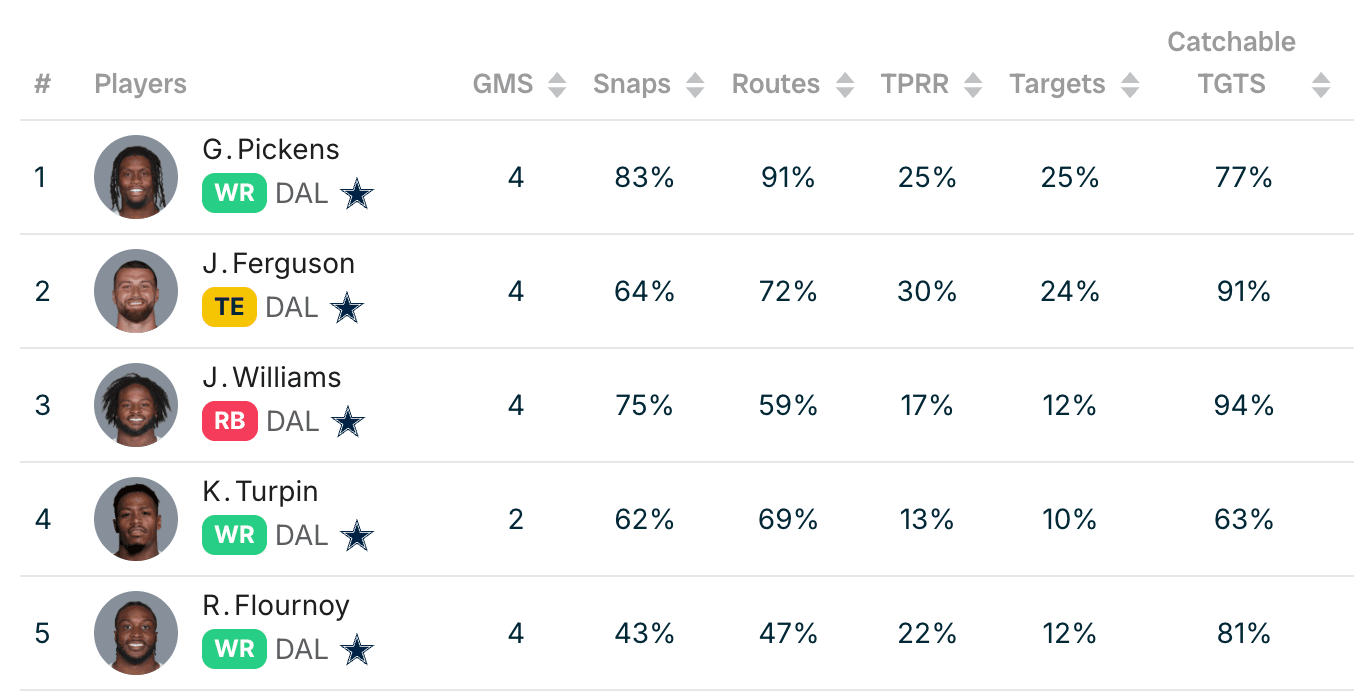
Meanwhile, when Lamb and George Pickens played in full, Ferguson averaged just 5.6 targets, 4.3 catches, 32.6 receiving yards and 9.5 PPR PPG. A dip in targets is especially notable for Ferguson since he doesn’t make the most of his looks to begin with. Ferguson recorded just two plays of 20-plus yards last year, while sporting an aDOT of just 5.0. In this offense, Ferguson will give you a solid weekly floor of receptions. But if Lamb and Pickens are healthy, there isn’t a very enticing ceiling.
 12. Dallas Goedert | PHI
Touchdown regression is about to hit Goedert like a ton of bricks.
After failing to catch more than five touchdowns in any season through his first seven years, Goedert exploded for 11 scores last season. He accounted for 40.9% of the Eagles’ targets from inside the 10-yard line, good for the second-highest rate in all of football. With the tush push losing effectiveness, the Eagles pivoted to the Goedert shovel, which also sounds like an awesome dance move. The Eagles often dialed up designed underhand/shovel passes to Goedert at the goal line, which accounted for five of his total scores. Goedert ultimately finished as fantasy’s TE5, despite ranking outside the top-10 tight ends in routes, targets and receiving yards.
Entering 2026, the Eagles seem poised to move on from A.J. Brown, but they’ll be replacing him with multiple pieces, making this passing attack far less concentrated than we’ve seen over the past few years. The 31-year-old also has sudden competition from rookie tight end Eli Stowers, making him a risky fringe-TE1 this season.

Join Our Newsletter
Trusted by 400,000+ fantasy football players. Get access to Fantasy Life's free award winning newsletter and tools, all in one step.
By registering or logging in, you agree to our Terms of Use and Privacy Policy.
Players Mentioned in this Article



Published Updated