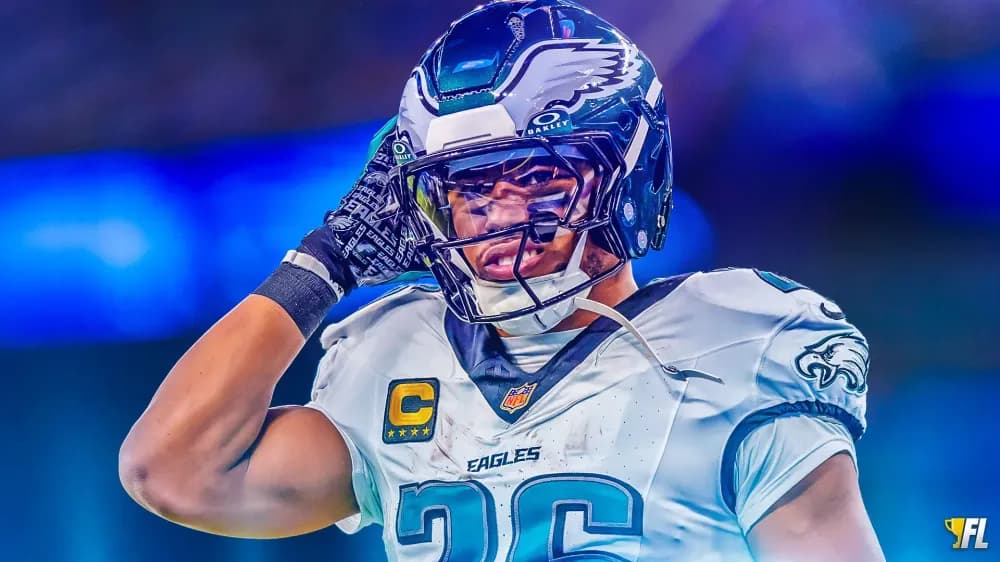
Fantasy Football 2026 Outlook: Can Saquon Barkley Go From Regression To Bounceback?
Adam Pfeifer breaks down how Saquon Barkley regressed last season and if he's a bounceback candidate for fantasy football 2026.
They say first impressions are everything.
In 2024, Saquon Barkley clearly got the memo. His first season as a member of the Philadelphia Eagles wasn’t just a success, it was one of the best seasons we’ve ever seen from a running back. Rolling up 2,005 rushing yards, 13 touchdowns to go along with 33 catches for an additional 278 yards and 2 more scores led to a position-best 22.1 PPR PPG. The idea of him behind the Eagles elite offensive line was exciting.
The result was borderline historic.
Entering the 2025 campaign, we knew some sort of regression was to be expected. Not just due to the toll 482 touches—playoffs included—can have on a running back, but the fact that usually when a player rushes for 2,000 yards, the yardage comes down the following year. Crazy, I know. But the dropoff was much steeper than anyone expected, making Barkley, then a top-3 overall selection, one of the top disappointments in all of fantasy football. Barkley rushed for 1,140 yards and 7 touchdowns, as his yards per carry plummeted to 4.1. But my favorite thing about fantasy football is that things don’t just happen. Finding out the why can make all the difference.
As we approach Year 3 of Barkley’s tenure in Philadelphia, there are plenty of changes within the Eagles offense. New playcaller, new receivers and a new offensive line coach will all impact Barkley in some fashion. But is a fantasy bounceback in store for one of the game’s best rushers?
Let’s take a closer look.

Join Our Newsletter
Trusted by 400,000+ fantasy football players. Get access to Fantasy Life's free award winning newsletter and tools, all in one step.
By registering or logging in, you agree to our Terms of Use and Privacy Policy.
Will Saquon Barkley's 2025 Regression Lead to 2026 Bounceback?
Again. Regression was bound to happen. But to this extent?
Something had to have gone wrong.
Let’s start with what disappeared from Barkley’s game—the explosive plays. In 2024, Barkley ranked second in the league with 17 runs of 20-plus yards, while comfortably leading the league with six runs of 50-plus yards. We know he’s always been one of the best home run-hitting backs in football, but the massive run-blocking upgrade he received when moving to Philadelphia played a key role. But this past season, the Eagles offensive line was often banged up, leading to a major step backward in the run-blocking department.
Those home runs suddenly turned into singles and doubles.
| 2024 | 2025 | |
|---|---|---|
| YBC/Att | 2.64 (1st) | 1.36 (23rd) |
| TFL Rate (Tackles for Loss) | 9.5% (24th) | 14.6% (3rd) |
| Stuff Rate | 17.1% (lowest among RBs) | 24.3% (3rd-lowest) |
| 20+-Yard Runs | 17 (2nd) | 4 (22nd) |
Watching Barkley play last season, I didn’t come away thinking “man, those near 478 touches from 2024 sure are catching up to him.” Instead, it was pretty evident that this wasn’t the same dominant offensive line, especially with injuries playing a role. We saw multiple starters on the Eagles offensive line miss time, most notably, RT Lane Johnson, who left a handful of games early before ultimately missing the final eight games of the year with a foot injury. Philadelphia was also without C Cam Jurgens for two games, while Landon Dickerson also missed one contest. But the absence of Johnson clearly told the story.
With Johnson on the field last season, Barkley’s overall numbers were clearly still down quite a bit from 2024, but they don’t look as bad when you consider what he did without his all-world right tackle. Barkley averaged 4.2 YPC and 1.97 YBC/ATT with Johnson on the field, while posting a 16.9% first down per rush rate. But with Johnson sidelined, the numbers plummeted even more, as Barkley averaged 4.0 YPC and just 0.88 YBC/ATT. And unsurprisingly, the Eagles offense was much worse without their star lineman on the field, averaging an ugly -0.04 EPA/Play and 5.1 yards per play, while posting a success rate of 39.1%. With Johnson on the field? 0.05 EPA/Play, 5.4 yards per play, 42.2% success rate.
Long story short, a healthy Lane Johnson alone should improve Barkley’s efficiency in 2026, especially if the rest of the offensive line can stay on the field, too.
On the bright side, at least Barkley’s volume remained strong. After averaging 23.6 touches per game in 2024, Barkley’s volume did come down a bit, but he still recorded a very healthy 19.8 touches per contest. He logged 79% of the snaps, while handling 70% of the rush attempts, 61% of the routes, 87% of the short down and distance snaps and 66% of long down and distance. Tank Bigsby looked explosive when given the opportunity, but he’s not a threat to steal meaningful work from Barkley. Instead, it was the shortcomings of the Philadelphia offense that led to Saquon’s drop in volume.
It’s no secret that Kevin Patullo’s scheme in Philadelphia last year was, well, overstaying its welcome. That’s the polite way to put it. The Eagles passing attack lacked any sort of creativity, resulting in way more stalled drives than we’ve grown accustomed to seeing from this offense. This past season, the Eagles posted the league’s fifth-highest three-and-out rate (38.2%), which was worse than both the Jets and Dolphins. Meanwhile, their 5.67 plays per drive were the 10th-fewest in football. Clearly, Barkley wasn’t the only one to regress from 2024. The entire Philadelphia offense took a huge step back, scoring touchdowns on 24.2% of drives (14th), while punting on 40.4% of drives. The only teams to punt at a higher rate than the Eagles last year? Cleveland, Tennessee and Las Vegas. Fortunately, things should be much better this time around.
I hope.
Saquon Barkley’s 2026 Fantasy Football Outlook
The Eagles hired Sean Mannion as the team’s new offensive coordinator this offseason. He is set to deploy more motion and under-center snaps. Both are fairly foreign concepts to the Eagles, but could be a terrific change of pace. Philadelphia has primarily operated from the shotgun over the years, leading to 445 runs out of shotgun from Barkley since 2024, the most in all of football. An uptick in under-center run plays is an exciting concept for Barkley, who can get downhill faster and see things a bit clearer. And although the sample size isn’t massive, we have seen Barkley impress on non-shotgun runs over the past two seasons:
- 5.3 YPC
- 2.04 YBC/ATT
- 22.2% avoided tackle rate
- 18.9% first downs per rush
Barkley is going to have more opportunities to run outside zone and get to the edge in this offense, which will hopefully help him get back to hitting home runs. But overall, Mannion’s offense, which should resemble Sean McVay and Matt LaFleur’s systems, will make things easier on everyone. Last year, the Eagles lacked any creativity, relying on Barkley, A.J. Brown and DeVonta Smith to simply win. And because they are great players, sometimes they did. But when they didn’t, this offense was pretty easy to defend, leading to those aforementioned stalled drives. The Eagles deployed hitch routes 24% of the time, easily the highest rate in football. And if/when nothing was open, it was usually the wideouts playing backyard football. Mannion’s creativity is going to make this offense more dynamic and less predictable, both of which benefit Barkley.
The Fantasy Life projections currently have Barkley penciled in for 284 carries, behind only Jonathan Taylor and Derrick Henry. He’s projected for nearly 21 touches per game, and given the expected boost in efficiency, that’s pretty exciting. Bijan Robinson and Jahmyr Gibbs are the clear top 2 running backs, but it wouldn’t at all surprise me to see Barkley finish third this season.
Now a second-round fantasy selection, Barkley is an ideal bounceback candidate for 2026.

Unlock Our Tools!
Stop hitting the paywall. FL+ gives you access to our premium in-depth content, expert rankings & projections, mock draft simulator, and all the tools you need – all personalized to your league.
Players Mentioned in this Article


Published Updated