Draft Strategy From The 1.06 In Fantasy Football 2026: Build Around Amon-Ra St. Brown
Chris Allen examines the 2026 fantasy football draft strategy from the 1.06 draft slot.
Django Unchained is in my top 10 for Greatest Movies of All Time. I’d recategorize it from a western to a film out of the MCU, but that’s a whole other debate. Anyway, I keep going back to Dr. King Schultz’s (played by Christoph Waltz) last moments.
He and Django were caught dead to rights and had to pay for their freedom before leaving a plantation. And instead of making the best of a bad situation, Schultz made a move that cost him. The sequence after, and the music, is an easy rewatch, but the decision left me confused on my first few viewings.
Because, like drafting from the 1.06, you could gauge where you’ll stand once the bullets stop flying and plan out your attack. There are multiple options in front of you. Some good. Some bad. But making a less-than-desired scenario worse will cut down your chances of succeeding before you even start.
Fantasy Football Draft Tip For The 1.06 In 2026
The Anatomy of THE WR1
Every season we try to find that year’s star WR. The next Jaxon Smith-Njigba. The next Ja'Marr Chase. And if you look at last year’s overall WR1, that gives us a glimpse at what it takes to be the league’s top receiver.
So, it’s simple. Find a guy that’s large and fast with skates for cleats who can throw their body around with simultaneous grace and reckless abandon. Sounds easy enough. Just give me a top-4 pick in all of my drafts, and I should be fine. But that range of WRs hasn’t always given us the guy we see winning leagues each year.
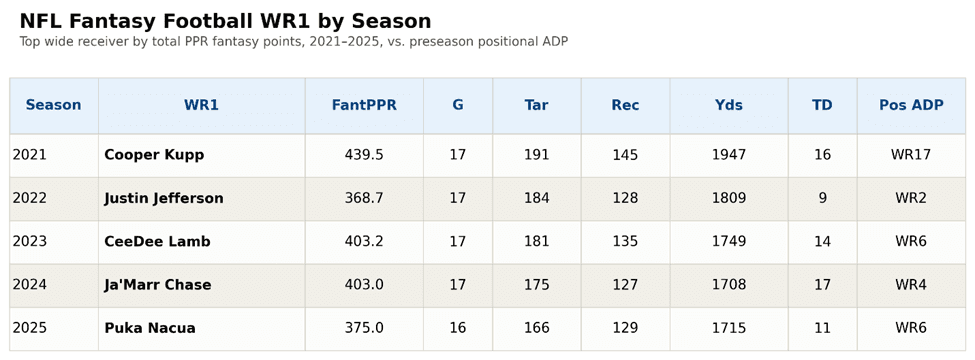
Of course, with the gift of hindsight, the ascension of every receiver in the table to the top spot makes sense. Well, it’d sure be nice if we knew that ahead of time. To help, I went under the hood of their campaigns to find the metrics that correlated the most with their fantasy totals.
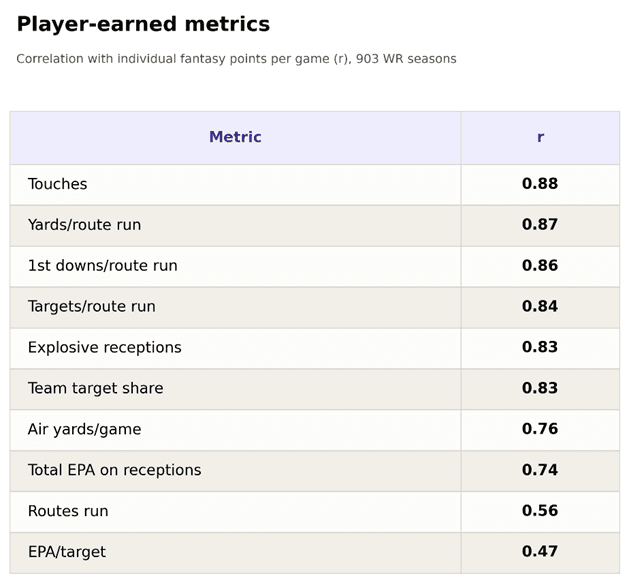
This sample actually goes back to 2015, but the takeaway is still the same. Volume is king. And for receivers, what you do with that volume (i.e, create first downs or explosives) makes all the difference between a top-12 receiver and the guy you ride through the playoffs. However, there’s a saying that “fantasy value resides at the intersection of talent and situation.” Or another along the lines of “just draft good players from good teams.” Coincidentally, the data points in the same direction.
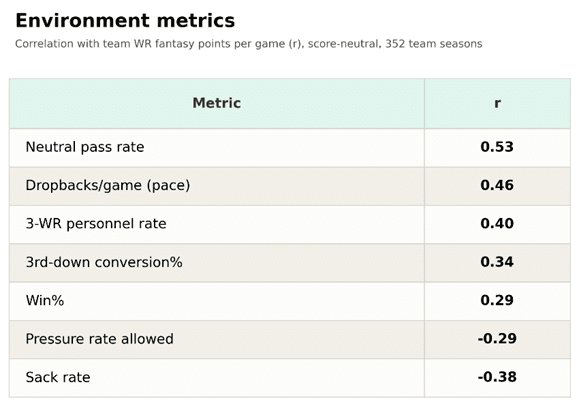
Seeing teams that decide to throw more (independent of the game situation) and can sustain drives while doing it contributing to overall-WR1 results makes sense. But again, all of this comes from looking in the rearview window. Or, as the nerds say, it confirms our priors. What we really need is a way to spin this forward.
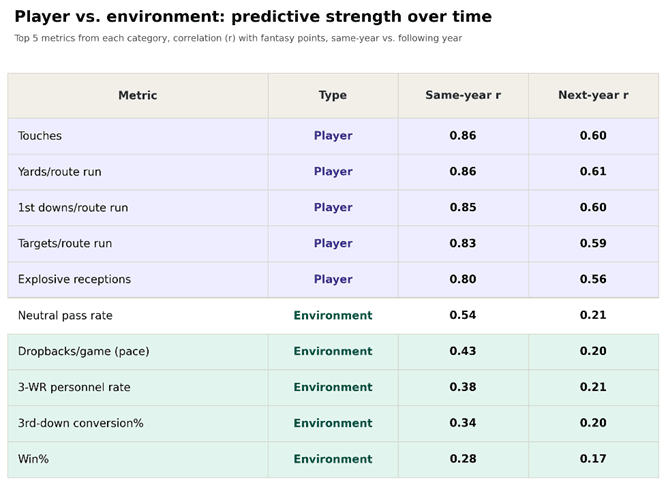
Using the same 11-year data set, I found which player and environment (read team) metrics were predictive year over year. Some have a strong signal (i.e., higher next-year r value), and most are at the player level. Again, that’s an intuitive result. Playcallers change, QBs can go down, offensive line units can fall out of sync or a myriad of other problems. Unsurprisingly, the receiver has the most control over their own future and not their team’s. Regardless, let’s pull all of this together and see which situations are the most conducive to bearing WR1 fruit based on past year’s output.
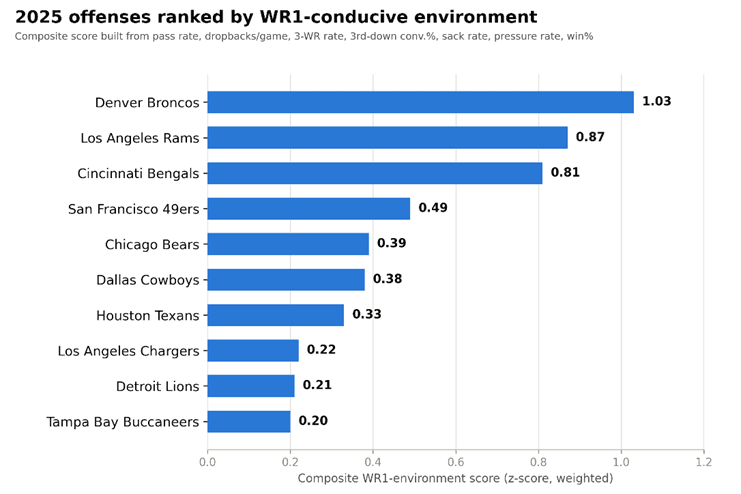
I standardized the top team metrics and added weights based on their predictivity (r value). Afterward, I summed them together to create a composite score. Admittedly, it’s not perfect. But the results at least pass the sniff test (I saw the Bengals on the list and immediately assumed I was right). Even better, we can gather some clues as to the potential origin of a new WR1.
Jaylen Waddle’s new situation in Denver sticks out.
With the former Dolphin, talent hasn’t been the issue. Across his five seasons as a pro, Waddle has finished inside the top 10 in YPRR and 1D/RR run three times. Now remember, those two stats are the second- and third-most predictive metrics for the overall WR1. But playing alongside Tyreek Hill kept Waddle from the volume to break into the elite discussion.
Bo Nix’s target rate to slot receivers climbed to 27.6% in ’25 while his deep-ball rate took a slight step back (11.6% to 10.8%). With Troy Franklin and Marvin Mims as his only targets outside of Courtland Sutton, and neither cracking the Top 24 in any efficiency metric, Waddle fills a stylistic gap as Nix develops as a passer.
But if not Waddle, then Nico Collins as the Texans revamp their offensive line with a fourth-year QB that’s flashed in previous segments of his career. Or maybe we’re understating Rome Odunze’s foot injury and the perfect storm of Caleb Williams and Ben Johnson in Year 2 combined with DJ Moore’s absence is the recipe for success. All are reasonable bets in 2026 based on the profile we’ve established for a top receiver in fantasy.
Now, let’s draft!
For reference, here’s the format I chose in our Draft Champion tool:
- 12 teams
- PPR
- 1QB, 2RBs, 2WRs, 1TE, 1FLEX, 1K, 1DST, 6 Bench
Matthew Berry's Draft Day Manifesto
You’re On the Clock at 1.06!
As I alluded to in the intro, let’s lay out your bad situation if you’re drafting from the six spot.
Sure, in your league, the order of the names might dither. Or, you’ll see Christian McCaffrey slide in place of JSN due to the RB’s dual-threat ability. Regardless, the state of the draft board remains the same.
The top-2 RBs? Gone.
The WRs with proven track records to be the overall WR1? On your rivals’ rosters.
Things look even more grim if you believe Father Time has come for McCaffrey. You start looking farther down the list of available players. Maybe Jonathan Taylor can recapture his early-season magic of multi-TD games with Daniel Jones cleared for camp. Or Justin Jefferson (hopefully) paired with the best QB of his career can beat his ADP. However, if we use the player metrics from ‘The Anatomy of THE WR1,’ there’s less cause to exacerbate your circumstances.
- Touches per Game (2023-2025): 4th (out of 74 WRs – min. 6 games per season)
- Yards per Route Run: 6th
- 1st Downs per Route Run: 3rd
Of the eight metrics most conducive to finishing as the overall WR1, Amon-Ra St. Brown has ranked no less than sixth over three years in seven of them. On top of all that, he’s accrued the highest team target share (29.0%) amongst his peers. It’s why he’s been a staple of the first round. But it’s always the middle of the opening set of picks. And we all know why.
- (Detroit) Neutral Pass Rate Rank: 24th (2023), 26th (2024), 5th (2025)
- Dropbacks per Game Rank: 28th, 26th, 6th
Last year was the first time we’ve seen the Lions open up their passing game. Their balanced and methodical approach to winning games was great for Detroit fans, and kind to gamers with St. Brown on their rosters. But the Lions’ play volume oscillated around the league average, capping the ceiling of their WR1. However, there’s a chance that 2025 wasn’t a fluke.
Detroit’s defense opened training camp with multiple starters on the PUP list. This is the same unit that finished ’25 in the bottom half of the league in points and yards allowed. And their earliest rookie addition came on Day 2. The prospect of the Lions becoming the “Bengals of the North” isn’t far-fetched, making St. Brown (and the 1.06 slot by extension) a solid bet to exceed value.
Optimal Fantasy Football Draft Strategy
The Rest of the Early Rounds from the 1.06
I swapped the roster settings back to requiring two each of RBs and WRs to see if our build paths diverge in the second round. In short, they do. But it’s nothing we haven’t seen before.
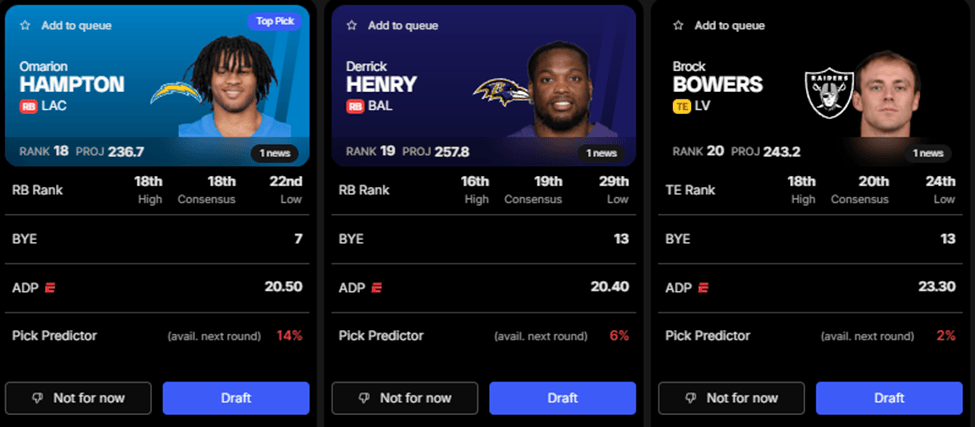
By this point, eight receivers were out of the player pool. That would put Brock Bowers at WR9 (or TE1). The exact position he finished in ’24, operating in a worse environment. This cost sits right at the threshold of consideration. Let’s look at the RBs available now and those with third-round ADPs to solidify our decision.
- Derrick Henry: 20.4 (ESPN ADP), RB6 (projected EOS Rank)
- Omarion Hampton: 20.5, RB14
- Kenneth Walker: 28.6, RB11
- Breece Hall: 32.5, RB15
Look at that. Outside of taking King Henry, I have a shot at nabbing two RBs with projections similar to Hampton’s later. A solid example of an arbitrage play. In either case, let’s work both sides of the coin and see where we land.
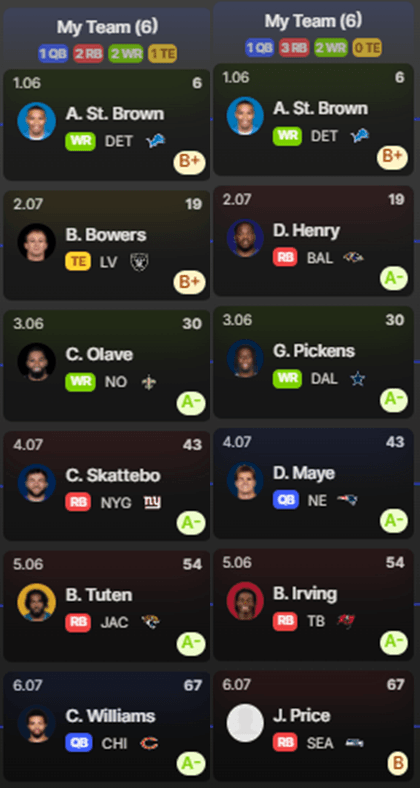
I took early QBs on both teams so I can focus on the core positions later. Also, I wanted to dig into Team 2’s addition of a third RB to close out the early rounds.
You could look at the rushers on both squads through six rounds and weigh them similarly. At least, Cam Skattebo and Bhayshul Tuten have paths to playing on passing downs. But for Bucky Irving, I have my doubts.
- Weeks 1-3: 63% (Route Rate), 15% (Target Share)
- Weeks 16-18: 45%, 9%
We can partially blame Irving’s injury for the decline. His nagging shoulder and lower-body ailments weren’t enough to keep him off the field, as his snaps were back up, but they were enough to tame his usage. However, more importantly, the offense was changing. Plays from 11-personnel formations were up with the WRs healthy. The same type of scheme the Bucs are likely to employ with Emeka Egbuka, Chris Godwin and Jalen McMillan all available to start the season. My uncertainty with Irving’s profile forced a slight pivot to take on another RB. Given the flatness of TE value and leaning on WR to start the draft, the risk was minimal.
Matthew Berry's Fantasy Football Rankings
Mid-Round Pitfalls When Drafting from the 1.06 in Fantasy Football
As always, let’s take a step back and take a big picture view of our roster. We’ll focus on Team 1. While having solid players, the weaknesses stick out.
- Need a TE1
- Need depth at RB/Want an RB2B
- Need depth at WR
Finding a tight end shouldn’t be a problem. Kyle Pitts (3rd in routes amongst all TEs in ’25; routes are a primary indicator of fantasy success for the position) and Sam LaPorta (5th) have 7th-round ADPs, or I can wait for other mid-tier options with a path to routes and targets like Dallas Goedert or Dalton Kincaid. Besides, I’d still like a WR for my FLEX slot. Coincidentally, a couple of past lessons combine to help me find the ideal receiver to open the middle rounds.
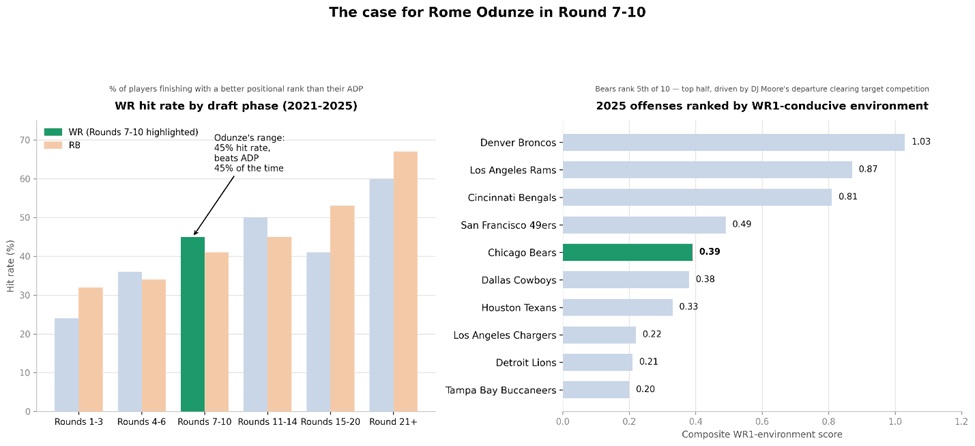
Rome Odunze’s ADP already sits in the range where WR hit rates are reaching their apex. Plus, Chicago’s offensive scheme and efficiency in Year 1 with Ben Johnson point to a similar (hopefully better) outcome in ’26. In other words, Odunze matches the profile for a potential overall WR1 as he still led the team in target rate with a busted foot. Also, there’s an argument he has a better bet to pay off his price than the Bears’ wide receiver whom drafters are currently taking ahead of him.
- Slot Target Rate: 22.0% (Loveland), 21.3% (Burden), 16.8% (Odunze)
- Slot Route Rate: 21.3%, 37.9%, 33.6%
While Odunze moves around the formation, a larger portion of Luther Burden’s work comes from the interior. The same area the now TE4 operates. They both play with a QB whose passing aDOT has ticked up since his rookie season. In other words, it’d be harder for both of them to succeed in the same area of the field. Odunze’s edge comes with his work on the outside. And with an offseason to get healthy, he fits in as the ideal receiver to add into a FLEX position.
Building a Championship Roster
All right. Let’s see how each team fared at least by the simulation’s standards.
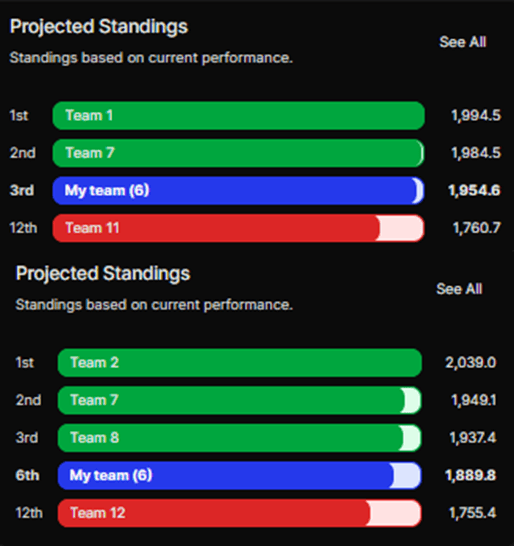
Understandably, taking an early TE with a QB in the seventh round will earn you favor in the projections. So, on the one hand, you could say that Team 1 “won” the draft. But look at Team 2’s projections.
Even after (slightly) waiting for a QB (4th round) and TE (7th), we’re only behind by 64.8 points. I say “only” because that’s 5.4 PPG if you spread it out over 12 weeks. A somewhat arbitrary timeline, but by then, you know who’s playoff-bound or not. So if all I need to do is make up five points a week with an edge at RB or WR, both strategies become viable to push for a championship.

Unlock Our Tools!
Stop hitting the paywall. FL+ gives you access to our premium in-depth content, expert rankings & projections, mock draft simulator, and all the tools you need – all personalized to your league.
Players Mentioned in this Article





Published Updated