
The History Of NFL Draft Capital: Where Rookies Are Selected Matters
Ian Hartitz analyzed historical data to determine how NFL Draft capital impacted rookie-year breakouts for skill-position players in fantasy football.
Underdog stories are a helluva drug. From Puka Nacua balling out as a fifth-round pick, to Peter LaFleur and his gang of Average Joes taking down Globogym in the American Dodgeball Association of America (ADAA) Championship: It's always fun to see the little guys come out on top.
Of course, these sorts of underdog stories understandably tend to get far more press and attention than chalk outcomes coming to fruition. It's fun to speculate who could be this year's Puka or James Robinson … but how often do these upsets actually occur in fantasy football land?
This brings us to today's goal: Breaking down the history of draft capital when it comes to top-scoring fantasy football rookies.
As always: It's a great day to be great.
How NFL Draft Capital Has Historically Impacted Rookie Breakouts
High-producing rookies are rare, but RB produces the most
And it's not particularly close. Overall, we've seen just six rookie quarterbacks and tight ends apiece post top-12 fantasy numbers as rookies since 2016. There have been only 13 wide receivers who have produced top-24 numbers over the last decade (PPR points per game, min. 8 games).
But running backs? A whopping 29 backs managed to put up top-24 per-game numbers over the last 10 years! That's more than every other position combined!
The Day 3 and undrafted representatives are awfully barren across the board, and a lot of the top performers had to benefit from preseason/early-season injuries. This is pretty true regardless of position:
- QB: Dak Prescott started from Day 1 with the Cowboys only because Tony Romo hurt his back in the preseason.
- RB: Soft depth charts helped a lot of these guys find their way to the top, but Elijah Mitchell (Raheem Mostert injury) and James Robinson (Leonard Fournette surprisingly released on Aug. 31) weren't exactly household names throughout the summer draft months.
- WR: Tyreek Hill was only a Day 3 pick because of off-the-field concerns, while Puka at least somewhat benefited from Cooper Kupp missing the first month of the 2023 season.
- TE: None! Sheesh.
Of course, injuries do happen, and these players deserve credit for being talented enough to make the most out of their newfound opportunities, but yeah: Don't expect many (any?) Day 3 quarterbacks, wide receivers or tight ends to provide consistent booms in fantasy land as rookies without an injury or off-the-field-related draft fall occurring.
Running backs, while still rare, are relatively much more prevalent and seem focused on soft existing depth charts—looking at you, Commanders and Seahawks. Unfortunately, the relatively lackluster 2026 RB class could make it tough to see another late-round representative emerge in 2026.
So yeah: High-performing rookies are pretty damn rare in fantasy football land, and the ones who do ball out are usually Day 1 or 2 picks. But is this the case for players throughout the rest of their career?

Unlock Our Tools!
Stop hitting the paywall. FL+ gives you access to our premium in-depth content, expert rankings & projections, mock draft simulator, and all the tools you need – all personalized to your league.
Were most high-performing fantasy producers early-round draft picks?
Abso-lutely. An overwhelming majority of fantasy football's top-scoring players were drafted in Rounds 1-3, regardless of position. Late-round picks simply don't make a habit of putting up big counting numbers in the NFL even after finding their footing..
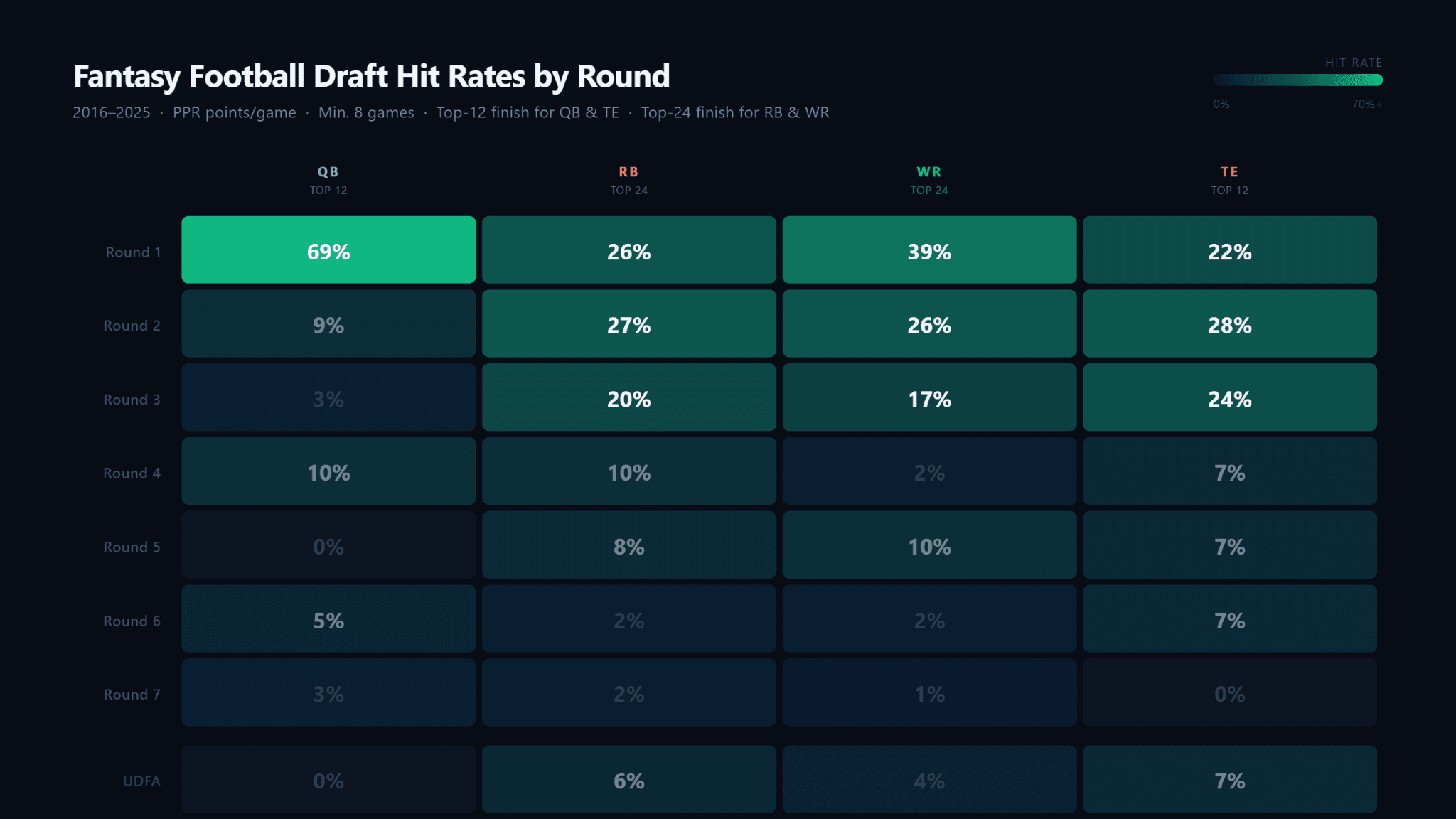
As we see, a very nice 69% of top-performing quarterbacks (top 12 in fantasy points per game) were originally selected in Round 1, while top-performing running backs (top 24), wide receivers (top 24) and tight ends (top 12) were spread out a bit more across the first three rounds of the draft. Still: We're talking about AT LEAST 72% of all top-performing fantasy producers originally being a Day 1 or 2 pick over the last decade of action.
And this does make sense at a high level: NFL teams pour millions and millions of dollars of resources into their draft prep. They take the players they believe to be the most talented first. Key decision makers within those organizations are also likely to give these high-investment types more opportunities and second chances than Day 3 picks.
NFL Teams Decide Playing Time, Not Draft Capital
It's fun to break down all sorts of prospects ahead of the NFL Draft. What else are us fantasy nerds and virgins supposed to do in April? Spend extra time with our family? Watch baseball? To hell with all that!
That said: Keep in mind that the opinions of NFL teams simply matter more than ours when it comes to projecting playing time–and thus, fantasy points. You might very well think Ted Hurst or Skyler Bell are the next big things at the position and deserve to be Round 2 draft picks, but it'd be silly not to adjust expectations in a pretty severe manner should they wind up falling to Round 4.
Again, this is just one piece of the puzzle as we try to predict the future of a sport that uses a ball that isn't even round. But keep in mind this simple reality during the thick of draft hype season: If the NFL didn't think enough of someone to be a top-100 pick, there's a pretty damn good chance that player won't be putting up big-time fantasy numbers anytime soon.

Join Our Newsletter
Trusted by 400,000+ fantasy football players. Get access to Fantasy Life's free award winning newsletter and tools, all in one step.
By registering or logging in, you agree to our Terms of Use and Privacy Policy.
Players Mentioned in this Article
Presented by



Published Updated