Using NFL Player Props To Exploit Fantasy Football Edges: Is Jared Goff Better At-Cost Than Joe Burrow In 2026?
Matthew "Daddy, Zaddy" Freedman is back from paternity leave ... aka back from months of studying NFL player props ... to highlight fantasy football edges to exploit that the draft market isn't accounting for.
Daddy (or "Zaddy," if you're feeling nasty) is back.
By the way, I'm daddy.
After spending the past couple of months on paternity leave, I have triumphantly returned to the world of the gainfully employed, which means now it's time for me to get serious about updating my fantasy football rankings, studying fantasy football ADP and adjusting my draft strategy.
With that in mind, I've decided to look at the NFL player prop market and see if there are any actionable takeaways and arbitrage-ish insights that might inform my approach to redraft, best ball, and Guillotine Leagues™.
Naturally, I believe I've found some. Here are three.
For all my content and ranks, use the promo code FREEDMAN for a 20% discount on the FantasyLife+ package.

Join Our Newsletter
Trusted by 400,000+ fantasy football players. Get access to Fantasy Life's free award winning newsletter and tools, all in one step.
By registering or logging in, you agree to our Terms of Use and Privacy Policy.
Fantasy Football Edges To Exploit From The Player Prop Market
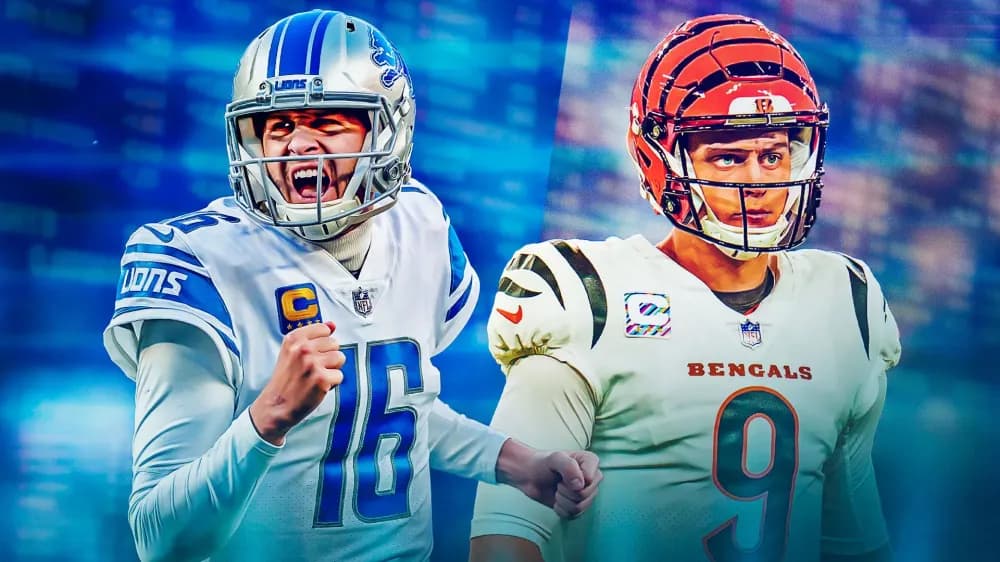
Why Draft Joe Burrow When You Can Get Jared Goff Later?
I have Joe Burrow ranked as a top-five QB, and he's universally going in the top four across all platforms.
He's better than Jared Goff.
But that raises the question: Is he actually better than Goff?
Over the past four years, Goff has had the superior AY/A and adjusted EPA/play (per RBs Don't Matter).
- Goff (2022-25): 8.3 AY/A | 0.202 EPA
- Burrow (2022-25): 7.6 AY/A | 0.180 EPA
On a passing yardage-per-game basis, Goff has also held the edge (267.7 vs. 264.9).
And Goff has played every game over the past four years, whereas Burrow has missed 17 games, literally an entire season's worth of contests.
If you look at DraftKings right now, Goff has the higher passing yardage over/under (4,099.5 vs. 3,999.5) and the superior odds to pass for 4,500+ yards (+210 vs. +250).
And in our fantasy football projections, we have Goff ahead of Burrow in our yardage projections (4,242 vs. 4,088).
I know numbers don't capture everything.
Burrow is the better player.
But he regularly goes in the first five rounds, while Goff is often available outside the top 100.
If I'm looking at pocket passers for fantasy, at cost, I probably prefer Goff.
Are We Sure Ja'Marr Chase Shouldn't Be the 1.01?
On almost every platform except for ESPN, Ja'Marr Chase is going as the consensus No. 1 WR.
That makes sense to me.
As I noted in my post-NFL draft edition of Freedman's Favorites, Chase over the past two seasons is No. 1 in targets (360), receptions (252), receiving yards (3,120) and receiving TDs (25), and that was without QB Joe Burrow for nine games last year.
No pass catcher is a QB-proof fantasy asset. Hall-of-Fame WR Larry Fitzgerald sadly proved that in the early 2010s.
But Chase has had 1,200+ yards receiving in four of five NFL campaigns. Since he entered the league in 2021, he's No. 2 in targets (767), receptions (520), receiving yards (6,837) and receiving TDs (54).
Out of the three WRs in the top WR tier (Chase, Puka Nacua, Jaxon Smith-Njigba), Chase is the old man at 26 years old, but that still puts him very much in his prime, and (in my opinion) he offers a reliable floor that the other two might not have, in part because of his TD-scoring prowess.
As yardage accumulators, Chase, Nacua and Smith-Njigba all have literally the same receiving over/under (1,324.5). They're all comparable in this regard.
But as an endzone excavator, Chase has the edge, ranking No. 1 in the market in odds to score 8+ (-450), 10+ (-155), 12+ (+155) and 15+ (+550) receiving TDs, whereas Nacua and Smith-Njigba are both outside the top three.
I'm the only ranker at Fantasy Life who has Chase as the No. 1 WR, and coming back from my baby-induced sabbatical, I've wanted to take some time to think about my position.
Because, honestly, I have Chase as not just my No. 1 WR. I have him as my 1.01.
As Dwain McFarland (our Director of Analytics) and I talked about months ago on an episode of Talk Data to Me, passing is down, which has especially impacted non-elite WRs, and in my thinking, that makes the best WRs (guys like Chase, Nacua, and Smith-Njigba) even more valuable.
And that means I'm more than willing to entertain the idea of taking a WR at 1.01 … and right now I think that guy should be Chase.
As the market indicates, the dude is as safe as a pass catcher can get.
Why Take Jonathan Taylor in Round 1 When Derrick Henry Goes in Round 2?
In fantasy, we generally want RBs who can contribute as pass catchers.
Receiving ability gives RBs the ability to play in more situations and thus accumulate more yards and TDs, and in leagues with point-per-reception scoring, RBs with three-down skill sets become all the more valuable.
And Jonathan Taylor is certainly a better receiver than Derrick Henry.
But that's accounted for in their price: Taylor is a locked-in first-rounder, whereas Henry rarely goes earlier than the middle of Round 2, and sometimes he's available in Round 3.
And I think it's worth asking this question: Are we sure Taylor is all that much better as a receiver?
Taylor is coming off a season in which he had a career-best 55 targets and averaged a career-high 22.2 receiving yards per game.
But in the two seasons before that, Henry and Taylor had the exact same receiving yardage per game (12.0), and Henry was more efficient (7.0 yards per target vs. 5.4).
I doubt Taylor will have another career-leading receiving season, which means that the gap between him and Henry might not be all that large … because Henry is likely the superior runner.
Despite joining the Ravens at the age of 30 years old, Henry has been an absolute T-800 Terminator dominator over the past two seasons. And that's not to take anything away from what Taylor has done in that stretch … but Henry has been the league's most dominant runner since 2024 (even at his advanced dotage).
- Henry (2024-25): 2.6 yards after contact per carry | 56.0% success rate
- Taylor (2024-25): 2.2 yards after contact per carry | 48.9% success rate
What do those numbers mean in terms of raw production?
- Henry (2024-25): 3,516 yards rushing | 103.4 yards per game
- Taylor (2024-25): 3,016 yards rushing | 97.3 yards per game
And then there's this nugget: Over the past four seasons, Henry has sat out just one game. Taylor: 16 games.
If we look at DraftKings, we see that Henry's the favorite to have 1,500+ (+230) and 2,000+ (+1500) rushing yards this year, whereas Taylor is tied for No. 4 in odds (+250, +1600) with Jahmyr Gibbs and James Cook.
And Henry's also tied with Gibbs at No. 1 to have 10+ (-370), 12+ (-160), 15+ (+175) and 20+ (+600) TDs rushing.
With new OC Declan Doyle, the Ravens offense is somewhat unknown, but Henry's ability and role aren't.
Even with Taylor's edge as a receiver, Henry has a shot to outproduce him in raw scrimmage yardage and scores this year.
Taylor's a fine selection in Round 1 … but I'd rather get Henry at the turn of Rounds 2-3.
Join Our Newsletter
Trusted by 400,000+ fantasy football players. Get access to Fantasy Life's free award winning newsletter and tools, all in one step.
By registering or logging in, you agree to our Terms of Use and Privacy Policy.
Players Mentioned in this Article
Presented by

 JaredGoffQBDET
- PPG
- 23.0
- Proj
- 19.5
 JoeBurrowQBCIN
- PPG
- 20.9
- Proj
- 18.3
 Ja'MarrChaseWRCIN
 JonathanTaylorRBIND
Published Updated