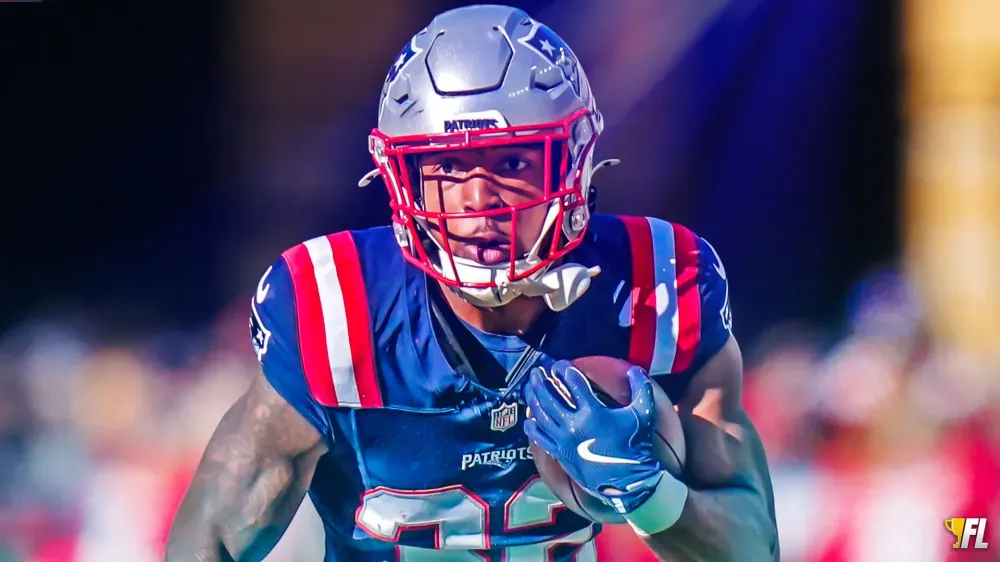
TreVeyon Henderson And More High-Risk, High-Reward Fantasy Football Picks For 2026
Adam Pfeifer profiles four high-risk, high-reward clicks in 2026 fantasy football drafts that offer league-winning upside with a scary-low floor.
Variance isn’t always a bad thing.
In fantasy football it can lead to high-upside opportunity if you take some stances on players others might be too worried about. Players that carry some risk and uncertainty, but also hold massive, league-winning potential.

Join Our Newsletter
Trusted by 400,000+ fantasy football players. Get access to Fantasy Life's free award winning newsletter and tools, all in one step.
By registering or logging in, you agree to our Terms of Use and Privacy Policy.
High-Risk, High-Reward Players For 2026 Fantasy Football
 Rashee Rice | WR | KC
Rice’s NFL career thus far has resembled a season preview of your favorite television show. The flashes and highlights over a small stretch are fun and exciting, but you’re really anticipating what it’ll look like when it all comes together.
We’ve yet to see a full season from Rice as a full-time starting wideout for the Chiefs, logging just 12 games over the last two years combined. Of course, when Rice has been on the field, both the fantasy ceiling and floor have been pretty, pretty strong:
2024 Weeks 1-3
- 33% TPRR (1st)
- 34% target share (2nd)
- 21.6 PPG (2nd)
2025 Weeks 7-15
- 29% TPRR (5th)
- 29% target share (10th)
- 18.0 PPG (8th)
That sample size has everyone expecting a top-seven season if he can play close to a full season. And it makes sense. The Kansas City passing game funnels through Rice, especially the older Travis Kelce gets. All of the designed and schemed touches go towards Rice. Over the last two seasons (again, 12 games), Rice is averaging 2.25 targets per game when in motion (3rd), while being targeted on 58% of such routes. During that same span, Rice ranks 11th in wide receiver screens with 25, despite the rest of the wideouts playing more than double the games.
Clearly, Rice has top-seven fantasy upside as long as he’s on the field. However, whether it’s been injury-related or off the field, Rice hasn’t always been available for the Chiefs, which does present some risk on draft day. And on top of that, while it sure seems like Patrick Mahomes will be ready for Week 1, it remains to be seen if he’ll be 100% healthy to open the season.
 Luther Burden | WR | CHI
Everyone, and I mean everyone, is excited about Burden in 2026. And don’t get me wrong.
You should be, too.
A preseason injury limited Burden’s early playing time, as the rookie only ran 46% of the routes on the year. However, when he was out there, he was getting the ball, sporting a team-high 23% TPRR. From Week 11 on, the involvement increased, as Burden’s route share climbed to 61%, while drawing a target on 24% of routes. During that stretch, so much of the schemed looks went Burden’s way, as 11 of his targets came from motion, with another seven being wide receiver screens. Whether you put a ton of weight into his 2.71 yards per route run (3rd-best) is up to you, but there’s no doubt that Burden will be heavily involved as a sophomore, especially with DJ Moore now in Buffalo. And while Burden’s prospects, especially in a Ben Johnson-led offense, are enticing, it does feel like he’s being drafted as if there is little to no ambiguity.
Burden is the first Bears player off draft boards right now, but this absolutely feels like a Chicago offense that is going to spread the ball around. And our fantasy football projections agree, penciling in Burden for 115 targets, with Colston Loveland and Rome Odunze right behind him with 114 each. Although we have him projected for the most targets (barely), it wouldn’t at all surprise me to see Burden finish third, especially when you remember how Odunze opened last season. From Weeks 1-8, Odunze was dominant, sporting a 23% TPRR and 26% target share. During that span, Odunze averaged 15.5 PPR PPG, good for 10th among qualified wide receivers, but a foot fracture derailed his breakout campaign.
I expect Burden to be good in 2026. No doubt about it. But I wouldn’t exactly consider him the safest fourth-round selection.
 TreVeyon Henderson | RB | NE
This time last year, we all expected Henderson’s immense talent to propel him to a starting role over Rhamondre Stevenson. At first, we were patient, understanding it might take a few games for the Patriots to fully commit to a rookie running back. So we kept waiting, daydreaming of the week Henderson took over the job.
It didn’t happen.
Even through another stretch of Stevenson fumbles, Henderson just didn’t take over the New England backfield. And to make things worse, the flashes were there, as the rookie drew three starts with Stevenson sidelined. The production, as expected, was awesome:
- 15.7 carries
- 88 rushing yards
- 4.0 targets
- 3.3 receptions
- 22 receiving yards
- 19 touches
- 24.3 PPR PPG
Upon Stevenson’s return, Henderson’s involvement did increase from the first eight weeks of the season. During Weeks 1-8, Henderson logged just 32% of the snaps, handled 29% of the rush attempts and averaged 8.6 touches per game. But following his three-week dress rehearsal as the starter, Henderson climbed to a 45% snap share, 53% rush share and 14.8 touches per game. This was it. Henderson’s promotion as New England’s RB1 was about to begin.
Not so fast.
During New England’s Super Bowl run, Stevenson re-emerged as the clear lead running back, logging 71% of the snaps and 61% of the rush attempts. Henderson averaged just 8.8 touches per game throughout the playoffs, while playing just 31% of the snaps during that stretch. Overall, in games Henderson and Stevenson were both active, the rookie averaged under 11 touches and just 8.4 PPR points per game.
Entering the 2026 season, I have zero idea what Josh McDaniels is going to do with this backfield. One would think the more explosive player who will only improve going into his sophomore season would naturally take on a larger role. But the Patriots trust Stevenson in all aspects, and while we want Henderson on the field, the veteran was pretty damn good last year, ranking third in yards per touch (5.9), 10th in yards per route run (1.45) and first in rushing yards over expected per attempt (+1.4).
Given his home-run hitting ability that could, in theory, relegate Stevenson to a backup role at any time, Henderson clearly has tantalizing upside. But Stevenson’s presence and strong play means Henderson could finish 2026 anywhere between a FLEX option and a top-15 fantasy running back.
 Brian Thomas Jr. | WR | JAX
You could probably place any Jacksonville receiver in this category, but especially Thomas, who has already had two polar opposite outcomes through his first two NFL seasons.
Following a breakout rookie campaign, Thomas took a massive step backwards in his sophomore season, hauling in just 48-of-91 targets for 707 yards and two touchdowns. The combination of injury, added target competition and changed role led to inconsistent, and often unusable, fantasy production from Thomas, who really slowed down during the second half of the season.
The Jaguars traded for Jakobi Meyers in Week 10 and from that point on, Thomas transformed into primarily a field-stretching wideout. From Weeks 10-19, 29.9% of Thomas’ routes were go routes, the 10th-highest rate in the league. During that span, over 35% of his targets came 20-plus yards down the field, while averaging just 5.2 targets and 8.9 PPR PPG. The addition of Meyers and emergence of Parker Washington relegated Thomas to a tertiary role, raising questions of what his usage may look like entering year three.
Thomas struggled on passes over the middle of the field last year, though it is worth pointing out he was battling through an early-season wrist injury. Perhaps he’ll see more in-breaking looks now that he’s healthy, which would certainly raise his floor. But with Meyers, Washington and Brenton Strange able to operate the middle of the field, it’s entirely possible Liam Coen keeps Thomas in a field-stretching role to give them space to work. There is still so much uncertainty around Jacksonville’s wide receiver room, and although last year was rough, I still hold onto hope that the true version of Thomas lies somewhere in between years one and two.
Join Our Newsletter
Trusted by 400,000+ fantasy football players. Get access to Fantasy Life's free award winning newsletter and tools, all in one step.
By registering or logging in, you agree to our Terms of Use and Privacy Policy.
Players Mentioned in this Article




Published Updated