The Worst Pick In Every Round Of 2026 Fantasy Football Drafts: Justin Jefferson, Travis Etienne & More
Adam Pfeifer goes through the first 10 rounds of fantasy football drafts to highlight the WORST pick you can make in each in 2026.
You can’t love every player in every round of a fantasy draft.
And if you do, well, drafting is probably a whole lot of fun.
Like everyone else obsessed with our addicting game, I’ve been staring at drafts and fantasy football ADP for months now. So, because I’m obviously in a terrific mood, I decided to highlight the worst picks you can make over the course of the first 10 rounds.
RELATED: The best fantasy football team names for 2026.

Unlock Our Tools!
Stop hitting the paywall. FL+ gives you access to our premium in-depth content, expert rankings & projections, mock draft simulator, and all the tools you need – all personalized to your league.
The Worst Pick You Can Make In Each Round Of 2026 Fantasy Football Drafts
 Round 1: Justin Jefferson | WR | Vikings
Choosing the worst pick in Round 1 is brutal. Everyone who goes in the first round of a fantasy draft is pretty damn good. And believe me, I am fully on board with the Justin Jefferson bounceback in 2026.
Poor quarterback play limited Jefferson to just 11.9 PPR PPG (28th) and two (!) receiving touchdowns. His 67.4% catchable target rate ranked 63rd among wideouts, while over 21% of McCarthy’s attempts were deemed bad throws, the second-highest rate among qualified signal callers. But when he actually had serviceable quarterback play, Jefferson did Justin Jefferson things.
In five games with Wentz under center, Jefferson averaged 10 targets, 6.8 receptions, 95.4 receiving yards and 16.3 PPR points per game. And the fantasy production is even more impressive when you consider Jefferson didn’t score a single touchdown during those games. Jefferson should benefit from the addition of Kyler Murray, who helped DeAndre Hopkins haul in 15 passes for 1,407 yards back in 2021.
But despite all of that, Jefferson’s ADP isn’t my favorite in the world, mainly because I’d rather draft the running backs that follow him (James Cook, Saquon Barkley, Ashton Jeanty).
Still love you, Jettas.
 Round 2: Omarion Hampton | RB | Chargers
As I mentioned in my 2026 Busts article, I am absolutely terrified about how wrong I could end up being about Omarion Hampton.
Terrified.
Hampton is an awesome player and flashed fantasy upside as a rookie. From Weeks 3-5 (post Najee Harris injury), Hampton’s per-game averages:
- 14.3 carries
- 6.0 targets
- 5.7 receptions
- 20 touches
- 121.4 scrimmage yards
- 21.8 PPR
Entering the 2026 season, Hampton will be the lead option for the Chargers’ new rushing attack led by Mike McDaniel, who is the best run game designer in the league. But will it feature multiple players? During Hampton’s absence, Kimani Vidal filled in admirably, ranking 13th in rushing yards and 14th in YAC/ATT (3.1). Los Angeles also signed Keaton Mitchell, who McDaniel coveted, giving them the game-breaking speed that perfectly complements this run scheme.
At the end of the day, I’m just not taking Hampton over Saquon Barkley, Kenneth Walker, Chase Brown or De’Von Achane this season.
 Round 3: Travis Etienne | RB | Saints
I’m not saying Etienne is suddenly going to be a useless fantasy option now that Alvin Kamara is officially staying in New Orleans.
But I do think he’s a poor selection in the third round.
A huge component of Etienne’s RB13 PPG campaign a season ago was his receiving work. Liam Coen’s screen-centric scheme benefited Etienne, who ranked third among running backs in screen routes (19), first in targets (12) and second in receptions (9), while scoring 6 receiving touchdowns, second to only Christian McCaffrey. Of his 52 targets from last year, 49 (94%) came on early downs, which tells me that most of his looks in the pass game were schemed up by Coen. He lost third-down work to LeQuint Allen, who ranked seventh in third-down routes, while logging 79% of the long-down-and-distance snaps, as well as 66% in the two-minute drill.
Now in New Orleans, Etienne is going to lose notable pass game usage to Kamara, while his rushing efficiency once again plummeted as the year went on. If I need a running back, there’s no way I’m drafting him over Javonte Williams or Josh Jacobs.
 Round 4: Tetairoa McMillan | WR | Panthers
McMillan is an awesome real-life receiver, but an overvalued fantasy one.
70 catches, 1,014 yards and seven touchdowns is a very strong season, especially for a rookie. But it didn’t exactly translate to a ton of fantasy upside on a weekly basis. McMillan finished as WR16 overall and WR20 PPG. He finished as a top-12 wideout just twice all year long, while ranking outside the top-24 receivers in 12 of 17 weeks. This is still an underwhelming passing attack, as Bryce Young failed to reach 200—not even 300—passing yards in 12-of-17 games. And among 37 qualified quarterbacks, Young’s metrics didn’t exactly wow anyone:
- 30th in EPA/play (-0.03)
- 33rd in YPA (6.3)
- 22nd in CMP% (63.6%)
No one should expect McMillan to struggle for targets in this offense. But it is also fair to wonder what the target share might look like with a fully healthy Jalen Coker, who made his season debut in Week 8. And following Carolina’s Week 14 bye, which included Carolina’s playoff game against the Rams, the usage was eyebrow-raising:
- McMillan: 23% target share, 18% TPRR, 25% EZ targets
- Coker: 22% target share, 19% TPRR, 32% EZ targets
 Round 5: Bucky Irving | RB | Buccaneers
I’ve talked about it all offseason, but I want nothing to do with Irving this season.
Shoulder and foot injuries sidelined Irving for seven games last season. And when he did return, the usage wasn’t exactly what we're looking for from a fantasy running back. Sure, he averaged a strong 18.8 touches per game from Week 13 on, but it didn’t translate to stellar fantasy production. Irving was dominating the carries in between the 20s, but wasn’t seeing the high-value touches we covet for fantasy.
Irving will improve on his zero inside the five carries from a year ago, but his pass-catching upside is limited with Kenneth Gainwell in town.
 Round 6: Brian Thomas Jr. | WR | Jaguars
Thomas should certainly have a better third season than his sophomore campaign, but it still doesn’t mean he’ll return sixth-round value. The Jaguars traded for Jakobi Meyers in Week 10, and from that point on, Thomas transformed into primarily a field-stretching wideout. From Weeks 10-19, 29.9% of Thomas’ routes were go routes, the 10th-highest rate in the league. During that span, over 35% of his targets came 20-plus yards down the field, while averaging just 5.2 targets and 8.9 PPR PPG.
During that stretch, go routes made up 29.9% of Thomas’ utilization, the 10th-highest rate among all receivers. That was a 9% boost from his 20.8% go route rate during the first nine weeks of the season. With Parker Washington’s emergence making this receiver room even more crowded, Thomas is likely to be an inconsistent fantasy producer in 2026.
Round 7: Chuba Hubbard | RB | Panthers
A running back who lost his job last year coming off the board in the middle of Round 7?
Sure sounds like the RB dead zone to me.
Hubbard missed Weeks 5 and 6 of last year, but even if he were healthy, we still likely would have seen more Rico Dowdle. Among 64 running backs with at least 50 carries, Hubbard ranked:
- 52nd in EPA/rush (-0.11)
- 48th in YPC (3.8)
- 64th in explosive rush rate (0.75%)
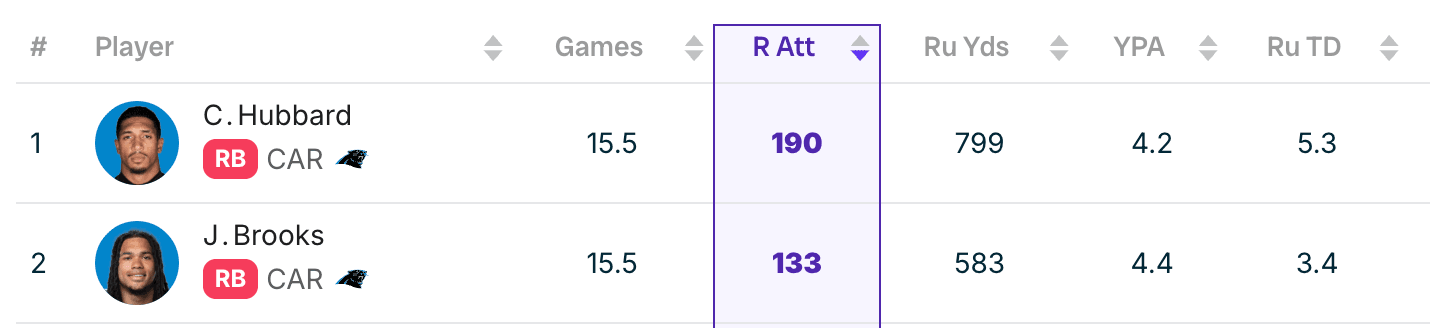
We’ve already seen this coaching staff relegate Hubbard to a backup role, and now Jonathon Brooks is generating a ton of buzz this offseason. A pair of ACL tears has limited Brooks to just nine carries and 23 snaps to begin his NFL career, but the Panthers remain committed to the former second-round pick. Our fantasy football projections currently have Hubbard penciled in for 190 carries, but Brooks isn’t too far behind with 133. I’m really not drafting running backs in this range, but if I do, I prefer Jaylen Warren or Rhamondre Stevenson.
 Round 8: Xavier Worthy | WR | Chiefs
Rounds 8 and 9 are where I continue to try adding Chris Godwin, Josh Downs and Jayden Reed to as many teams as possible, making any other wideouts an afterthought. If it weren’t for Worthy’s Week 1 shoulder injury, we’d very likely be looking at him through a different lens. In Rashee Rice’s absence, the Chiefs were set to scheme so many layup looks for Worthy, but once he suffered the injury, the team didn’t want to deploy him in the same way.
Fast forward to 2026, and he’ll be third on the Chiefs in targets, while the addition of Kenneth Walker likely leads to more of a focus on the run game.
 Round 9: Kyle Pitts | TE | Falcons
The Pitts breakout finally happened last season, setting career-highs in targets, routes, receptions and fantasy points. And while it was both impressive and long overdue, it was definitely buoyed by the absence of Drake London.
London missed Weeks 12-15, which really kicked off Pitt’s league-winning stretch. During that span, Pitts averaged 8.8 targets, 6.5 receptions, 90.8 receiving yards and just over 20 PPR points per game. He was targeted on 26% of his routes during those games and with London off the field over the course of the year, Pitts’ TPRR climbed by 10%.
Pitts should still thrive in Kevin Stefanski’s tight end-friendly scheme. But nearly 40% of Pitts’ total fantasy points from last year came with London sidelined. And if I’m not selecting one of the elite, top-three tight ends, I’ll just keep waiting and draft Mark Andrews, George Kittle or Dalton Kincaid.
 Round 10: Romeo Doubs | WR | Patriots
Doubs is a good, underrated player. But he’s going to be a better real-life receiver for the Patriots than for fantasy teams. His stint as New England’s WR1 lasted a few months before the inevitable A.J. Brown trade that sapped any potential upside he might have had. Brown has seen a target share of at least 30% in each of the past three seasons, while the Patriots still have secondary pass catchers who will earn targets. Doubs did account for 32% of Green Bay’s targets from inside the 10-yard line (eighth-highest rate), but is now competing with Hunter Henry, who is averaging 0.48 end-zone targets per game over the past two seasons, which ranks fifth-best among tight ends.

Join Our Newsletter
Trusted by 400,000+ fantasy football players. Get access to Fantasy Life's free award winning newsletter and tools, all in one step.
By registering or logging in, you agree to our Terms of Use and Privacy Policy.
Players Mentioned in this Article
Presented by





Published Updated