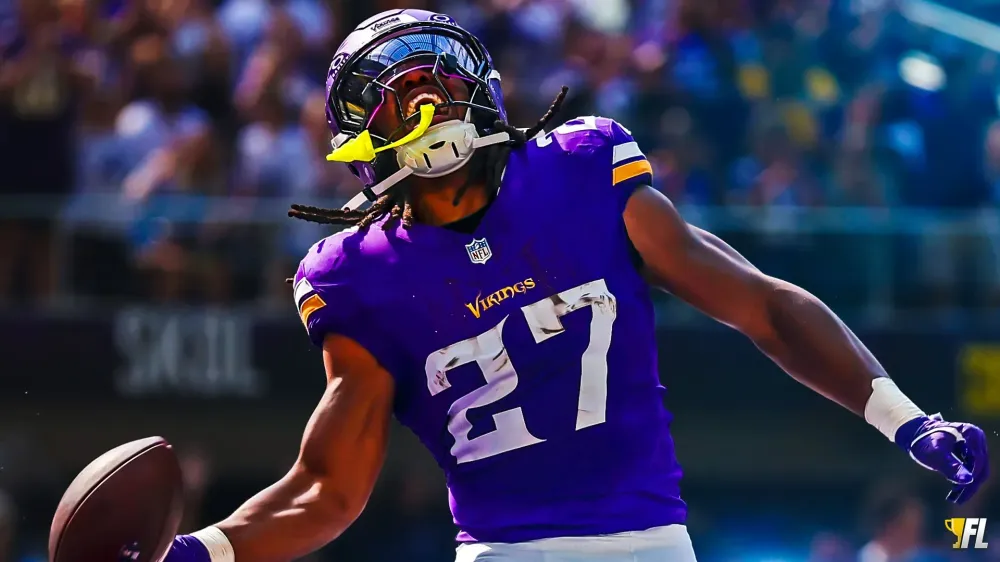
Mid-Round Fantasy Football ADP Values: Jordan Mason Has Hidden Upside
Justin Carlucci highlights a trio of mid-to-late-round running backs worth taking shots on in your 2026 fantasy drafts.
We’re in the heart of June, and fantasy football draft season is starting to heat up. Minicamps are in full swing, and news and rumors are popping up all over the place.
If you’re an OG fantasy footballer, you remember a different era of the game. In the ’90s and early 2000s, running backs ruled the roost. You could spend your first three picks on running backs, and nobody at your in-person draft would blink twice. If I can remember that, I guess it officially label me as “Unc” status, as the kids say.
If you draft running backs in the first three rounds today, the masses might show up at your door with pitchforks. The NFL game has clearly evolved, and it’s tougher to find true workhorse tailbacks, which changes the way we play our game.
That said, the position is making a quiet comeback in fantasy. According to the consensus fantasy football ADP, 13 of the top 25 players by average draft position are running backs, with Derrick Henry rounding out the group at 23rd overall.
If you’re loading up on receivers early, you’re going to need to find opportunity at the RB position later. Let’s look at a few mid-round names I’m getting more comfortable with, and today we’ll focus on running backs.

Join Our Newsletter
Trusted by 400,000+ fantasy football players. Get access to Fantasy Life's free award winning newsletter and tools, all in one step.
By registering or logging in, you agree to our Terms of Use and Privacy Policy.
Mid-Round ADP Targets For 2026 Fantasy Football
 Tony Pollard | RB | TEN
Some of these familiar names might not scream “sleeper,” but they fit the bill as great value.
Coachspeak is part of the equation for Pollard. I still believe rookie Nicholas Singleton can be a real commodity at some point this season, but for a meaningful chunk of the year, it looks like Pollard is going to keep playing a big role in the Titans’ offense. You can’t help but wonder what the situation would have looked like if Jeremiyah Love had been on the board at No. 4 overall for Tennessee in April.
Robert Saleh has told Titans media that Pollard and Spears are “the bellcows of the football team.” However, with Spears on a contract year, the door isn’t completely closed on him being dealt, which would obviously be a big boost to Pollard’s fantasy outlook.
I’m not all the way bought in, but the longer we go into the summer, the more believable it is that Singleton still has a ton of work to do and may be more of a second-half asset. He’s also coming off an injury that wiped out a sizable portion of the time between the end of his college season and the present day. I love Singleton as a dynasty and late-season stash, but the Titans need to establish competency right away, so why not lean on Pollard?
My issue with Pollard has been the under-the-hood stuff. Among 49 running backs with at least 100 attempts last year, Pollard ranked 40th in missed tackles forced per attempt and 22nd in yards after contact per attempt. That’s pretty average, and that might be who he is at this point. However, if he does garner a bulk of the opportunities, he’ll have a pretty nice floor every week.
Zoom out, and Pollard has now put together back-to-back 1,000-yard rushing seasons. If you’re building a receiver-heavy roster early and want a back who can hit your optimal lineup most weeks—particularly in best ball or as a high-floor redraft RB2—Pollard is a safe play, at least for a bulk of the season.
What happens down the stretch if Singleton gets healthy and flashes? It may turn into more of a committee. What happens in 2027? TBD—and that’s exactly where Singleton becomes interesting in dynasty. But we’re drafting for this year, and at an ADP around 84 as the RB31, Pollard offers one of the highest floors of any back going in his neighborhood.
 Jordan Mason | RB | MIN
Next up is Jordan Mason at 128th overall.
Mason’s backfield mate, Aaron Jones, is now 31 and seems to miss time every year—because he usually does. Jones played just 12 games last season, gave us a full year in 2024 and only suited up for 11 games in his final season in Green Bay. He’s on the wrong side of 30, which, as a 36-year-old human being, makes me feel ancient. But for the sake of feeling better about myself, I’m going to refer to him as “Unc” Aaron Jones.
Mason has standalone value on his own merit. He was banged up at points last year and still compiled 758 rushing yards on 159 carries with six touchdowns, averaging 4.8 yards per attempt — well above Jones’ 4.2.
After Week 10 of the regular season last year, among ball carriers with at least 50 attempts, Mason ranked third in explosive run percentage and 10th in missed tackles forced per attempt. He also ranked ninth in success rate compared to Jones at 37th. The advanced stuff really likes him more than Jones, and he runs violently—we all remember him filling in for Christian McCaffrey in that San Francisco scheme.
The Vikings’ ecosystem is the other half of the bet. I’m expecting Kyler Murray to win the starting job, and this offense should be quite a bit better in a division stacked with high-scoring offenses. It’s also a nice feather in the cap that the Vikings inherit two dome games against the Lions every year.
There are plenty of reasons to like Mason at this price: ascending offense, standalone value, advanced metrics that pop and an aging backfield mate with a real injury track record.
 Jonah Coleman | RB | DEN
Last up is Jonah Coleman, who has an overall ADP of 146.9, which puts him just outside the 12th round. There’s more risk-reward at this stage, but at a 12th-or-13th-round price, you can afford to take some swings depending on how your roster is shaping up. If you’re in dire need of a running back by this point in your draft, you’re probably already hurting, but Coleman is the type of name I want exposure to early in the summer.
The Broncos took Coleman in Round 4 (No. 108 overall) in the 2026 NFL Draft. RJ Harvey and J.K. Dobbins are still on the team, but health is a massive concern. Dobbins has an injury track record like a CVS receipt, and that’s a bummer, because he seems like a good guy and is still only 27 years old. But I’d have to imagine there is only so much this guy’s body can handle, and he’s been through the war.
Meanwhile, news quietly broke that Harvey underwent offseason surgery to repair a torn labrum in his shoulder. By default, Coleman is the healthiest back in this room as we sit here in mid-June.
The Broncos didn’t pick him on a seventh-round flier, so I think there was some intention here. And this Denver offense should be better than it was a year ago after adding Jaylen Waddle to the mix.
The Harvey conversation is worth zooming in on. He was particularly disappointing as a rookie and certainly did not pay off his hefty cost in drafts. Harvey didn’t hold up well to NFL contact: among 65 ball carriers with at least 50 attempts last year, he ranked 51st in yards after contact per attempt and 59th in success rate.
When you stack Coleman’s current cost against the ailments of the other two backs in the room and the draft capital Denver invested, there’s a real chance he carves out a meaningful niche. It’ll be fascinating to see how the rest of the summer plays out as the dominoes fall.
Happy drafting!
Join Our Newsletter
Trusted by 400,000+ fantasy football players. Get access to Fantasy Life's free award winning newsletter and tools, all in one step.
By registering or logging in, you agree to our Terms of Use and Privacy Policy.
Players Mentioned in this Article

Published