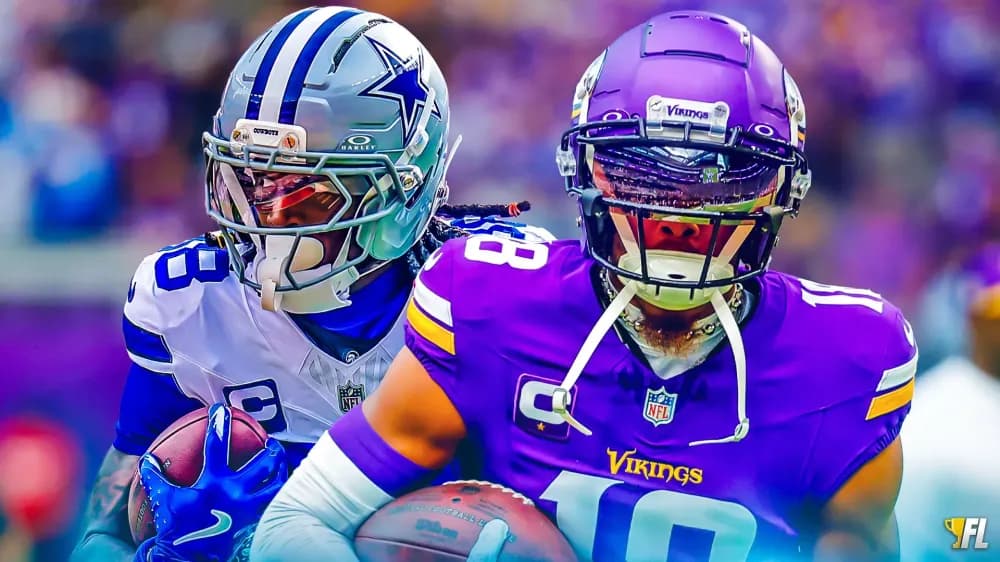
Justin Jefferson vs. CeeDee Lamb: Who Should You Draft In 2026 Fantasy Football?
Justin Carlucci profiles a pair of elite WRs going back-to-back in Round 1 of 2026 drafts, and gives his verdict on whether CeeDee Lamb or Justin Jefferson is the better click this season.
You're on the clock in the first round, and two of the best wide receivers in football are staring back at you: CeeDee Lamb and Justin Jefferson. What do you do? There's no wrong answer here, but if we're splitting hairs, let's dive into the weeds and discuss a few different perspectives.

Join Our Newsletter
Trusted by 400,000+ fantasy football players. Get access to Fantasy Life's free award winning newsletter and tools, all in one step.
By registering or logging in, you agree to our Terms of Use and Privacy Policy.
Who Should You Draft In 2026 Fantasy Football: CeeDee Lamb or Justin Jefferson?
 The Case for CeeDee Lamb
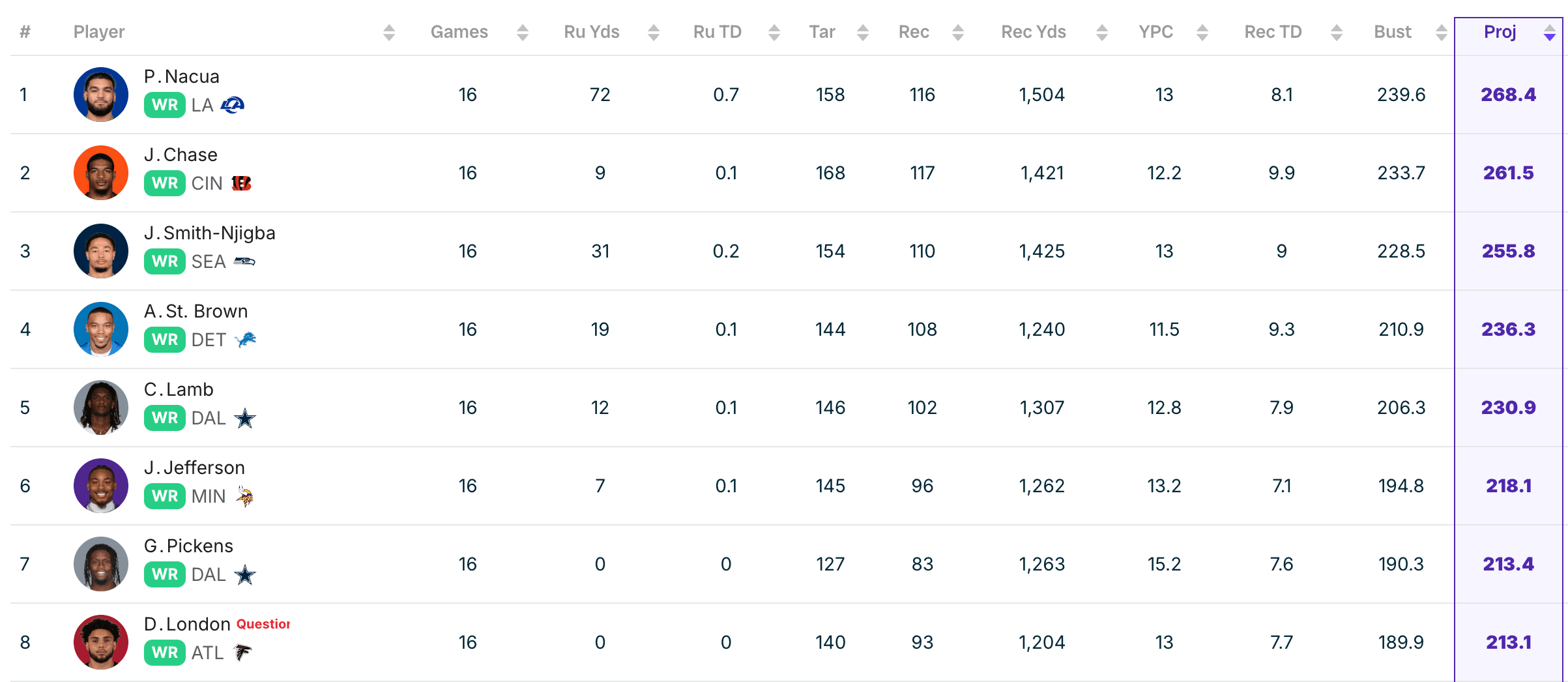
We project CeeDee Lamb for 230.9 fantasy points in half-PPR formats, and that number is built on a foundation of consistency. When healthy, Lamb is about as reliable as they come, and the Cowboys' offense as a whole carries a much higher floor than Minnesota's. That's a big deal.
Dak Prescott remains one of the most underappreciated quarterbacks in football, and the supporting cast is a huge reason Lamb's floor sits where it does. Dallas ranked top-five in EPA per play offensively last season, and Prescott graded out in the upper-third of the league across a host of advanced metrics.
But that same supporting cast is also where the cause for hesitancy creeps in. George Pickens commands a ton of targets from the opposite side of the formation. In fact, after Lamb returned from injury last season, Pickens averaged nearly a full PPR point more per game. So playing devil's advocate, pending a Pickens contract resolution, there's likely a target hog lined up across from Lamb, great for real life, slightly detrimental for Lamb's fantasy football ceiling.
That said, some touchdown variance can very well flip this, and the Cowboys love putting the ball in the air, and they have good reason to, given how much the offense was clicking in 2025. Dallas owned the 10th-highest pass rate and threw at the 13th-highest neutral clip in football, per Fantasy Points.
The other dynamic at play is the cost of each player's teammates in terms of fantasy football ADP. If you're playing best ball and hunting for a stack, doubling up with Pickens (consensus ADP 26.4) sometimes makes sense, but you'll pay a hefty price, and Javonte Williams (37.6), one of my favorite picks this season with a serious floor-ceiling combo, isn't cheap either.
You won't have any problem targeting Jake Ferguson all the way down at 114th overall, and Prescott, at a consensus ADP of 87.8, is still extremely feasible if you're chasing the stack angle.
 The Case for Justin Jefferson
Jefferson is a bit more ambiguous of a pick, and it comes with a lower floor. So much hinges on the Kyler Murray–J.J. McCarthy quarterback battle. Personally, I've never been sold on McCarthy, and I'm hoping Murray wins the job—I think he's at least a tier upgrade over anything McCarthy would show us in terms of supporting a No. 1 receiver with that kind of first-round draft equity.
That said, I still have reservations. Murray's health scares me. In seven NFL seasons, he's played more than 14 games just three times. Last year got tricky with Jacoby Brissett inserted toward the tail end, but you get the picture I'm painting.
When Murray has been upright, though, he's supported alpha target earners: a late-career Larry Fitzgerald led the Cardinals with 804 yards in 2019, DeAndre Hopkins went for over 1,400 in 2020, Christian Kirk—multiple tiers below Jefferson's talent—approached 1,000 in 2021, and Trey McBride topped 1,100 in 2024. Murray isn't the traditional drop-back, surgical passer, but he feeds No. 1 options when he stays on the field.
Minnesota has mouths to feed, too — Jordan Addison has proven he can do damage, newcomer Jauan Jennings signed in from San Francisco, and T.J. Hockenson still exists, believe it or not. But Jefferson is the clear target earner, and I believe Murray would treat him as such.
Even amid ugly quarterback play last season, Jefferson posted a 28% target share and a whopping 39% air-yards share, per Fantasy Points, while still cracking 1,000 yards—and that's with Addison on the field for 14 games and Jalen Nailor also commanding a double-digit percentage of targets.
Here's the case for positive regression: among receivers who ran at least 200 routes, Jefferson ranked 118th of 149 in catchable target rate (71.7%). That doesn't fall on him; that's squarely on the quarterbacks. For perspective, Lamb's catchable target rate was 82.3% (49th), and Pickens was above 80% as well.
It's hard to compare apples to oranges, but going back to Murray's healthy 2024, he ranked 17th of 46 qualifiers in adjusted completion percentage (76.9%) and 22nd in highly accurate throw rate via Fantasy Points. McCarthy in 2025 ranked 41st of 45 in highly accurate throw rate and 35th in adjusted completion (72.5%).
The gap between the two isn't that massive, but Murray's track record of feeding alphas, plus a Vikings scheme I really like, gives me cautious optimism. Still, Prescott has been consistently better than both of them in terms of throwing catchable footballs.
Cost is where Jefferson pulls ahead for stackers. He's going around 12.4, with Addison at 111.6, Murray at 124.6 and running backs available anywhere from 115–130. Jennings and Hockenson sit in the 150s in early July.
The Lamb vs. Jefferson Verdict - Who Should You Draft?
I'm peppering my portfolio with both. But gun to head, I believe Jefferson is the better best ball play because his peers are a lot cheaper to stack with. Murray goes roughly 35–40 picks after Prescott, and Minnesota's No. 2 receiver is well outside pick 100—that's cheap correlation and more opportunity to build around.
The ceiling is just slightly higher for Jefferson, but the week-to-week floor is much scarier, especially since we don't have final confirmation on the quarterback situation. And even if we do, it still leaves me with a tiny bit of reluctance.
For other formats—where there's a starting lineup and a bench, plus higher-stakes industry leagues—give me the floor-ceiling combo of Lamb. Some touchdown variance could flip this whole conversation between Lamb and Pickens and their cost with one silly year; that's all it takes. A couple of outlier games, and in a fantasy game with only 17 weeks of sample size, things can get skewed.
Happy drafting in July!
Join Our Newsletter
Trusted by 400,000+ fantasy football players. Get access to Fantasy Life's free award winning newsletter and tools, all in one step.
By registering or logging in, you agree to our Terms of Use and Privacy Policy.
Players Mentioned in this Article


Published