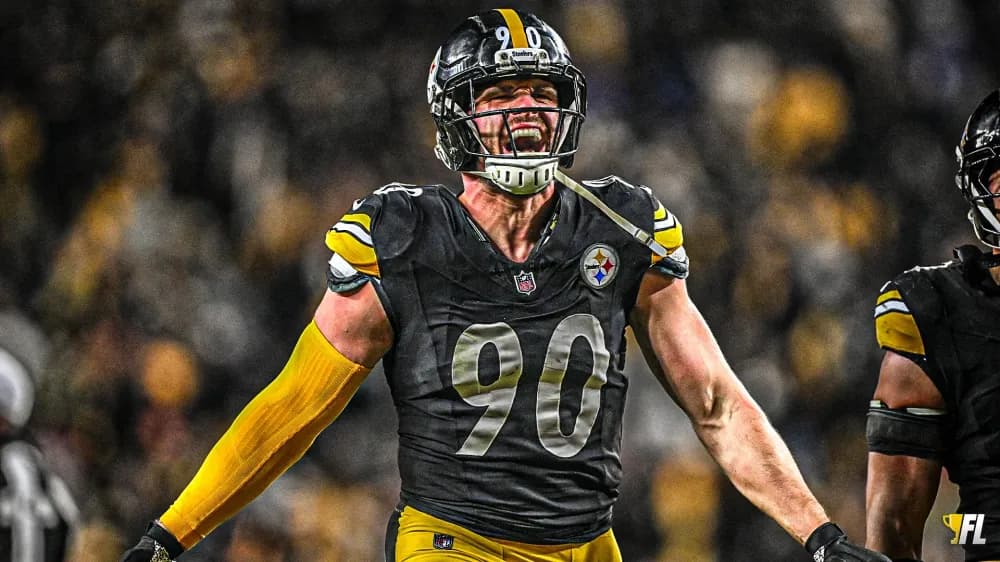
IDP Fantasy Football Strategy: How To Evaluate The Defensive Side Of The Ball
Mike Woellert breaks down how to evaluate the defensive side of the ball in IDP fantasy football as it relates to how we traditionally evaluate the offensive side.
One of the common misconceptions I hear when it comes to trying IDP fantasy football:
- It’s too complicated
- Too many more players to track
- I don’t watch defense
- Scoring is all over the place
I’m here to tell you, IDP fantasy football isn’t any different than the offensive side of the ball, and it doesn’t require you to watch hundreds of hours of film. However, I do love watching the film.
What if I told you that evaluating the defensive side of the ball isn’t any different than the offensive side?
You’ve been doing it for years (without even knowing it). You see a running back’s snap/usage tick up in training camp. Or, a wide receiver gets moved to an advantageous role.
You don’t need anyone to tell you how to act on that. You already know. IDP fantasy football doesn’t require you to unlearn what you’ve learned. Thanks, Yoda!
Apply your knowledge to the other side of the ball.
It’s like a player changing teams. The framework is the same. The terminology is slightly different.

Join Our Newsletter
Trusted by 400,000+ fantasy football players. Get access to Fantasy Life's free award winning newsletter and tools, all in one step.
By registering or logging in, you agree to our Terms of Use and Privacy Policy.
How To Evaluate The Defensive Side Of The Ball In IDP Fantasy Football
Snaps Are Snaps
When evaluating a running back or wide receiver, one of the most important things you can track is their snap count. How often is he on the field? What’s his role when he’s out there?
For IDP, the question is identical.
A linebacker who plays 100% of the snaps is going to be more valuable than the one who plays 75%. Even the linebacker who might play 85% of the snaps is going to be more valuable. The 100% guy, typically the green dot (QB of the defense), is on the field for every snap. His production is structured because of his volume and role.
The linebacker who might play 60%-70% of the snaps is coming off the field in key situations. He might come off the field on passing downs because he can’t cover or rush the passer. For the LB playing fewer than 80% of the snaps, everything needs to go right, and there's a small margin of error and a low floor.
Now, depending on the size of the league and how many linebackers you start, you might need to draft a few of these guys.
The same goes for the defensive line and defensive backs. You need the guys who play the majority of the snaps.
I compare the defensive line/defensive back positions to wide receivers/tight ends. These guys might not play 100% of the snaps, but if they’re on the field for roughly 80% of the snaps, they provide value.
You already know this; you just call it an every-down back vs. running back by committee.
For the defensive side of the ball:
- Three-down LB
- Green dot LB
- Full-time LB
- Rotational DL
- Slot corner
When evaluating an IDP, start here: How many snaps is he playing? Is that trending up or down?
Target Share = Tackle Opportunity
When you evaluate a WR, you want to know how often he’s targeted and what he does with the ball in his hands.
For a linebacker, replace "targeted" with "in position to make a tackle." The principle is identical. Off-ball linebackers typically play near the line of scrimmage. You’ll see outside linebackers, but for the most part, those are edge rushers like T.J. Watt or Micah Parsons. They are labeled as linebackers, but play on the edge/defensive line.
You want your linebackers “off-ball”, which essentially means they play a bit off the line of scrimmage or “in the box.” A linebacker who’s playing more than 85% of their snaps off-ball, is getting their target share. His tackle volume is the output of his alignment.
Defensive backs typically work the same way. You want your safeties playing near the line of scrimmage with an LOS rate over 60%.
Line of scrimmage rate = Box Snaps + Slot Snaps + DL snaps/Total Snaps
I wrote an article on the importance of safety alignment in IDP fantasy football.
The safety is in tackle range playing near the LOS. The deeper safeties, while they make tackles, are the big-play DBs, kind of like the big-play WR with a big YPC because he stretches the field. They have a lower floor.
You’re not rostering a WR who rarely gets targeted in hopes he scores. Don’t roster an LB who rarely gets on the field and hope he racks up tackles.
That’s why, when you see an LB at the top of the fantasy scores that seems a bit out of place, immediately check the snap count.
Role Security Is What You're Really Buying
Here's something that doesn't get said enough in IDP circles: You're not necessarily drafting a player. You're drafting a role.
When you take Derrick Henry in the first round, you're not just taking Derrick Henry. You're taking the lead back role on a team that wants to run the ball. If Henry gets hurt, you care because the role changes, not just because the name changes.
IDP works the same way.
The reason Zaire Franklin was an IDP LB1 in Indianapolis wasn't just because he was good (although last season, he wasn’t). It was because the Colts made him their green dot LB. The role generated the production. Franklin was the right player in the right role.
When Green Bay traded for Franklin, the analysis didn't start with "Is Zaire Franklin a good linebacker?" It started with "Does Green Bay's defense have that same role available?" That's the right question. That's the offensive-side instinct applied correctly.
Devin Bush was a dependable LB2 in IDP because of the role and volume. The Browns were in nickel and deployed two off-ball LBs for the majority of the game, and that led to Bush’s tackle opportunities.
Draft the role. Confirm the player fits it. In that order.
Scheme Fit Is Your Offensive Coordinator Analogy
You already think about offensive coordinators when you draft skill players. You know that some offenses feed tight ends and some never use them. You know that some coordinators use three wide receivers on every snap, and some still run two-back sets.
Defensive coordinators work the same way.
Some defenses keep their linebackers in the box on almost every down—Tampa-2 shells, old-school 4-3 fronts, run-first schemes. Those defenses manufacture linebacker production. The linebacker is always near the ball.
Some defenses rotate their linebackers out on passing downs and bring in a nickel corner or a hybrid safety. On those teams, your linebacker is leaving the field when the opponent passes — which is more than half the time in today's NFL. His production ceiling drops significantly because his snap count drops significantly.
This isn't more complicated than knowing that air-raid offenses don't feed running backs. It's the same logic. The team's scheme either puts your player near the ball or it doesn't.
The key question for DL is role clarity. An edge rusher with a defined every-down role in a four-man front has a structural path to sacks and pressures. A rotational lineman on a six-man rotation is splitting snaps and production—the raw numbers might look okay until you realize he's only on the field for half the game. Interior DL is scheme-dependent in a different way: a penetrating three-tech in a one-gap system gets backfield disruption opportunities that a block-eating nose tackle never will. Same position, completely different value.
The key for defensive backs is alignment. A safety playing in the box is an IDP asset. A safety playing 15 yards deep in center field is a great football player who will never help your fantasy team. Cover-2 shells keep safeties active near the line and generate tackle volume. Cover-3 and Cover-4 push them deep and kill their floors. Cornerbacks are the most volatile IDP position because their value is almost entirely splash-play dependent. Good corners get avoided, which means fewer opportunities, not more.
The DB question is simple: is this player's alignment putting him near the ball or keeping him away from it? Answer that first, then look at the stats.
Injury Replacement Looks Identical
Your handcuff strategy for offensive players is well-developed. You know which backup running back to stash. You know which tight end steps into a bigger role if the starter goes down. You've done this enough times that it's almost automatic.
IDP injury replacement follows the same logic with one key difference.
You usually don't need to pre-stash the handcuff.
Defensive backups are almost always available on the waiver wire when you need them, because most IDP managers aren't thinking about it in advance. That's your edge. When a starting linebacker goes down, the player stepping into that role is available. Go get him before anyone else figures it out.
The waiver wire move you make in Week 3 when an IDP goes down is the same move you've made for offensive players your entire fantasy career. You're just looking for a different jersey number.
The IDP Fantasy Football Translation Table
If you want to keep it simple:
| Offensive Concept | IDP Equivalent |
|---|---|
| Snap count/usage rate | Defensive snaps per game |
| Target share | Box rate/tackle opportunity |
| Every-down back | Three-down linebacker/player |
| Situational back (third down only) | Pass-rush specialist/rotational DL |
| Role security | Starting role + scheme fit |
| Handcuff | Backup monitoring for waiver wire |
The barrier to IDP isn't knowledge. You have the knowledge. It's vocabulary—learning to hear "box rate" and think "target share," learning to hear "three-down linebacker" and think "every-down back."
Once that translation clicks, the defensive side of the ball stops looking like a foreign language and starts looking exactly like what it is: the same game you've been playing, with different players.
Join Our Newsletter
Trusted by 400,000+ fantasy football players. Get access to Fantasy Life's free award winning newsletter and tools, all in one step.
By registering or logging in, you agree to our Terms of Use and Privacy Policy.
Published