
Fantasy Football Takeaways From Week 5: Leads Utilization Report
Welcome to the Utilization Report, where Dwain McFarland highlights his top fantasy football takeaways heading into Week 6.
Welcome to the Utilization Report, where Dwain McFarland highlights his top fantasy football takeaways heading into Week 6.
The Top Fantasy Football Takeaways From Week 5
Let's follow the data to identify the top waiver wire options, trade targets, upgrades, and downgrades based on what we learned in Week 5.
If you love the sweet Utilization data below, you can access it all for yourself!
- Comparison tool
- Team-based views with game logs
- League-wide views for NFL leaders
- Customizable time periods and sample sizes
- Seasons: 2020 to 2026
Use the Utilization Report suite of tools to dominate your league, y'all!
 1. Isaiah Likely: Enters High-End TE1 Territory
Likely went through a rough patch in Weeks 2-3 with 8.3 and 3.3 PPG, driving a buy-low recommendation heading into Week 4.
Since then, fantasy points have followed the Utilization, as they often do. In the last two games, Likely has scored 13.6 and 32.4 points. He leads all NFL TEs with a 30% target share. Likely ranks third in Utilization Score (95) and PPG (17.1).
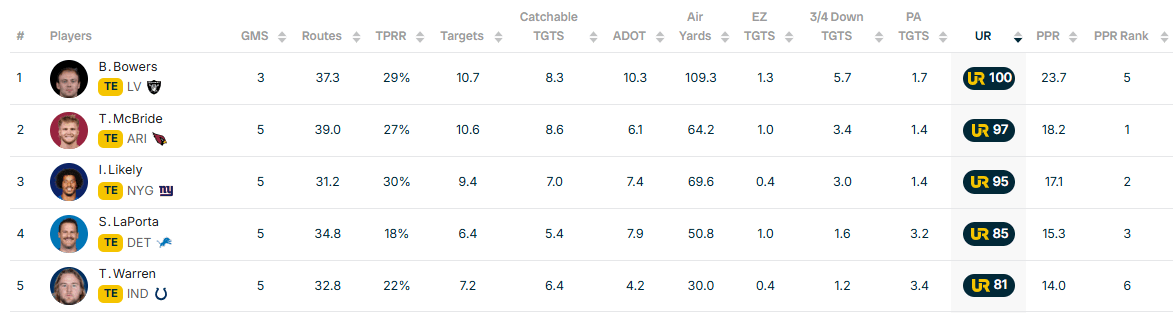
Likely is averaging 9.4 targets (3rd) and 69.6 air yards (2nd) per contest. Since 2011, here are the TE seasons from players that reached 8.5 targets and 65 air yards per game:
- Darren Waller (2020): 17.5 PPG
- Delanie Walker (2015): 16.2 PPG
- Jason Witten (2012): 14.5 PPG
- Jimmy Graham (2011): 18.4 PPG
- Jimmy Graham (2012): 15.8 PPG
- Jimmy Graham (2013): 19.0 PPG
- Mark Andrews (2021): 17.5 PPG
- Travis Kelce (2018): 18.5 PPG
- Travis Kelce (2020): 20.8 PPG
- Travis Kelce (2022): 18.6 PPG
- Trey McBride (2025): 18.6 PPG
- Zach Ertz (2018): 17.5 PPG
- Zach Ertz (2019): 14.4 PPG
That is a great list. And the Utilization Score (95) paints a similar picture—his historical comparisons since 2020 averaged 16.8 PPG, with 100% finishing as a top-three TE.
The nitpicks with Likely's rest-of-season outlook:
- Jameis Winston could get benched at some point for J.J. McCarthy. But at 4-1-1, there is a decent cushion.
- The Giants rank 27th in DBOE (-5%), which could cap Likely's target upside compared to the Raiders (-1%) and Cardinals (1%).
- New York has dominated time of possession (32.7 minutes per game). That is a very volatile stat for high-variance offenses like the Giants.
That said, Bowers and McBride face similar QB questions. We could see Fernando Mendoza and Carson Beck at some point. The biggest difference is that Bowers and McBride were better prospects and have a longer track record of excellence at the NFL level.
Likely ascends to high-end TE1 status in a mini-tier behind Bowers and McBride. He sits right next to George Kittle.
 2. Mike Evans is creeping toward WR1 territory in fantasy.
Evans has battled through multiple injuries to start the season, but we're beginning to understand his ceiling in a fantastic 49ers offense.
In Week 5 against the Seahawks—one of the NFL's toughest pass defenses—the 33-year-old WR scored 26.3 fantasy points. Evans finished the day with a monstrous 36% target share and a 92 Utilization Score.
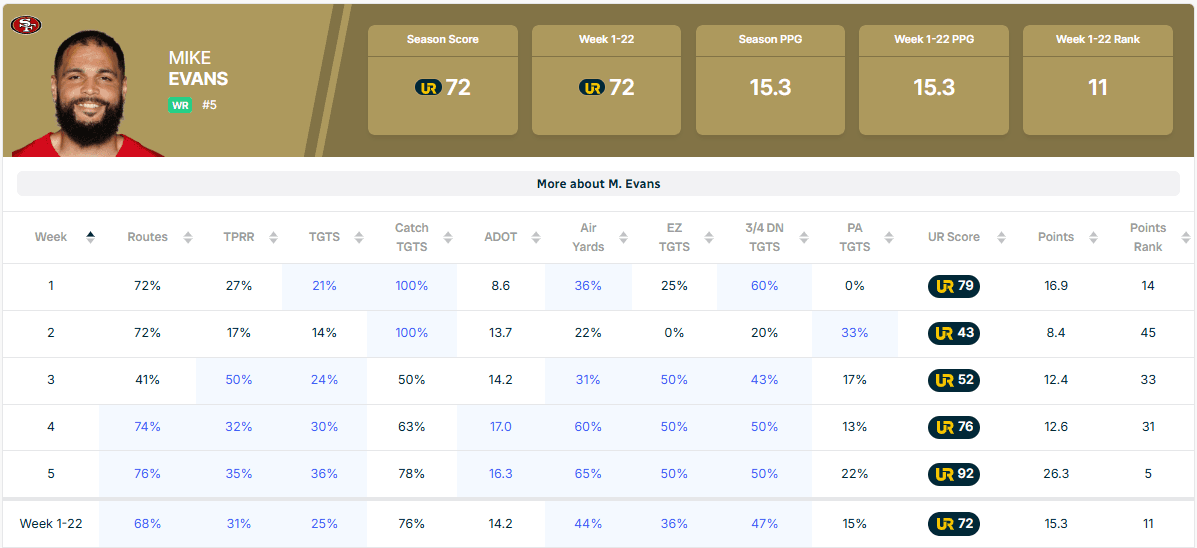
Evans is in the best scheme of his career under Kyle Shanahan. He's highly integrated into the offense, as shown by his 31% targets per route run (TPRR)—the second-highest mark in the NFL behind Jaxon Smith-Njigba for WRs with at least 100 routes.
Evans ranks third in yards per route run (YPRR) at 3.05. The veteran has been dominant against man and zone, with YPRRs of 4.14 and 2.43, respectively. Plus, he is the top end-zone target in the No. 3 scoring offense (30.8 PPG) with a 36% end-zone target share.
The 49ers' new weapon left Week 2 (hip) and Week 3 (ribs) early. Excluding those games, he has averaged 18.6 PPG with an average Utilization Score of 82. His historical comps have averaged 16.6 PPG, with 70% securing top-12 seasons.
- WR1-6 season finishes: 19% (ceiling outcome)
- WR7-12: 51% (median outcome)
- WR13-18: 17% (floor outcome)
- WR19-24: 9% (outlier floor outcome)
- WR25-36: 4% (outlier worst-case outcome)
The biggest concern is his 74% route share in the three non-injury games. But the 49ers are prioritizing his looks when on the field, and we still haven't seen him at 100%.
And Evans has a fantastic schedule over the next month:
- Week 6: Commanders (+4.3 PPG WR room boost)
- Week 7: Falcons (+1.4)
- Week 8: Bye
- Week 9: Raiders (+4.8)
- Week 10: Cowboys (+2.5)
Evans carries re-injury risk at his age, but he has a long history of playing through issues that often sideline other WRs.
Given the schedule, he could play an integral role in a fantasy playoff run, making him a strong BUY-HIGH candidate. He is a BUY target at a mid-range WR2 price tag. In that scenario, based on the range-of-outcome analysis above, we would profit in 70% of outcomes, break even 17%, and lose 13% of trades.
If you are nervous about injuries and age and believe now is the time to sell high, you should seek a low-end WR1 price tag.
Evans ascends to high-end WR2 territory and will likely be viewed as a low-end WR1 within the next two weeks.
 3. Bhayshul Tuten: Snap and attempt shares trending up.
Tuten made my sell-high recommendation list two weeks ago—and I stand by that. The premise was that, given the industry steam at the time, if you could get someone willing to pay a high-end RB2 price tag already, he was worth moving.
But now we have more than great underlying efficiency—which doesn't correlate to more opportunities historically. Sometimes it leads to more work. Other times it doesn't. This might be one of those times when efficiency prompts a Utilization change. The Jaguars are actively reallocating snaps and attempts to their Year 2 back over the last three games:
Over the last three games, his snap share has improved (49%, 57%, and 66%), and his attempt share has increased (54%, 68%, 92%).
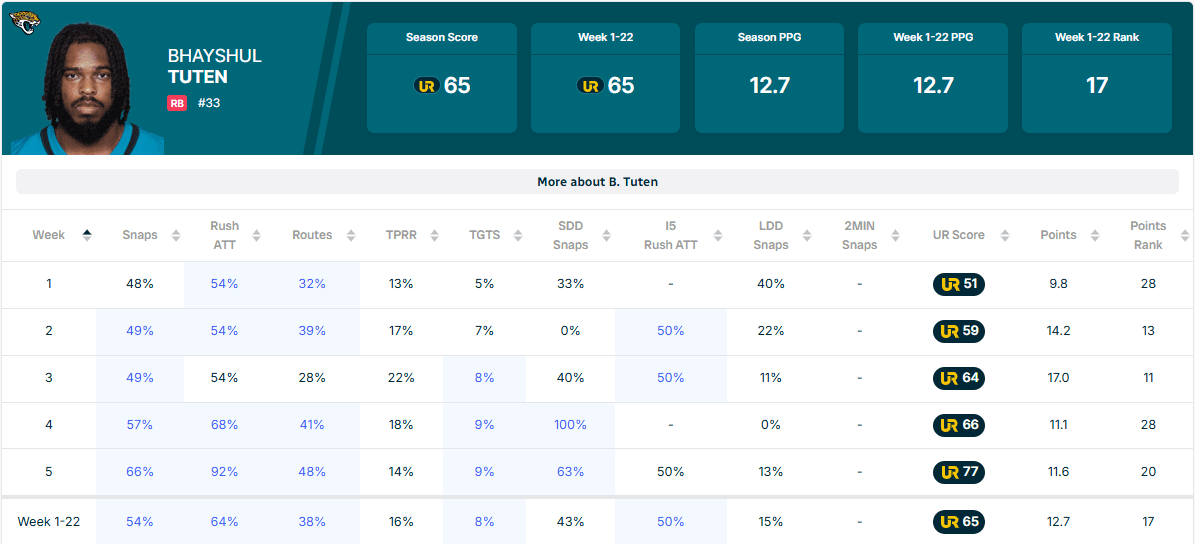
Tuten has also handled 100% and 63% of the short-down-and-distance work over the last two games. Chris Rodriguez Jr. is still hanging around inside the five-yard line with 50% of the carries in 2026, but there is a strong correlation between short-yardage work and inside-the-five attempts.
Week 5 also brought a season-high 48% route participation. While that isn't elite, it is in the range we would hope to see for his archetype. With a loaded pass-catching unit, we are unlikely to see a massive target share for Tuten in 2026, but 8-10% is realistic.
Efficiency has dipped slightly with a larger workload, but Tuten still looks good.
- Yards per carry: 4.3 (12th out of 31 RBs with at least 50 attempts)
- Yards after contact: 3.8 (5th)
- 10-plus yard attempts: 13.4% (6th)
- Missed tackles forced: 29.3% (4th)
The biggest change over the last three games is the elimination of Ameer Abdullah's role. He has been primarily a special teams option. While we could still see an annoying committee in some game scripts, Tuten is clearly at the top of the pecking order and offers 65% snap upside in competitive games.
Tuten's biggest challenge is the Jaguars' offensive line's lack of push. Jacksonville ranks dead last in average yards before contact on RB attempts (0.61). And left tackle Anton Harrison suffered a knee injury in Week 5. Harrison is undergoing an MRI to determine the severity.
Painting a range of outcomes for Tuten is a bit tricky. So, we will look at two scenarios, and you can choose.
Scenario 1: Week 5 represents Tuten's role.
If Week 5 was not a blip on the radar, things have improved dramatically. His historical Utilization Score (77) comparisons averaged 14.9 PPG and 62% finished as RB2s. And his outlier ceiling outcome reaches top-six RB status.
- RB1-6 season finishes: 10% (outlier ceiling outcome)
- RB7-12: 23% (ceiling outcome)
- RB13-18: 33% (high median outcome)
- RB19-24: 28% (floor outcome)
- RB25-30: 5% (outlier floor outcome)
If you believe this is the new state of affairs in Jacksonville, Tuten is a BUY-LOW candidate. He is a mid-range RB2 with RB1 upside.
Scenario 2: Weeks 4-6 represent Tuten's role.
In this scenario, we take a more balanced view, incorporating Tuten's role growth over the last three games without taking a hardline stance on 66% snap and 92% attempt shares. His Utilization Score over that span is 71. His comparisons averaged 13.8 PPG, with fewer RB1 seasons and more RB3 finishes.
- RB1-6: 7% (outlier ceiling outcome)
- RB7-12: 13% (outlier ceiling outcome)
- RB13-18: 22% (ceiling outcome)
- RB19-24: 36% (median outcome)
- RB25-30: 18% (floor outcome)
- RB31-36: 4% (outlier floor outcome)
In this runout, Tuten profiles as a low-end RB2 with borderline RB1 upside and low-end RB3 downside.
My lean is Scenario 1 given the strong three-week trend, but these are hard situations to predict.
Bottom Line: I would be willing to BUY Tuten at a low-end RB2 price and SELL at a low-end RB1 price tag.
 4. Will Marvin Harrison Jr. Improve With Houston?
This is a very hard question to answer. And there are multiple layers.
Let's start with Harrison's talent profile.
Below is a list of WRs taken in the top-12 picks of the NFL draft that failed to reach 12 PPG (PPR) in fantasy over their first two years:
- Harrison: 11.7, 10.5
- Corey Davis: 6.5, 11.5
- Drake London: 10.7, 10.7
- Mike Williams (Chargers): 2.1, 11.1
- Tavon Austin: 9.8, 6.0
That isn't a great list, y'all. The one big hit is London, whose underlying data was far superior to Harrison's over his first two seasons. You could argue he was doing his part, but the lack of passing offense was holding London down:
- London: YPRR: 2.07, 1.87; TPRR: 27%, 22%; First Downs: 32%, 26%
- Harrison: YPRR: 1.63, 1.58; TPRR: 21%, 19%; First Downs: 22%, 20%
Harrison's profile aligns more closely with Davis and Williams than London.
That brings us to Arizona's scheme.
This offseason we heard buzz that Harrison's role would evolve under Mike LaFleur. The team wanted to integrate him further into the offense with a wider variety of routes, rather than playing strictly on the boundary as a vertical threat—something that challenged Davis and Williams.
But that didn't stick. Instead, Harrison stayed in the same role, while Michael Wilson stepped into a much better situation as the move option, getting the higher-target-likelihood routes. That also isn't ideal. It means a team that spent a top-4 draft pick on Harrison decided Wilson was a better fit for its offense.
Why would a team decide to do that? One potential reason: the data suggests Harrison isn't a strong playmaker after the catch. His best skill is winning in contested situations downfield.
Historically, WRs with a similar average depth of target (aDOT) to Harrison's over his first two years (14.2 and 13.9) haven't been high-end yards-after-the-catch (YAC) players. There is an inverse relationship between aDOT and YAC. But they were much better than Harrison.
His aDOT comparisons that had at least 40 targets averaged 3.7 after the catch. Harrison has averaged 2.6. And that was the biggest weakness in his collegiate profile. Harrison rarely created after the catch on his own at Ohio State. That created a low-end comp of Courtland Sutton in the Rookie Super Model.
Because of this, it makes sense that the Cardinals put Wilson in the YAC role and kept Harrison as a downfield threat.
Harrison ranks 2nd in average route depth (12.3) out of 73 WRs with at least 100 routes in 2026. His closest peers: Jameson Williams (12.7), Rashod Bateman (12.0), Rome Odunze (11.7).
Harrison ranks fourth in go-route percentage at 28.9%, behind only Isaiah Williams, Romeo Doubs, and Dohnte Meyers. He is tied with DK Metcalf. He is barely ahead of Kayshon Boutte (25%), whom he will replace in Houston.
It's hard to be a high-end target earner in that role.
That brings us to the Texans.
Do they see Harrison as more than a vertical boundary WR who can attack the inner portions of the field?
Ultimately, we don't know. But Houston was willing to move a second-round pick to attain Harrison's services. To do that, you would think they have a bigger plan.
I don't think we'll see Harrison suddenly become a dynamic YAC monster in Houston. But he can run a more diverse route tree, which could improve his target share. With the Texans, he won't have to deal with two high-end target earners (Trey McBride and Michael Wilson). He will primarily compete with Nico Collins. Dalton Schultz is not a priority target.
Additionally, C.J. Stroud is having a strong season, averaging 280 YPG. While I don't think that will sustain when the Texans don't face elite offenses and their defense can clamp down on opponents, it helps to know Stroud has that in his bag. Of course, the Texans don't have a strong run game, which can also influence pass rate. Currently, Houston ranks seventh in Dropback Rate Over Expected (DBOE) at 3%.
Putting it all together: Harrison's range of outcomes with Houston.
Harrison has a good chance to improve with the Texans. But I don't think he'll suddenly become a top-24 WR in fantasy football.
A more realistic outcome would be a WR3 finish if the team broadens his role—an outstanding question considering how they have used Boutte to this point.
Harrison UPGRADES to WR4 territory and could evolve into a WR3 option once acclimated. If Collins misses time with an injury, a WR2 outcome could be on the table. We will continue to monitor and adjust as we get more data.
 5. Rhamondre Stevenson: Short-Term Fantasy Upgrade.
TreVeyon Henderson exited Week 5 with an ankle injury that already cost him one game this season. His return timeline is unknown, but Week 6 is certainly in jeopardy.
Stevenson has delivered back-to-back strong performances with 18.4 and 17.5 fantasy points, leading the backfield despite dealing with his own ankle injury.
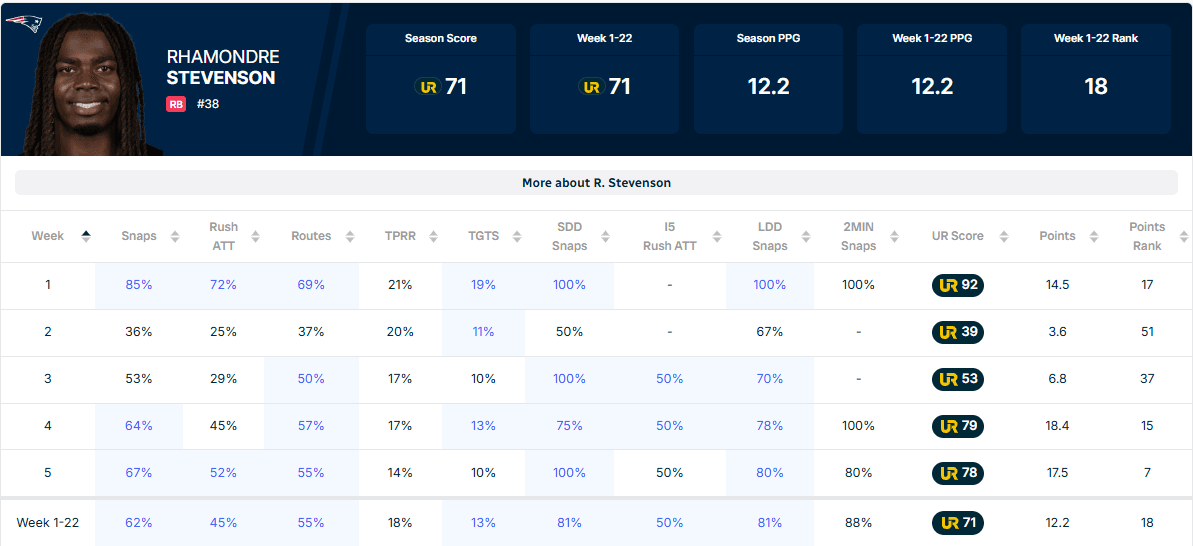
In Week 1, with Henderson out, Stevenson got 85% of the snaps. Stevenson shared the backfield with Corey Kiner after Henderson's departure in Week 5. However, Stevenson entered the game with an injured ankle, and the team built a significant lead over the Raiders.
Kiner played 60% of snaps and accounted for 67% of fourth-quarter attempts. The Patriots led by between 21 and 28 points on those drives. On the first four drives after Henderson's injury, Stevenson had the backfield on lockdown:
- Snaps: 86%
- Attempts: 75%
- Routes: 60%
If Stevenson becomes the clear-cut RB1 in the coming weeks, he could post top-12 RB production. The Patriots offense has found its groove, averaging 37 PPG over the last two outings.
And the schedule is fantastic over the next four weeks, packed with plus matchups for RBs:
- Jets (+2.4 PPG to RB rooms)
- Bears (+2.1)
- Dolphins (+5.9)
- Packers (+3.4)
Stevenson is a borderline RB1 in games without Henderson.
 6. Jaylen Waddle is Not Thriving in Sean Payton's offense.
There was hope that shifting play-calling duties from Davis Webb to Payton would cure Waddle's woes. But that didn't happen. Waddle's role stayed the same, with a sub-80% route share.
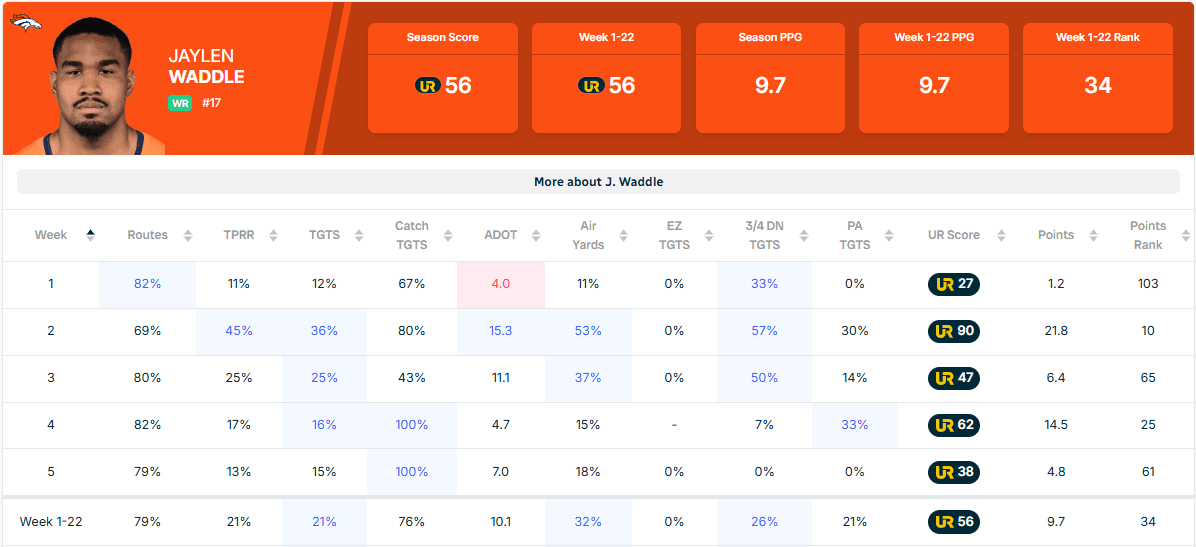
Historically, a team's WR1 with a talent profile like Waddle—who the team traded a Round 1 pick for—plays 88-92% of pass plays. From a fantasy football perspective, this is a maddening development for Waddle managers. This route participation is in WR3-WR4 territory.
Waddle's 21% target share aligns with WR3s, and his 1.50 YPRR is in WR4 territory. He and Bo Nix haven't found a strong connection yet. At this point, we have to wonder whether the Dolphins' heavy-motion, play-action attack boosted Waddle's production in a way that doesn't translate to Denver.
The Broncos rank 13th in play-action (27%) and 25th in motion at the snap in 2026, per TruMedia.
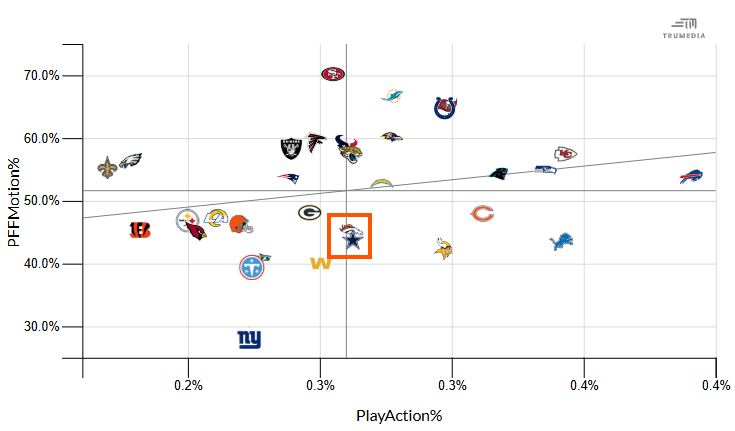
I noted this possibility in my preseason tiers, but I thought the tradeoff would be a higher route share. There is certainly always room for a strong talent profile like Waddle to rebound—he isn't suddenly a bad player—but he needs more playing time.
If the role doesn't change, the outlook is not good. Waddle's historical Utilization Score (56) comparisons have rarely notched difference-making fantasy seasons. The majority were WR3s or WR4s.
Waddle DOWNGRADES to WR3 territory.
 7. Vikings Defense: Don't start your fringe players vs. MIN.
I added a new section to this week's Utilization Report on defensive tendencies. You can find it at the bottom of this article.
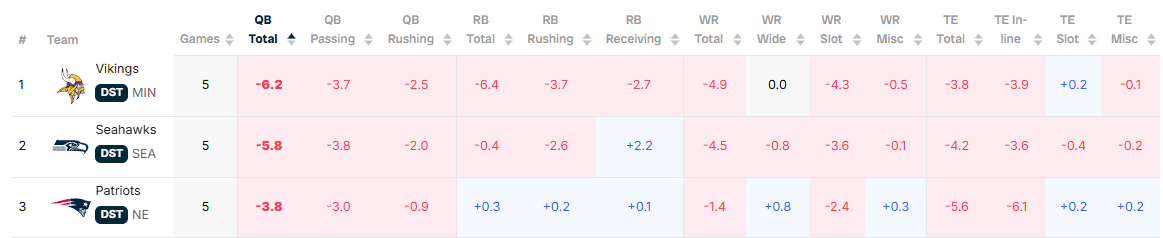
The Vikings defense is one of the primary reasons I wanted to dig deeper into defensive schemes. Their unique scheme is causing absolute havoc across the board, which you can see at a high level in our Defense vs Position (DvP) tool that is opponent-adjusted:
- QB: -6.2 PPG boost (hardest matchup)
- RB: -6.4 PPG boost (hardest matchup)
- WR: -4.9 PPG boost (fifth-hardest matchup)
- TE: -3.8 PPG boost (eighth-hardest matchup)
Brian Flores' scheme creates chaos through a specific combination of characteristics.
- Pressure Rate: 46% (1st)
- Pass Blitz Rate: 66% (1st)
- Zone Coverage: 77% (T-5th)
At a macro level, QBs are much worse when pressured vs. kept clean. That is widely known, so I won't spend much time on it, but it significantly impacts YPA and completion rates. The Vikings rank first in completion rate allowed (53%), seventh in YPA allowed (6.3)
Historically, RBs and TEs become the safety valves for high-pressure/high-zone defenses. But that hasn't been the case in 2026. Because Minnesota blitzes so often and has such a great pressure rate, teams are forced to use more heavy personnel and keep their TEs and RBs in to block.
For example, the Saints have used 11 personnel as their primary personnel package in 2026, ranking 3rd (72%). But against Minnesota, they utilized 12 personnel on 42% of plays. And many of the TEs had significantly lower route shares than pass snap shares:
- Cade Otton: 93% pass snaps, 86% routes
- Colston Loveland: 85% pass snaps, 71% routes
- Juwan Johnson: 81% pass snaps, 65% routes
- Tucker Kraft: 59% pass snaps, 48% routes
Johnson is the only TE to notch a 20%-plus target share against the Vikings.
At RB, we see a similar trend.
- D'Andre Swift: 72% pass snaps, 45% routes
- Ollie Gordon: 68% pass snaps, 37% routes
- Chris Brooks: 65% pass snaps, 22% routes
- Kenny Gainwell: 63% pass snaps, 30% routes
- Alvin Kamara: 35% pass snaps, 8% routes
Minnesota is holding RB corps to -2.7 PPG in the receiving department.
Simply put: Teams are more likely to play max-protection schemes, or at least keep an extra blocker in, against the Vikings.
We must lower our offensive expectations against this defense across the board—even at the positions that usually benefit from zone coverage with blitzing.
8. Utilization Score Underperformers
The Utilization Score is made up of the fantasy data points that have historically correlated the most strongly with future fantasy success. It is a similar but different concept compared to expected fantasy points. How it differs:
- Accounts for snaps and routes in addition to attempts and targets.
- Accounts for catchable targets and catchable air yards.
- The underlying role accounts for ~75% of a player's Utilization Score.
- Uses fantasy points per game (PPG) as a proxy for talent (i.e., has the player done something with their opportunities). Fantasy PPG is worth ~25% of a player's Utilization Score.
 Jeremiyah Love | RB | Cardinals
The Utilization Score (59) isn't going to tell you that Love is a strong buy-low. But it doesn't understand the context: Great prospect + battling injuries.
My stance is simple: Love has scored 6.5 and 2.2 points in the last two weeks. He'll outperform that, and your local Love manager won't be able to help but feel queasy about his rest-of-season outlook. Recency bias is near-undefeated.
And you are getting additional help from the social media pile-on.
And we do have a strong three-week trend in the rushing share department: 78%, 58% (injured late), 71%. The team is trying to get Love more involved.
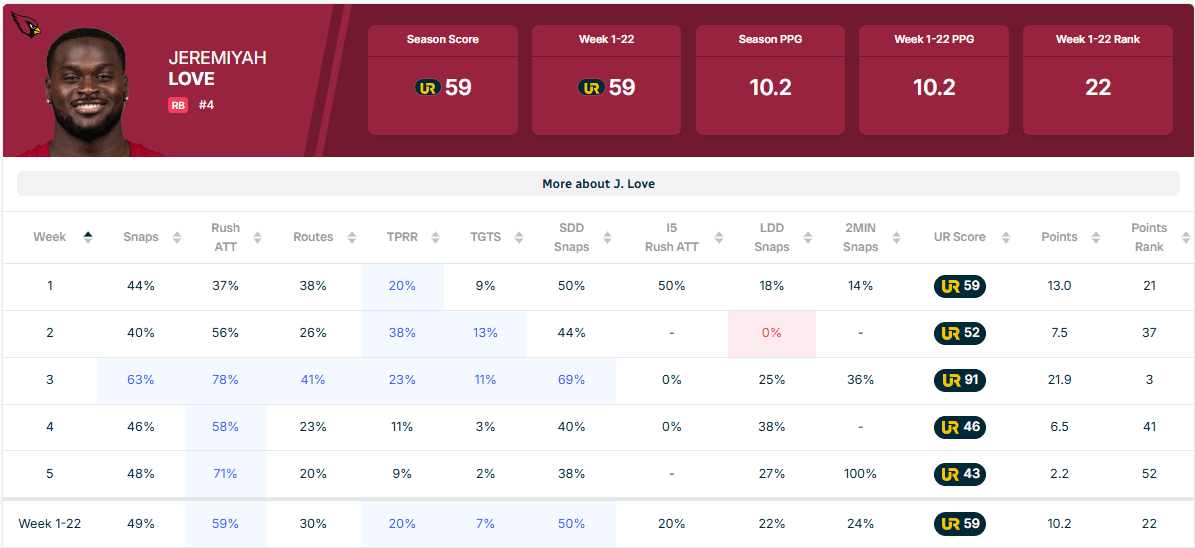
In Week 4, Love tweaked his ankle in the second quarter. Before that, his utilization mirrored his Week 3 breakout.
- Snaps: 75%
- Attempts: 67%
- Routes: 29%
In Week 5, with Love nursing a new ankle issue, they fell behind the Lions in a blowout. He played only 11% of fourth-quarter snaps while the team was down 24. In the first half, before the game was completely out of hand, Love was the RB1:
- Snaps: 74%
- Attempts: 90%
- Routes: 42%
I am not saying Love is going to be a top-12 RB this season. The specter of a Carson Beck takeover looms, and he might not earn a high route share for the rest of the season, as the team prefers Tyler Allgeier.
But there is also a world where both of those things break his way—he is a good receiving back with the size to block, and Beck might not take over soon OR could be okay. I am fairly certain that his play-making upside becomes more evident as his health improves.
Love is HOLDING STEADY as a low-end RB2 with borderline RB1 upside. He is a BUY-LOW target.
Schedule: The Cardinals face a tough RB matchup in Week 6 against the Rams (-7.9 PPG), but things improve after that against the Broncos (+2.1) and the Cowboys (+4.9). After that, things tighten up again against the Seahawks (-0.8) and the Rams. In the fantasy playoffs: Jets (+2.4), Saints (+4.8), Raiders (+1.7).
Note: For more buy-low options, check out the Utilization Bytes below.
9. Utilization Score Overperformers
 Denzel Boston | WR | Browns
Boston is looking like a good draft pick for the Browns, proving he can stretch the vertical boundary and haul in high-value downfield looks. But from a fantasy perspective, now is the time to SELL HIGH.
The Round 2 NFL pick is averaging 13.8 PPG as the WR17 in fantasy. That will be an extremely hard mark to maintain in a passing attack averaging 202 yards (21st) and 1.4 TDs (20th).
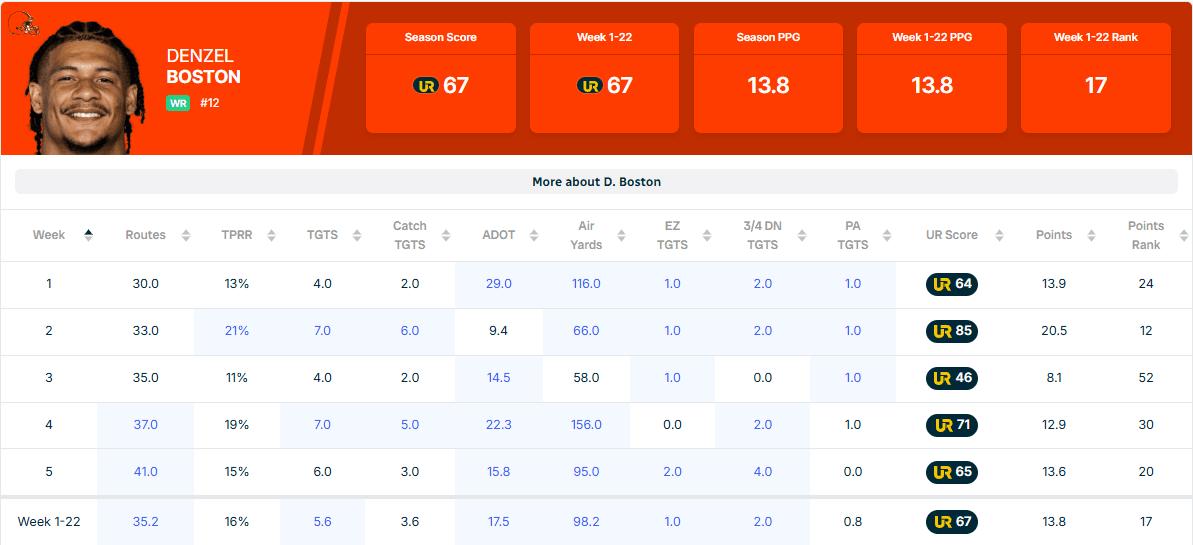
Boston's ranks in key categories that signal future fantasy production:
- Targets per game: 5.6 (37th)
- Catchable targets per game: 3.6 (51st)
- aDOT: 17.5 (3rd for WRs with at least 100 routes)
- Average route depth: 11.0 (8th)
- Air yards per game: 98 (12th)
- Catchable air yards per game: 55.2 (21st)
Boston is living on the air yards with a high target depth despite low target volume. That is a highly volatile combination and very likely to regress. Additionally, Boston is getting significant love on social media—and for good reasons—but public sentiment is overly positive. All of this stuff matters. It enters the psyche of your leaguemates.
Boston's Utilization Score (67) comparisons have rarely pulled off a WR2 season. They averaged 12.5 PPG, but only 16% secured WR2 campaigns.
- WR13-24: 16% (ceiling outcome)
- WR25-36: 46% (median outcome)
- WR37-48: 36% (low-median outcome)
- WR49-60: 2% (outlier floor outcome)
Boston is most likely a WR3 or WR4 by season's end. Again, that doesn't make him a bad player. It just means I am willing to SELL-HIGH if someone is ready to pay for him like he is a WR2 the rest of the way. I would even trade him away at a WR3 price tag if it helps my team at another position and I am deep at WR.
10. Waiver Wire Roundup
QB WAIVER WIRE OPTIONS FOR WEEK 5 IN FANTASY
- Aaron Rodgers | Steelers: The Steelers have shown impressive pliability in their game plans under Mike McCarthy. They attacked deep when it made sense and shifted to an underneath approach when it was viable—like Week 5 in bad weather. Available in 73% of leagues. Rodgers is averaging 17.4 PPG (18th), 247 yards (12th), and 2.0 TDs per game (T-7th). He is a mid-range QB2 with low-end QB1 upside.
- Longview Players Your Leaguemates Could Cut: Kyler Murray (41%).
RB WAIVER WIRE OPTIONS FOR WEEK 5 IN FANTASY
- Woody Marks | Texans: I understand. Marks is not available in my league, pal! But he is available in 47% of Yahoo leagues, so he gets a callout here just in case, with David Montgomery (groin) week-to-week. In Week 5, Marks dominated the Texans' backfield with Monty exiting early. The second-year back notched an 84% snap share, totaling 15 attempts and four targets. Marks is a low-end RB2 while Montgomery is out and has a chance to take over the RB1 duties the rest of the way if he performs well. He is worthy of 10-20% of FAAB in small leagues. He will likely cost you 40%+ in larger formats if available (not likely).
- Raheim Sanders | Browns: Quinshon Judkins (ankle) is day-to-day after leaving the stadium in a walking boot. Dylan Sampson's (knee) practice window could open this week, but most reports point to a later return date. That means Raheim Sanders could have short-term value should Judkins be unavailable. Sanders would be a high-end RB3 without Judkins. He is available in 94% of leagues and is a 2-7% bid option in deeper formats unless we hear Judkins will miss extended time—that would bump him to 10-15% territory.
- Kendre Miller | Saints: Miller handled 59% of the rushing attempts for the Saints in Week 5 with Travis Etienne (hamstring) still on IR and Alvin Kamara battling injuries. We still saw a three-way split, which makes it hard to get too excited. Etienne is eligible to return in Week 9. Miller is available in 93% of leagues and would be a short-term rental as a high-end to mid-range RB3 if this workload holds even when Kamara is healthy. New Orleans has a plus RB matchup against the Giants (+2.3 PPG) before a harder matchup against Pittsburgh (-1.7) and then a bye.
- Dameon Pierce | Eagles: Will Shipley (plantar fascia) could miss multiple games, and Saquon Barkley's status (hamstring) for Week 6 is in doubt. Pierce played 78% of snaps and handled 65% of the attempts in Week 5. The Eagles face a tough RB matchup in Week 6 against the Panthers (-7.8 PPG), but get a favorable Week 7 matchup against the Cowboys (+4.9). Pierce would be a high-end RB3 if Barkley is out in Week 6.
- Kimani Vidal | Chargers: Let's just zoom out for a second here. Can I interest you in an RB almost certainly locked into a committee behind a Round 1 pick in a terrible offense with massive o-line problems? No. Yes, the TD looked great. Yes, Vidal is underrated. No, we should not be bidding any sort of significant FAAB on him. Outlook: Low-end short- and long-term value. He is an RB4-5.
- Samaje Perine | Bengals: Bye in Week 6. But he is one of the most underrated handcuffs in fantasy football (15.8 points in Week 5). Perine also offers long-term viability if Chase Brown continues to struggle. He is available in 97% of leagues.
- Emmett Johnson | Chiefs: Available in 76% of leagues, coming off a bye. One of the top fantasy football handcuffs behind Kenneth Walker.
- Tier 1 Handcuffs: Brian Robinson (50%), Kaelon Black (67%), Tyler Allgeier (55%), Chris Rodriguez (65%),
- Tier 2 Handcuffs: Ray Davis (93%), Mike Washington (58%), Tyler Goodson (99%), Justice Hill (97%), Seth McGowan (99%), Tyjae Spears (78%)
- SICKO STASHES: Roschon Johnson (99%)
- Longview Players Your Leaguemates Could Cut: Brian Robinson Jr. was the most-cut RB after Week 5 in early waiver wire action. Remains a Tier 1 handcuff.
- IR Stash: Jonathon Brooks (52%). Expected to return in early-to-mid November. Panthers' offense is much improved.
WR WAIVER WIRE OPTIONS FOR WEEK 5 IN FANTASY
- Germie Bernard | Steelers: With Michael Pittman Jr. on IR for at least three more games and Roman Wilson (finger) week to week, Bernard could become a focal point of the Pittsburgh passing attack in the coming weeks. He led the team with a 29% target share in Week 5 and scored 14.4 points with an 82 Utilization Score. The Round 3 draft is the perfect complement to DK Metcalf as an underneath YAC option (7.2 aDOT). The Round 3 pick UPGRADES to WR3 status while Pittman is out and could become the offense's permanent WR2 with strong performances. Bernard is a PRIORITY WAIVER WIRE TARGET in deep leagues. He is available in 99% of Yahoo leagues.
- Makai Lemon | Eagles: Fantasy managers are dropping Lemon. The Round 1 NFL Draft pick is available in 58% of leagues. While the Eagles offense doesn't look good, Lemon is getting plenty of snaps, and Dontayvion Wicks isn't a high-end WR2. We are still at the point in the year where we should stash players like Lemon to see what happens. He is a WR5 and is available in 58% of leagues.
- Ja'Kobi Lane | Ravens: Lane (wrist) has a chance to return from IR and play in Week 6. He had a strong camp, and Rashod Bateman hasn't capitalized on the WR2 reps he's been given. Lane is a WR6 with upside once Lamar Jackson is back under center.
- Jaylin Noel | Texans: Noel has flashed as the primary slot option, with 11.9 and 15.2-point performances. His low route share (53%) is challenging, and the addition of Harrison could further muddy the outlook, but he ranks 14th in YPRR (2.05) out of all WRs with at least 100 routes. There is a chance the Texans decide to play more 3-WR sets with the Year 2 WR performing well. Noel is a WR6 stash option and is available in 96% of leagues.
- Not Interested: These players could be one-week flyers if you are facing bye-week challenges but should not be priority FAAB bids due to role or talent limitations. They are min-bid options:
- Darius Cooper | Eagles
- Kendrick Bourne | Cardinals
- Demario Douglas | Patriots
- NFL Trade Candidates: The NFL Trade Deadline is November 10th (Tuesday after Week 9). Multiple teams have good QBs who could look to bolster their WR corps, like the Chiefs. The names below are widely available on waivers and could offer more season-long upside if traded than the options listed after them, depending on the landing spot.
- Jerry Jeudy | Browns: 96% available
- Calvin Ridley | Titans: 99% available
- Candidates to return from IR:
- Christian Kirk | 49ers: Week 6-7; Deebo Samuel (hamstring) will miss at least two weeks
- Omar Cooper | Jets: Week 6-8
- SICKO STASHES: Cyrus Allen (98%), Jalen Royals (99%), Antonio Williams (91%), Kyle Williams (99%)
- Longview Players Your Leaguemates Could Cut: Jakobi Meyers (50%), KC Concepcion (32%), Tre Tucker (74%)
- IR Stashes: Jordyn Tyson (51%), Alec Pierce (44%), Adonai Mitchell
TE WAIVER WIRE OPTIONS FOR WEEK 5 IN FANTASY
- Brenton Strange | Jaguars: The Jaguars are embracing more heavy TE personnel, creating advantageous situations for Strange. That takes a WR like Brian Thomas off the field for Nate Boerkircher—who is not a strong target earner. Strange has a 20% target share on a 75% route participation rate. He is averaging 10.1 PPG with a 71 Utilization Score. Strange UPGRADES to high-end TE2 territory and is available in 68% of leagues. If the team moves BTJ, confidence in him finishing top-12 improves.
- Pat Freiermuth | Steelers: Freiermuth's role is volatile and seems to be game-plan specific. In some games, he clears a 70% route participation rate; in others, he is in the low 60s. But with Pittman and Wilson hurt, the team needs pass-catchers. His season-long 15% target share is in line with his career, so don't expect massive fireworks. But Freiermuth could push toward high-end TE2 territory until the WRs are healthy. He is available in 85% of leagues.
- Longview Players Your Leaguemates Could Cut: Kenyon Sadiq (59%)
- IR Stash: Terrance Ferguson (85%)
Utilization Bytes
Quarterbacks
- Drake Maye | Patriots: After consecutive strong outings with 27.2 and 39.5 points, Maye is back on the map. He even added a designed rushing TD in Week 5 against the Raiders, whom he carved up for 374 yards and four TDs via the air. With A.J. Brown returning as soon as Week 6, Maye UPGRADES to mid-range QB1 status and offers high-end QB1 territory.
- Kyler Murray | Vikings: Murray had his best game of the year against the Saints, scoring 18.3 points. He added 54 yards on the ground on seven (18%) scrambles. After the Week 6 bye, Murray has the second-best ROS schedule. And it is super juicy in the near-term: IND (+3.1), DET (+9.6), BUF (+0.0). Fantasy playoffs: DET (+9.6), WAS (+8.3), NYJ (-3.3). Murray is a BUY-LOW option with low-end QB1 upside.
- Jayden Daniels | Commanders: I faded Daniels in Week 5 because of the weather, re-injury risk, limited involvement in the designed run game, and a banged-up WR group. That ended up being drastically wrong. While the passing yards only reached 200 yards without a passing score, including overtime, Daniels scrambled for 103 yards and two TDs against the man-heavy Giants defense. He only handled one designed attempt. The Year 3 QB still clearly carries high-end QB1 upside in any given game. But I still have long-term health concerns behind a troublesome offensive line (38% pressure rate), and he has schedule challenges. Short-term: SF (-0.8 PPG), BYE, PHI (+3.0), Rams (-7.0). Fantasy playoffs: Falcons (+0.1), Vikings (-6.2), Jaguars (-1.4). If someone thinks Daniels is a high-end QB1 after his 32.3-point outburst, I am willing to SELL HIGH.
Team Trends To Monitor Ahead Of Week 6 Fantasy Football
With five weeks of data for most teams, it's a good time to examine team-level trends that affect fantasy production. You can find the data across all 32 NFL teams in the Team Styles tab of the Utilization Report tools.
- Redzone Drive Rate vs. Touchdown Drive Rate: Percentage of drives that reach the red zone versus how often the team is scoring a touchdown per drive. Large deltas indicate room for positive or negative regression.
- Titans: 15% (28% vs 13%)
- Bears: 15% (41% vs 26%)
- Texans: 13% (13% vs 20%)
- Cardinals: 11% (32% vs 21%
- Dropback Over Expected (DBOE): How often teams pass the ball compared to their peers when considering the score differential over the last five weeks:
- Panthers: 8%
- Packers: 8%
- Bengals: 6%
- Cowboys: 6%
- Steelers: 5%
___ - Seahawks: -5%
- Giants: -5%
- Bears: -5%
- Chargers: -6%
- Ravens: -6%
- Dolphins: -9%
- Falcons: -12%
- Neutral Playclock: Teams that are leaving more or less time on the play clock when the score is within three points (neutral situations) over the last five weeks. The NFL average is 8.3 seconds.
- Browns: 11.54
- Cowboys: 11.25
- Chiefs: 10.65
- Chargers: 10.60
- Falcons: 10.52
- Bears: 10.22
___ - Dolphins: 6.66
- Commanders: 6.63
- Titans: 6.37
- Giants: 6.33
- Play action pass rate: Teams that are utilizing play action the most per dropback over the last five weeks, which adds value to WRs and TEs on a per-route basis in fantasy:
- Bills: 39% (Pre MNF)
- Chiefs: 34%
- Seahawks: 34%
- Lions: 33%
- Panthers: 31%
- Bears: 31%
___ - Cardinals: 20%
- Steelers: 20%
- Saints: 18%
- Bengals: 18%
- Eagles: 16%
Personnel: When teams deploy more heavy personnel, with extra TEs and RBs on the field, the pass-catchers who remain on the field face less target competition. For example: WRs saw a 29% boost in PPR points per route with two WRs on the field vs. three WRs over the last three seasons. This is year-to-date data until Week 6, when we flip to the last five. Game scripts can impact this data over small samples.
21 Personnel (2 RB, 1 TE, 2 WR) – large boost
- 49ers: 33%
- Chargers: 29%
- Dolphins: 26%
22 Personnel (2 RB, 2 TE, 1 WR) – large boost
- Giants: 19% (21 + 22 = 33%)
- Raiders: 17% (21 + 22 = 36%)
- Vikings: 9% (21 + 22 = 25%)
11 Personnel (1 RB, 1 TE, 3 WR) – negative boost
- Eagles: 76%
- Titans: 74%
- Buccaneers: 71%
- Cowboys: 71%
- Saints: 70%
12 Personnel (1 RB, 2 TE, 2 WR) – small boost
- Bengals: 46%
- Raiders: 40%
- Bears: 33%
- Colts: 32%
- Falcons: 32%
13 Personnel (1 RB, 3 TE, 1 WR) – large boost
- Rams: 31% (Pre MNF)
- Bills: 28% (Pre MNF)
- Cardinals: 23%
Offensive Lines: Pressure rates are huge for QBs. Most signal callers who are constantly harassed will struggle to find consistent fantasy value. QBs partially own pressures, so it isn't all an offensive line issue. The NFL average pressure rate is 36% over the last three seasons.
Yards before contact matters for RBs. Backs who get better blocking have a better chance to thrive in fantasy. The NFL average yards before contact on RB attempts is 1.29 over the last three years. It is important to remove QBs since scrambles often come with defenders' backs turned and can inflate these numbers.
Pressure Rate Allowed:
- Falcons: 27%
- Cardinals: 27%
- Bengals: 30%
- Jaguars: 32%
- 49ers: 33%
- Buccaneers: 33%
- Cowboys: 33%
—-
- Patriots: 42%
- Browns: 43%
- Dolphins: 45%
- Eagles: 46%
- Chargers: 47%
- Panthers: 48%
Average Yards Before Contact Rushing
- Bills: 3.03 (Pre MNF)
- Rams: 2.14 (Pre MNF)
- Panthers: 1.74
- Chiefs: 1.72
- Lions: 1.72
- 49ers: 1.66
—
- Eagles: 0.81
- Giants: 0.81
- Raiders: 0.75
- Seahawks: 0.69
- Texans: 0.68
- Browns: 0.68
- Jaguars: 0.61
Defensive Tendencies
Pressure Rate: Defenses with high pressure rates can dramatically impact QB performance. Under pressure, QB statistics become much more unstable and decline at the macro level.
- NFL Average in 2026: 36%
- Vikings: 46%
- Seahawks: 45%
- Falcons: 44%
—
- Colts: 29%
- Buccaneers: 27%
- Titans: 27%
- Giants: 26%
Pass Blitz Rate: Defenses that blitz often can impact how often TEs and RBs run routes. Against heavy blitz teams, they can remain in to block more often.
- Vikings: 66%
- Commanders: 43%
- Buccaneers: 41% (low pressure rate = big plays available)
- Jets: 40%
—
- Falcons: 21% (high pressure rate = tough pass defense)
- Raiders: 21%
- Colts: 21% (low pressure rate = dice'em up however you want)
- Seahawks: 20% (high pressure rate = tough pass defense)
- Texans: 18% (strong pressure rate of 39% = tough pass defense)
- Bengals: 17% (strong pressure rate of 39% = tough pass defense)
Man Coverage: Targets skew toward the top WR options against man coverage, while TE and RB opportunities decline at the macro level. Of course, there are exceptions for elite TEs. Also, many teams that utilize man concepts have a shut-down corner, which can be problematic for WRs—especially if the CB shadows.
Scrambling QBs also benefit from man coverage. When defenders turn their backs, QBs can tuck the ball and run. And it can take defenders longer to realize it is happening (i.e., Jayden Daniels vs. the Giants in Week 5).
- NFL Average in 2026: 23%
- Browns: 41% (Denzel Ward. Doesn't always shadow.)
- WR units: +2.9 PPG boost
- Giants: 35%
- Lions: 31% (Bad corners + man = great for opposing WRs)
- WR units: +7.1 PPG boost
- Jets: 30%
- Patriots: 30% (Christian Gonzalez. Will shadow.)
- Steelers: 30%
Zone Coverage: Targets spread out against heavy zone teams. RBs and TEs get more involved, while WR targets tend to take a bit of a hit. There are exceptions. Underneath, WRs can benefit from zone.
- NFL Average in 2026: 71%
- Seahawks: 81%
- Adding up the tendencies: High pressure, low blitz, heavy zone →
- RBs: +2.2 boost to receiving PPG
- WRs: -4.5 boost
- Panthers: 81%
- Saints: 80%
- Packers: 78%
- Titans: 77%
- Raiders: 77%
- Vikings: 77%
- Adding up the tendencies: High pressure, high blitz, high zone →
- RBs: -6.4 boost overall; -2.7 receiving boost (staying into block + zone bad for RB targets)
- WRs: -4.9 boost
- Falcons: 74%
- Adding up the tendencies: High pressure, low blitz, high zone →
- RBs: +1.8 boost to receiving PPG
Players Mentioned in this Article



Published Updated