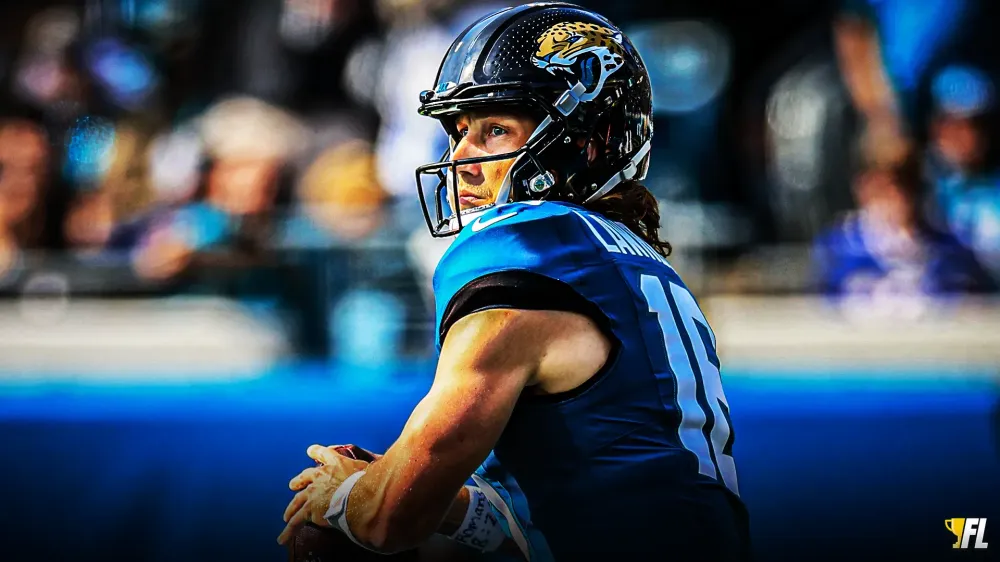
Early Superflex Fantasy Football Draft Strategy For 2026
Chris Allen breaks down the two biggest pillars of his superflex fantasy football draft strategy for the 2026 season.
Inglourious Basterds isn't my favorite Quentin Tarantino movie—Pulp Fiction still has the crown for me—but the tavern scene has lived on in infamy. Michael Fassbender (incorrectly) holding up three fingers is now the symbol of if you know ball. For instance, I'll make a statement about superflex leagues.
Superflex leagues are just regular fantasy squads where you can start two QBs.
Like Major Hellstrom, all you can do is sit there. Yes, the statement carries some truth to it. But the lack of nuance is what gives you pause. Because if you've been in SF leagues, the added QB spot changes our strategy for the popular format.
RELATED: 2026 fantasy football rankings
Superflex Draft Strategy For 2026 Fantasy Football
Don't Be Afraid to Wait on QB*
*If need be.
I'm throwing out the caveat early because building a superflex roster, like any other format, hinges on draft position. Sure, there's the extra QB slot to fill. And, absolutely, this means that at a minimum, 24 passers will be on active rosters every week (assuming a 12-team league). Which doesn't even get into the people taking at least one backup, let alone a second. I mention all this because the common knee-jerk reactions are some that I've had in the past:
- I hope I don't get stuck with a late draft slot.
- I have to hammer QBs early and often.
- My team is going to be terrible if I don't get at least one elite QB.
Essentially, you're on tilt before you get to the lobby. Plus, the anxiety only ratchets up a notch when you pick (or get assigned) anything in the back half of the draft. The result is a hyperfocus on a singular position. Or, said another way, you're drafting for (a self-imposed) need. However, if you do get stuck with a less-than-desirable spot, there's a way you can pivot. I'll use last year's results as a proxy.
- Josh Allen: 374.5 (total points)
- Drake Maye: 358.9
- Matthew Stafford: 358.3
- Trevor Lawrence: 350.1
- Caleb Williams: 323.8
While I agree that the results don't reflect how we felt about each signal-caller, the idea that even within the Top 5 there's a gap in scoring should be clear. Even the best fantasy football projections (i.e, Dwain's or Freedman's) would highlight the same behavior. Of course, you'd see Lamar Jackson, Jalen Hurts or Joe Burrow in the conversation, but there's a tier breaking up even the best passers. As you can see, there's about a 50-point delta between the QB1 and QB5. Just 24 points separate the QB6 (323.8 points) and the QB10 (299.8). Meanwhile, a few non-passers were giving us QB-worthy performances.
- Puka Nacua: 375.0 (total points), WR6 (Consensus ADP)
- Jaxon Smith-Njigba: 359.9, WR14
- Amon-Ra St. Brown: 324.0, WR5
- Christian McCaffrey: 416.6, RB4
- Bijan Robinson: 370.8, RB1
- Jahmyr Gibbs: 366.9, RB3
Jaxon Smith-Njigba is the outlier, but the others were part of real decisions when gamers were on the clock. Puka Nacua or Jalen Hurts? Amon-Ra St. Brown or Patrick Mahomes? And while we treat QBs like brand names, there's viability in getting the generic version at a cheaper cost. Bo Nix as your QB1 isn't as worrisome if you secure Bijan Robinson, aka "A Non-QB Who Can Score like a QB," with your first pick. But, again, you should only have to resort to this decision-tree thinking if you get boxed out of one of the high-end passers to kick off the draft.
Every Action Begets Another
A few famous movie (and book) quotes come to mind as the draft unfolds.
- "Out of the frying pan and into the fire." —The Hobbit
- "I immediately regret this decision." —Anchorman
- "Now what?" —Finding Nemo
Drafting is like the classic cartoon trope of the main character plugging a leak only to find one after another pop up. For example, let's say you got your early spot like you wanted. And here's your team after a few rounds.
- Round 1: Drake Maye
- Round 2: Trevor Lawrence
- Round 3: Nico Collins
Wow, two top-tier QBs! And a solid WR1. Cool. But at least 15 RBs will go before you get your first one. There's also that pesky TE position you have to worry about, too. Essentially, as one part of your roster gets stronger, the other (likely) gets weaker. That's the nature of opportunity cost. You're sacrificing strength at the core parts of your team (i.e., RB and WR) to have better QBs. However, there's a way to mitigate the dropoff.
Understanding player archetypes and how they're deployed on the field will boost your chances of limiting your roster weaknesses. Take Collins as your WR1, for instance. He ranked inside the Top 12 in both targets per game (7.8) and aDOT (13.3), but finished outside the Top 24 in seven games.
Just taking the next available receiver shouldn't be the approach. Someone to complement Collins' volatility would raise the floor and ceiling of your budding squad. One of the Jaguars' WRs—I prefer Jakobi Meyers, after quickly developing a connection with Trevor Lawrence—with access to a reliable weekly workload on an efficient offense, would be a suitable pairing. Add in a Jordan Addison or Quentin Johnston later, both with active (read explosive) roles in passing games with good QBs, and the risk of avoiding the position earlier in the draft has diminished with the type of opportunity you've been able to acquire.

Join Our Newsletter
Trusted by 400,000+ fantasy football players. Get access to Fantasy Life's free award winning newsletter and tools, all in one step.
By registering or logging in, you agree to our Terms of Use and Privacy Policy.
Published